
Welcome to Car and Driver’s Testing Hub, where we zoom in on the test numbers. We’ve been pushing vehicles to their limits since 1956 to provide objective data to bolster our subjective impressions.
When the Hyundai Ioniq 5 N arrived on the scene back in 2023, it introduced simulated shifting to electric vehicles, offering drivers a novel way to interact with an EV powertrain. We were so enthralled by its combustion-engine cosplay that it played a major part in the 5 N being named our 2024 EV of the Year. As fun as it is to bang through gears in a vehicle without an internal-combustion engine, our rigorous track testing proved that the 5 N’s acceleration times significantly suffered in “N e-Shift” mode compared with its standard drive mode.
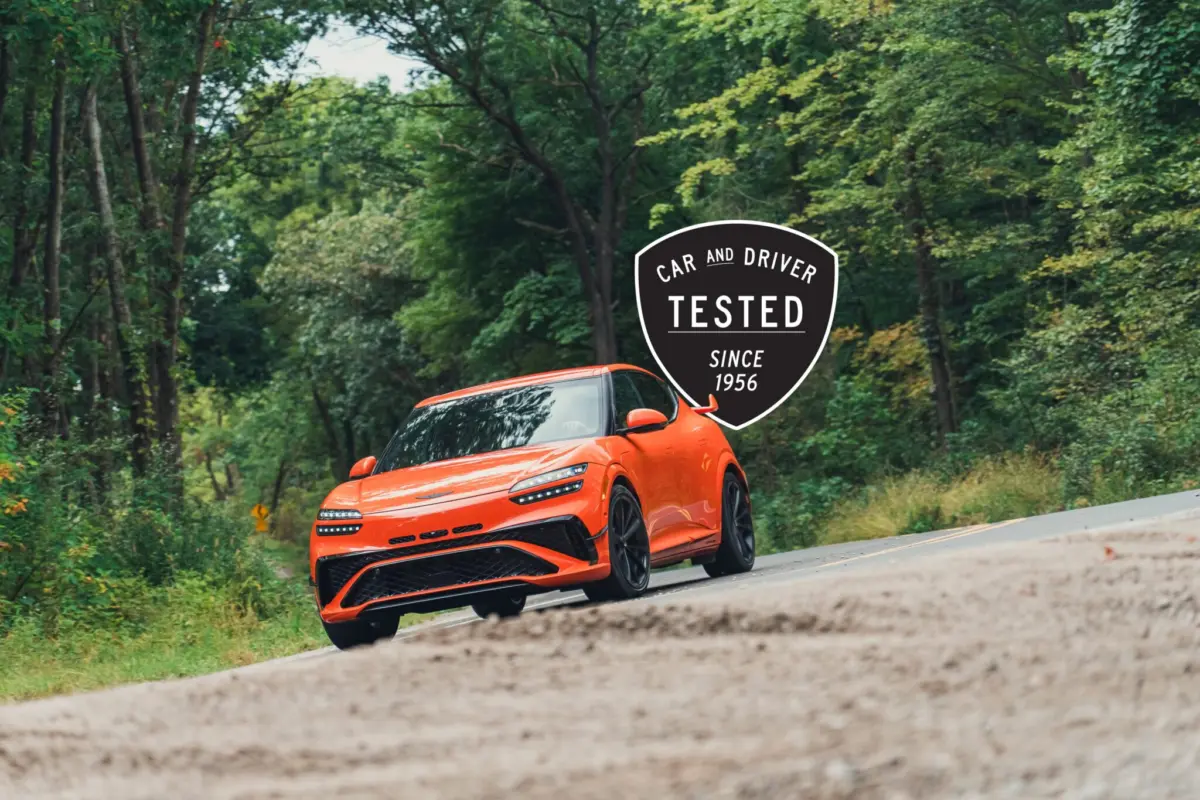
Like the Ioniq 5 N, the new Genesis GV60 Magma—the luxury brand’s first entry in its performance-focused Magma sub-brand—features a “Virtual Gear Shift” mode that mimics the sensations of an eight-speed dual-clutch automatic paired to an internal-combustion engine. But this time around, the auditory and tactile theatrics don’t come at a performance cost.

Beneath the surface, the Ioniq 5 N and the GV60 Magma feature nearly identical hardware. Both models are built on Hyundai Motor Group’s highly versatile E-GMP electric vehicle platform. They both feature a dual-motor all-wheel-drive powertrain that produces up to 641 horsepower, make use of a robust 84-kWh battery pack, and both roll on 275/35R-21 Pirelli P Zero Elect tires. However, it is worth noting that the Magma gets newer PZ5-spec rubber compared to the Ioniq 5 N’s slightly older PZ4 Pirellis. Besides the GV60 Magma’s nearly four-inch-shorter wheelbase and 91-pound-heavier curb weight, the differences between the pair are primarily software-related or matters of exterior styling and interior design.
Some of those discrepancies are purely superficial. For instance, the 5 N’s faux-engine soundtrack mimics a high-revving 7750-rpm inline-four, while the Magma’s aural signature is modeled after a thrilling 9000-rpm V-6. Other differences, however, have a direct impact on real-world performance. Both models can only access their maximum power output with a time-limited Boost mode. While the Hyundai can maintain its 641-horsepower peak in 10-second bursts, the Genesis can continue at full tilt in 15-second increments.
That longer duration of peak output allows the Magma to slowly walk away from the 5 N as both vehicles approach their maximum velocity. For example, the Genesis beats the Hyundai to 150 mph by almost two seconds. Up to 120 mph, however, the two performance EVs are virtually bumper-to-bumper. The real performance delta between the straight-line capabilities of the Hyundai and the Genesis only surfaces once both are switched into their respective simulated-shift drive modes.

The last time we had an Ioniq 5 N at our test track, we performed two separate acceleration runs: once without N e-Shift activated, and once with it turned on. Importantly, N e-Shift mode disables the 5 N’s N Grin Boost and launch-control features, essentially robbing the vehicle of 40 horsepower and an optimized start off the line. To even the playing field a bit, we conducted our standard baseline run without launch control as well.
Even with those parameters accounted for, the 5 N proved to be significantly quicker when it wasn’t hammering through make-believe gears. It silently rocketed to 60 mph in 3.1 seconds, reached the 100-mph mark in 7.2 seconds, and crossed the quarter-mile marker in 11.3 seconds. With N e-Shift activated, the dynamics shifted noticeably. It took the Ioniq 5 N 3.5 seconds to reach 60 mph—representing a four-tenth-second increase. More drastically, it took 8.3 seconds to hit 100 mph, which is a whopping 1.1 seconds slower than its standard drive mode, and 11.8 seconds to clear the quarter-mile, landing five-tenths behind our non-N e-Shift run.
When we conducted the exact same experiment in the GV60 Magma, we recorded very different results. During our comprehensive testing regimen, the Magma achieved nearly identical acceleration figures regardless of whether its simulated-shift drive mode was active or turned off. In both of its acceleration runs, the Genesis managed a blazing 3.0-second sprint to 60 mph, a 6.8-second dash to 100 mph, and an identical quarter-mile time of 11.0 seconds. (Note that the minor 0.1-second difference between our reported official quarter-mile time of 11.1 seconds for the Magma and the 11.0-second figure quoted here is due to the fact that we were comparing two runs in the exact same direction for this specific analysis, whereas all of our official acceleration figures represent a two-way average to account for wind and track conditions.)

Given that the Ioniq 5 N and the GV60 Magma feature nearly identical specifications, and that all environmental and testing factors were kept strictly equal, what gives? To our testing team, the answer seems pretty straightforward.
Unlike in the 5 N, engaging the Magma’s Virtual Gear Shift mode does not lock out its boost or launch-control functions. This crucial software difference allows the luxury performance crossover to access its full 641-horsepower output and execute a traction-aided, "6000-rpm" takeoff whether it is actively fake-shifting or not.
The additional 40 horsepower and the superior getaway also clearly explain why the Genesis’s fake-shift acceleration figures are far superior to the Hyundai’s. The Magma manages to beat the 5 N to 60 mph by 0.5 second, to 100 mph by a significant 1.5 seconds, and to the quarter-mile mark by 0.8 second. Ultimately, the Hyundai Ioniq 5 N forces the driver to choose between its primary technological party trick and its absolute peak performance, whereas the Genesis GV60 Magma successfully lets you have your cake and eat it too.









No comments yet. Be the first to join the conversation!