
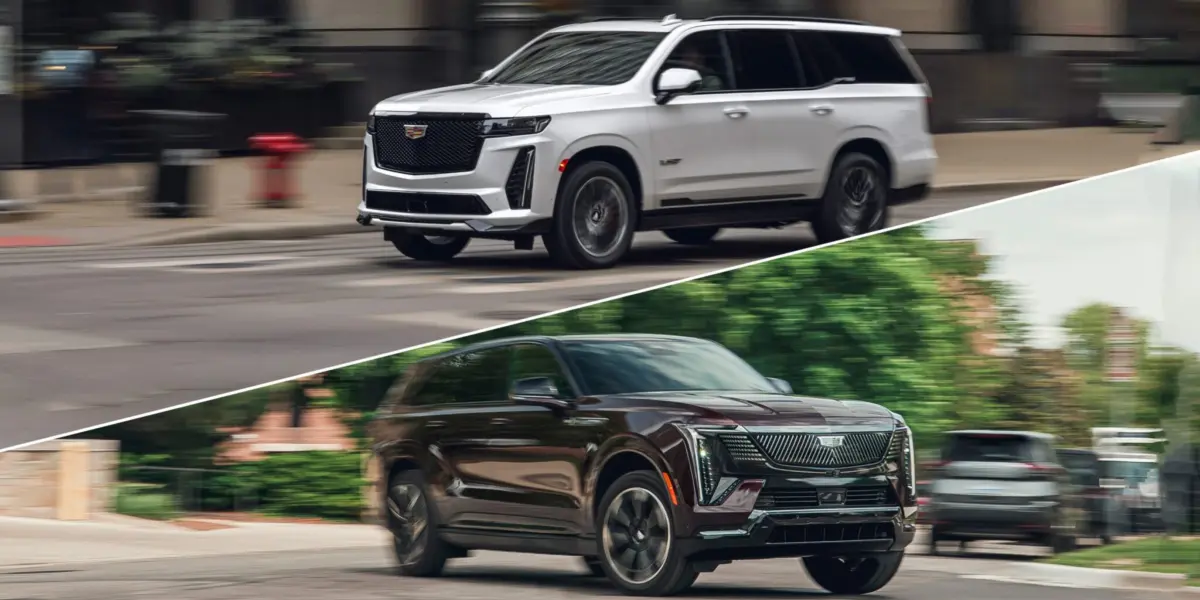
For decades, automakers attempting to bridge the gap between internal combustion and electrification have operated under a relatively straightforward guiding principle: build an electric vehicle that mimics its gas-powered counterpart, delivering the core experience of "the car you liked before, but electric." This design philosophy creates a tight thematic cohesiveness across lineups. A BMW i3 and a BMW M340i, for instance, each endeavor to arrive at their own optimized level of BMW-ness despite utilizing entirely different powertrains.
The Cadillac Escalade, however, refuses to play by those rules. While General Motors offers both gas-powered and fully electric versions of its iconic luxury behemoth, the two variants share similarities only insofar as they each avidly pursue the high-level Escalade goals of cosseting bigness and cocky braggadocio. When Tony Soprano famously acquired an Escalade during the fifth season of The Sopranos, the only real question surrounding that casting decision was what took the production team so long.
Today, fictional mob bosses and real-world buyers alike face a broader array of choices when pursuing the absolute maximum expression of a General Motors SUV. For anyone with roughly $160,000 to spend on a flagship luxury vehicle, a fundamental question emerges: Would you rather have a supercharged V-8 Escalade-V, or a fully electric Escalade IQ?

Performance
To understand the engineering divergence between these two heavyweights, one need only look at how Cadillac approaches their respective capabilities. Cadillac specifically designed the Escalade-V’s exhaust system to be extra boisterous, adding a 360-degree loop to the passenger-side pipe to equalize its length with the driver-side counterpart for maximum sonic resonance.
The battery-electric Escalade IQ, by contrast, does not feature equal-length dual exhausts, because it does not have an exhaust system at all. While the IQ’s lack of a traditional tailpipe spares its owner from tedious and potentially confrontational Thanksgiving dinner debates with relatives about well-to-wheel emissions, it also means you will never have to worry about thieves crawling underneath your vehicle to steal catalytic converters. Call that particular round a draw.
A look at the raw specifications reveals a startling comparison regarding curb weight. At first glance, the specs suggest the Escalade-V actually outweighs the IQ by a mere eight pounds. That anomaly, however, can be attributed to an errant set of notes that inadvertently included a Toyota GR86 parked upside down on the V’s roof. Once that extra car is removed, the supercharged V-8 model is considerably lighter: 6290 pounds for the Escalade-V, compared to a pavement-crushing 9120 pounds for the all-electric IQ.

Despite that massive weight disparity, the two flagships are remarkably evenly matched in a straight line. The 750-horsepower IQ trails the 682-horsepower V-V8 by just a couple of tenths of a second in the sprint to 60 mph, achieving the benchmark in 4.5 seconds compared to the V’s 4.3 seconds. From a rolling start at 5 mph, they are dead even at 4.7 seconds. Furthermore, passing slower traffic on the highway is actually a quicker task in the electric IQ, which dispatches the 50-to-70-mph interval in 2.6 seconds, compared to 3.1 seconds for its loud, fuel-burning sibling.
The acceleration profile of the electric model yields an unexpected character. Modern drivers might remember a time when a Ferrari 458 Italia felt as though it possessed formidable passing power, yet the Escalade IQ’s 2.1-second time from 30 to 50 mph beats the legendary Italian sports car by a tenth of a second. If the Escalade IQ had participated in a classic high-end performance comparison test from yesteryear, its 50-to-70-mph acceleration time would have placed it just a tenth of a second behind the 458 and two-tenths ahead of a McLaren MP4-12C.
Neither of those supercars, however, heaves its hood skyward during heavy acceleration quite like a 70-foot Viking sportfish climbing onto a plane, whereas the Escalade IQ certainly does. Critics who claim electric vehicles lack dramatic flair behind the wheel have clearly not experienced an IQ accelerating with an improbability that makes the vehicle feel as though it is struggling to cope with its own superpowers. Meanwhile, the Escalade-V drives more like a mutant CT5-V Blackwing, representing the rare modern luxury vehicle where the driver’s seat remains vastly more desirable than the chauffeur-style captain’s chairs in the back.

Style
Evaluating styling through the lens of an Escalade’s primary mission—projecting brash, unapologetic confidence where hugeness is a fundamental requirement—the Escalade IQ wins the stylistic battle decisively. In profile, it evokes a scaled-up Rolls-Royce Cullinan, offering an immense amount of metal to behold given that the IQ is more than a foot longer than the standard gas-powered Escalade.
Moreover, its status as a clean-sheet electric design helps maintain an exclusive premium aura, ensuring that owners are not constantly reminded of lesser Chevrolet Tahoe or GMC Yukon variants sharing similar body panels. Additionally, the inclusion of rear-axle steering on the IQ serves as an undeniable technological flex that the internal-combustion Escalade simply cannot match.
Inside the cabin, both models offer massive digital screen real estate, copious amounts of premium leather, and power-operated doors. However, only the Escalade IQ is eligible for Cadillac’s bespoke personalization program, which allows buyers who fork over an additional $54,995 to select from an expansive palette of interior and exterior colors. With 44 distinct interior color choices available, buyers can easily specify a completely unique, one-of-one IQ. By comparison, the gas-powered Escalade-V largely settles for a guiding design philosophy that feels akin to a more expensive Yukon Denali.

Intangibles
In the traditional calculus comparing electric vehicles to internal combustion, driving range is almost always an easy victory for the petroleum-powered candidate. Yet that is not the case here. The Escalade-V carries an EPA-rated range of 312 miles, while the massive battery pack in the Escalade IQ commands a stellar 465-mile rating. While the V-8 model can replenish its fuel supply much faster at a traditional gas station, its driver will be stopping significantly more often on a long road trip. Furthermore, with modern fuel prices pushing pump limits past $100, filling the V’s 24-gallon premium fuel tank often requires swiping a credit card twice just to top it off.
Another intangible consideration involves cultural footprint, specifically rap music references. On that front, the Escalade-V remains the clear winner, largely because the IQ is still a relative newcomer to the cultural lexicon, and most existing Escalade lyrics default to gas-powered models. While Cadillac did enlist hip-hop artist Big Boi from Outkast to compose a promotional rap single for the IQ—featuring lines welcoming listeners to the all-electric Cadillac perfection—it will take time for the electric model to embed itself into mainstream lyrics. Eventually, however, lines about rolling in an IQ to a house with a view will inevitably join the canon.
Ultimately, a significant portion of the Escalade mystique has always hinged on leadership. It is the quintessential executive truck, having starred in prestige television from The Sopranos to Succession. As the luxury landscape shifts away from internal combustion toward rapid technological progress—highlighted by General Motors’ development of advanced battery chemistries that improve range while occupying 20 percent less space—electrification is becoming the dominant paradigm.

A time is approaching when electric vehicles will make the most objective sense for the majority of use cases, leaving internal combustion as a purely nostalgic play. For a buyer stepping up to a $160,000 flagship SUV, the Escalade IQ successfully fulfills the modern role of being quick, cocky, luxurious, and incontrovertibly bold.







No comments yet. Be the first to join the conversation!