
Back in 2007, a casual ride in a Dodge Viper test car sparked a chain of events that would quietly alter automotive history for one family, proving that casual car advice can sometimes be a dangerous thing. Offering a passenger-side tour of the high-powered Viper, the conversation naturally drifted toward what else was out there on the market. Offhandedly, a comparison was made: for anyone enamored by the raw, aggressive performance of the Viper, a Saturn Sky Red Line represented roughly 80 percent of the driving thrill at a mere 30 percent of the price.
It was meant to be a throwaway observation rather than a formal pitch from a dedicated car salesman. Yet, roughly a month or so later, that casual comment yielded surprising fruit when the listener—a father-in-law named Roger—went out and actually purchased a brand-new Saturn Sky Red Line for less than $30,000.

Automotive journalists and experts are accustomed to fielding requests for car-buying advice on a regular basis. Typically, however, the dynamic follows a predictable script: someone asks for a recommendation regarding an efficient electric sedan, the expert directs them toward a vehicle like the Lucid Air, and the individual promptly heads out to purchase a heavy-duty pickup truck instead. Roger’s literal follow-through was simultaneously rewarding and unnerving. It meant he now owned a Saturn Sky, while the advisor was left owning an opinion—a risky combination in the automotive realm.
Past experiences had already taught the dangers of making overly specific car endorsements. On one occasion, a workplace superior asked for a recommendation describing a car that was "overpowered but understated." Three words slipped out that would be regretted for years to come: "Volkswagen Phaeton W-12." It was suspected that the corporate handbook was shortly thereafter amended to classify the recommendation of a W-12 Phaeton as a fireable human resources violation.

Fortunately, Roger’s gamble paid off, and he genuinely liked the Sky. Notably, it happened to be the very first new General Motors vehicle he had purchased since a deeply regrettable 1982 Camaro Berlinetta. That earlier Chevrolet had proved to be so profoundly terrible that Roger had solemnly sworn an oath never to purchase another GM vehicle for as long as he lived.
As a general rule, Roger was a man of his word who strictly adhered to such decrees. Perhaps the Saturn brand was granted an exception simply because it did not exist back when his previous Chevy was establishing a first-name basis with the local tow-truck dispatchers. Regardless of the logic, the Sky served him well, with its only major mechanical hurdle stemming from the notorious pre-bankruptcy GM ignition-switch recall. Driven by a corporate commitment to cost-cutting that resulted in ignition cylinders fundamentally unfit for a child’s toy, the defect could cause random engine shutdowns while in motion.

This exact scenario befell Roger once while navigating a quiet back road, though he remained entirely unfazed by the sudden loss of power. Recounting the incident later, he noted that he simply shifted the car into neutral, restarted the engine while still rolling, and continued on his way without even stopping. It was suspected that the traumatic ownership experience of the 1982 Camaro might have permanently recalibrated his personal expectations for baseline automotive build quality.
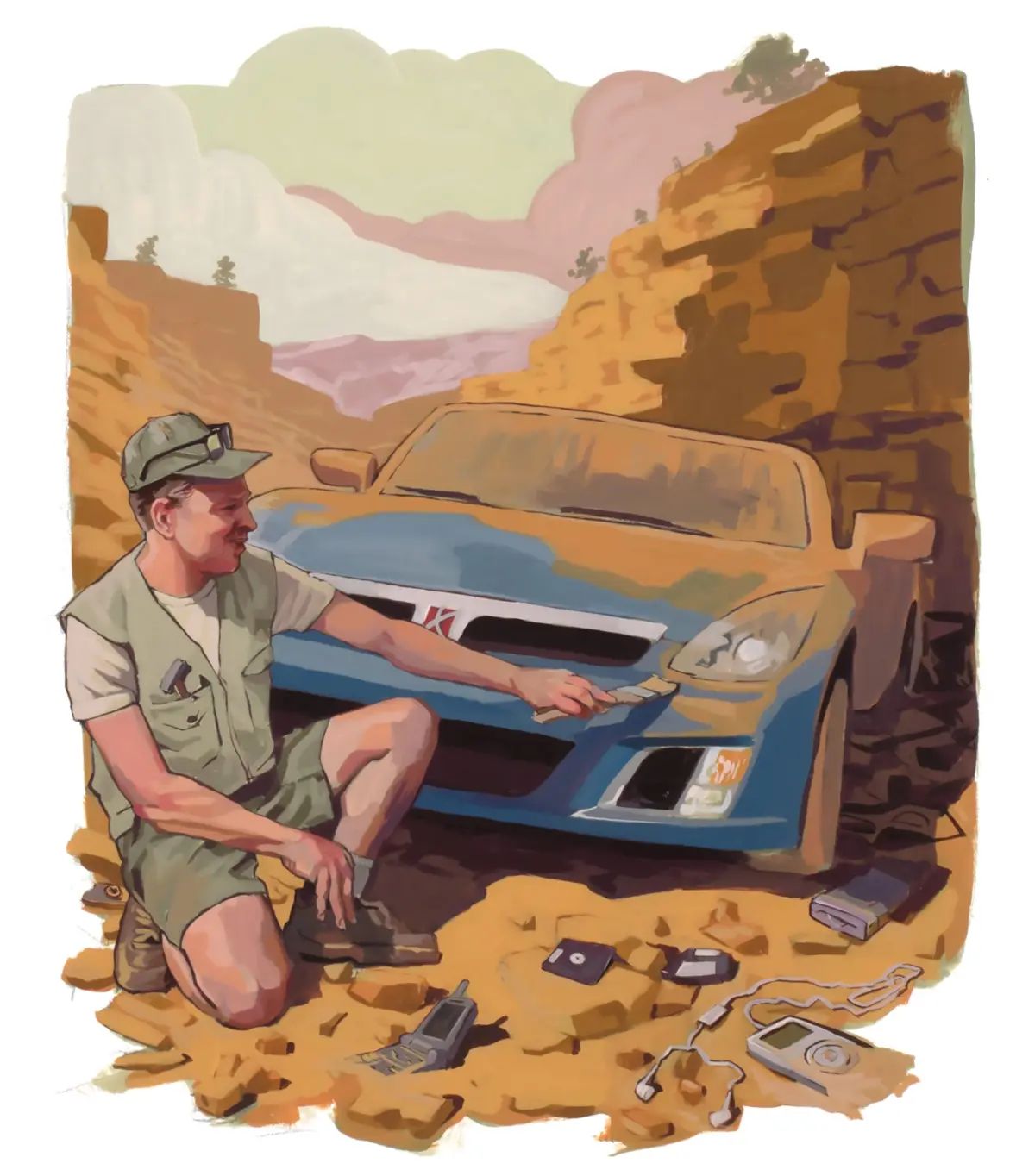
Eventually, the time came when Roger stopped driving entirely, but his affection for the Saturn convertible remained intact. Consequently, the car sat parked in his driveway for long enough that the neighboring residents eventually planted hedges simply so they would no longer have to look at it. To the casual observer, it was merely a dented, pollen-crusted eyesore resting on a pair of flat tires. But to an enthusiast’s eye, it was still a dented, pollen-crusted car hiding a potent 260-horsepower turbocharged four-cylinder engine, a manual transmission, rear-wheel drive, and a limited-slip differential. Recognizing the car’s underlying potential, Roger offered a deal: if anyone could figure out how to get it moving again, they could have it for the ultimate bargain price of getting it out of his driveway.

The rescue mission commenced on a designated day with a modest supply of restoration gear: a portable battery jump pack, an air compressor, and five gallons of fresh gasoline. Surprisingly, the weathered tires managed to hold air, and the vehicle’s electrical systems hummed back to life as the dashboard lit up. Fresh fuel was poured into the tank, and the key was turned. The Sky roared to life immediately, as though it had only been parked an hour prior, revealing a digital odometer that registered a mere 43,000 miles.
Eager to test the machine, the car was shifted into neutral and the clutch pedal was released, whereupon it promptly stalled because it was not, in fact, in neutral. A quirk of the Red Line shifter soon became apparent: the lever could be wiggled quite dramatically from side to side even when the transmission was firmly engaged in second gear.

Further exploration revealed the classic symptoms of a vehicle that had lived a "ran when parked" existence. The flat-spotted tires and the accumulated scars of various curb encounters over the years gave the Sky the distinct ride quality and directional stability of a grocery store shopping cart pulled hastily out of the corral before being immediately swapped for a better one. The battery refused to hold an electrical charge, the cabin had developed a stale aroma reminiscent of a fragrance called Old Must, and the air conditioning failed to blow cold air.
Yet, beneath the neglect, the scrappy Red Line ran like an absolute champion. The turbocharger emitted a cheerful chirp upon every upshift, and all 260 horses felt eager to break loose. The machine simply required a modest application of deferred maintenance.

Addressing the mechanical shortcomings began with a new set of Pirelli P Zero tires and a professional wheel alignment, based on the reliable rule of thumb that automobiles tend to drive significantly better when their tires are round and all pointing in the same general direction. An oil change was performed, and the air conditioning system was recharged.
Next came the battery replacement, a task complicated by the fact that the power storage unit is mounted deep within the vehicle’s architecture, somewhere near the earth’s molten core. Accessing the battery ordinarily requires the complete removal of the right front fender. Growing impatient with the multi-step procedure, a decision was made to only partially unbolt the composite panel, operating under the assumption that the flexible material could be bent sufficiently out of the way. That shortcut explained how a fender managed to get torn during a simple battery swap—not a sequence of words one typically expects to write when reminiscing about a car once recommended as a discount Dodge Viper.

Despite the mishaps and the cosmetic battle scars, the initial assessment stands firm. The Saturn Sky was, and remains, an immense amount of fun to pilot. It is agile, powerful, low-slung, and relentlessly eager to carve through a tight corner. Behind the wheel, everyday asphalt feels like a whimsical video game track where cartoon adversaries should be racing to beat you across the finish line of Rainbow Road.
The primary criticisms that followed the Sky when it was brand-new—such as its cheap interior plastics, limited cargo storage space, and restricted outward visibility—carry far less weight today. Saturn may have ultimately run out of time to fully refine and perfect the Sky, but in its current, battered state, it is more than good enough. Dents and all.









No comments yet. Be the first to join the conversation!