

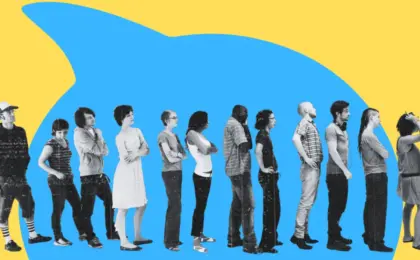
Imagine you have been standing on a sidewalk for 20 minutes, famished and desperate to order one of the viral bagels that continuously sell out, or perhaps you have endured a six-hour wait outside a crowded concert venue, fiercely determined to claim a coveted spot at the barricade to see your favorite band perform live.
Then, without warning, someone strolls up and casually slips into the queue directly ahead of you. Apparently, according to their actions, the rest of the people in line have simply been standing around for the ambiance and atmosphere.
Just how severe of a social transgression are line-cutters committing? According to Nick Leighton, an etiquette expert and co-host of the podcast Were You Raised by Wolves?, the offense cuts deep. "You are ripping the fabric of society apart," Leighton says, noting that while queue-jumpers certainly have to live with that reality, "worse, we have to live with you."
Navigating this universally maddening situation requires a careful balance of psychology, personal safety, and social etiquette, particularly when deciding whether and how to speak up.
When to speak up about someone cutting in line
If having a stranger jump ahead of you in a line feels strangely personal, Richard C. Larson entirely understands why. A professor emeritus of data, systems, and society at the Massachusetts Institute of Technology (MIT) who has dedicated academic research to the science of queuing, Larson points out the fundamental inequality at play. "We only have a finite number of minutes of life on Earth," he notes. The silent message conveyed by a line-cutter is often interpreted as: "A minute of my life is worth more than a minute of yours."
Before deciding whether to confront an offender, experts suggest taking a moment to evaluate what speaking up would actually accomplish. Are you trying to legitimately reclaim your rightful turn, or are you primarily motivated by a desire for revenge? Frequently, the initial impulse is simply "to sort of let them know you think they’re a jerk," says Ryan Martin, a professor of psychology and dean of the College of Arts, Humanities and Social Sciences at the University of Wisconsin–Green Bay. Martin is widely known online as the "Anger Professor" due to his academic focus on strong human emotions.
Martin notes that he would speak up to help someone recognize "that what they did wasn’t OK and that I wanted them to go to the back of the line." However, he also emphasizes the importance of a broader cost-benefit analysis: "What is going to allow me to have the kind of night I want to have?" If you spend an entire concert replaying a brief confrontation in your head instead of enjoying the music, you have ultimately lost far more than just your initial place in the queue.
Leighton applies a similar foundational gut check to these tense scenarios, asking a timeless question: Is this the hill you want to die on? "That’s always a good etiquette question," he explains.
At the same time, personal safety must always be factored into the equation. If the person who cut the line exhibits hostile behavior, or if you feel any sense of unease about approaching them, seeking assistance from venue staff or simply letting the incident go is often the wisest path forward. "Health and safety always trumps etiquette," Leighton stresses.
What to say—if you do decide to say something
The profound rage that line-cutting tends to provoke is not just anecdotal; it is deeply rooted in human social psychology. Marie Helweg-Larsen, a professor of psychology at Dickinson College who specializes in the study of social norms, has extensively explored the psychological mechanisms behind queue frustration. For a 2008 study, Helweg-Larsen and a colleague surveyed enthusiastic U2 fans waiting for prime concert-floor spots, asking them how they would react to various hypothetical line-cutting scenarios.
Interestingly, the researchers discovered that fans reacted just as negatively to someone cutting in behind them as they did to someone cutting ahead of them—even though their own physical place in the line was not directly affected by the rear-entry. "You have to have people follow the rules," she explains, "or your investment into the line falls apart." During the research, Helweg-Larsen’s co-author even overheard frustrated fans invoking a higher moral authority when someone misbehaved in the queue: "Bono wouldn’t like that!"
In everyday life, however, you do not need a rock star’s moral authority—or a grand, dramatic speech—to point out where a line properly starts. Helweg-Larsen suggests a straightforward, non-confrontational opener: "Excuse me, but the line starts down there." The key, she advises, is to aim for an "I’m just trying to be helpful" kind of vibe.
This measured approach gives the individual a graceful opportunity to correct their mistake without feeling forced to immediately defend their character. Furthermore, you do not necessarily have to believe that the cut was an innocent oversight in order to deliver the message with grace. "Even if they’re doing it on purpose, you still need to use that tone," Leighton says.
Leighton speaks from personal experience, having once been on the receiving end of a polite correction himself. While standing at a deli counter, he mistakenly joined what he assumed was the back of the line, only to later discover he had guessed incorrectly. He was ultimately grateful when someone kindly pointed him in the right direction.
When deciding to speak up, timing is critical. "Your window of opportunity is short," Leighton says. "As soon as it happens, that’s when you need to say something." Waiting five full minutes while silently glaring at the back of someone’s head will not make the subsequent conversation any easier or more effective.
For a queue that represents a significant and serious investment of time, Martin suggests spelling out that context clearly: "Hey, I’m not sure you noticed, but there’s actually a really long line here, and people have been waiting all day." By phrasing it this way, you have successfully identified the problem while simultaneously providing the offender with an easy opening to simply say "Oops" and rectify the situation.
Of course, everyday social scenarios are not always cut-and-dry. A lone individual returning to their spot after a necessary bathroom break is vastly different from a group of four friends arriving hours late to join a single person who was holding their places. While Leighton expresses reasonable sympathy for a quick water or restroom run, holding spots all day for a sudden, late-arriving entourage draws a different reaction: "I don’t love that," he admits.
What to do if a line-cutter won’t move
Occasionally, your polite reminder will not be met with a reciprocal level of courtesy or cooperation. The offender saw the line, understood it, and is simply staying put. In those moments, navigating the stalemate requires restraint.
If you feel comfortable continuing the interaction, Martin suggests a firmer, direct follow-up: "I really think you should go back to the back of the line." This approach makes a clear, direct request without resorting to insults or name-calling.
Similarly, Larson advises skipping confrontational nicknames or aggressive demands—such as asking, "What do you think you’re doing, bud?" The goal is simply to direct someone toward the proper end of the line, not to challenge them to a physical duel.
If the person continues to refuse to move, experts strongly advise resisting the urge to escalate the argument. "We can’t control everybody," Martin notes. Continuing to push an uncooperative individual who has already dug in their heels risks sparking "a more significant confrontation."
At staffed locations such as concert venues, amusement parks, or busy retail establishments, visitors have the option to seek backup. "You can always appeal to a higher authority," Leighton says. While there is never a absolute guarantee that staff will aggressively enforce queue rules, it remains a viable option worth pursuing when a line-cutting incident is particularly egregious.
Ultimately, if you decide to drop the matter, experts recommend dropping the parting verbal shot as well. While a sarcastic "Must be nice!" might feel entirely justified and irresistible in the moment, Leighton advises against adding further negativity to the encounter. "It will not achieve anything," he notes.
As Larson succinctly puts it, keeping the bigger picture in mind is paramount: "A fight can ruin your whole day—or life."






No comments yet. Be the first to join the conversation!