
In Rohinton Mistry’s acclaimed novel A Fine Balance, set against the turbulent backdrop of modern India in the 1960s and 1970s, the profound social meaning of the vote for society’s most marginalized is laid bare. Narayan, a Dalit tailor, fiercely insists on marking his own ballot in an upcoming election rather than submitting to the demands of an upper-caste landlord’s men who expect to vote on his behalf. When his father, Dukhi, warns him of the lethal risks involved in defying local power structures, Narayan responds with unwavering resolve: “Life without dignity is worthless… It is still my right. And I will exercise it in the next election, I promise you.”
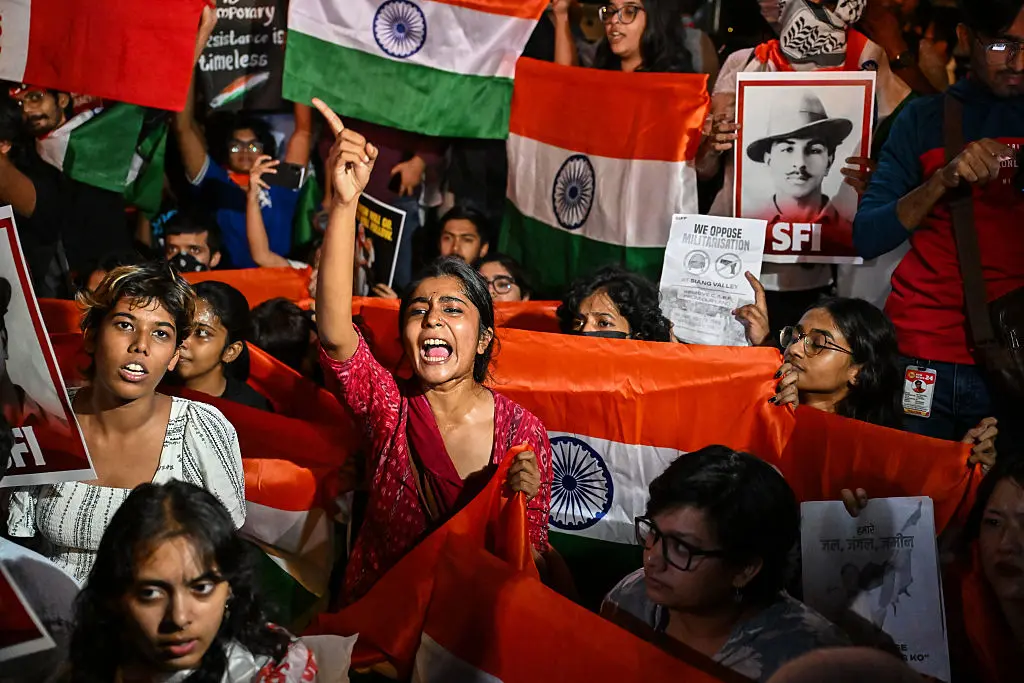
That fictional dialogue has echoed heavily across India over the past few weeks, as a wave of intense demonstrations has transformed October into a month of fierce, high-stakes battles over the integrity of the nation’s electoral system, the accountability of its core democratic institutions, the fundamental right to protest, and the very soul of Indian democracy.
The current unrest traces its immediate origins to the summer, when a nascent Gen-Z movement calling itself the Cockroach Janta Party organized massive demonstrations in Delhi over mounting concerns regarding education and unemployment. That youth-led insurrectionary energy forced the resignation of India’s higher education minister and quickly drew vital support from a broad coalition of opposition political parties, grassroots social movements, and diverse pillars of civil society.
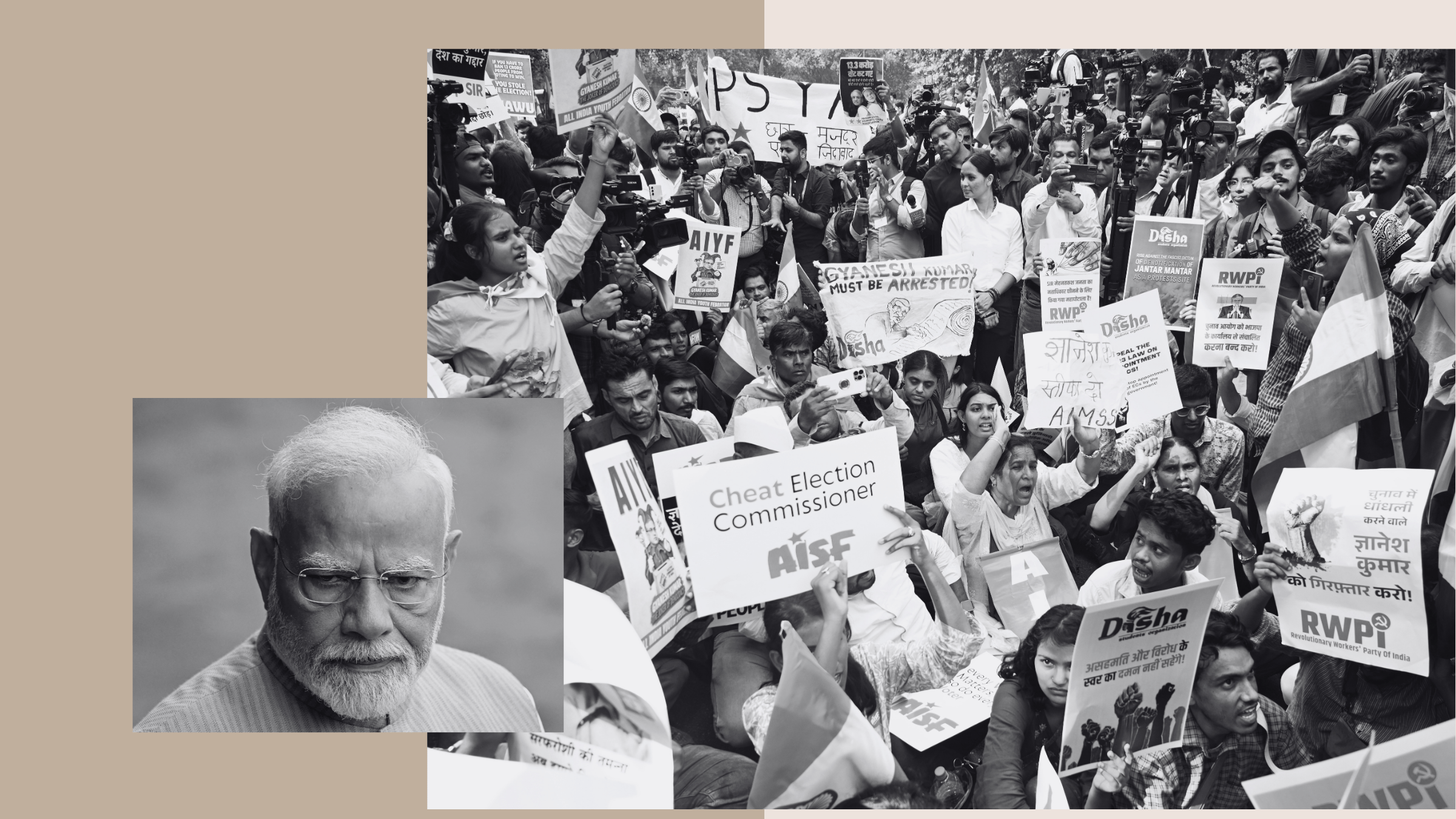
As October arrived, these assorted protesters shifted their focus to an existential threat: the sanctity of the vote, which stands as the essential bedrock of Indian democracy. Thousands of citizens joined marches in New Delhi and cities across the country, fueled by fierce anger over an ongoing national exercise to overhaul the nation’s electoral registers.
Known officially as the Special Intensive Revision, the initiative has resulted in the removal of more than 130 million voters from electoral lists, according to protesters and civil society groups. While electoral rolls undergo periodic revisions under normal administrative procedures, this marks the first time such an extensive exercise has placed the absolute burden of proof on individual citizens to actively establish their eligibility. This shift has ignited widespread fears that millions of legitimate voters—particularly the rural poor, domestic migrants, religious minorities, and marginalized communities—will be systematically disenfranchised.
Seeking accountability, protesters have demanded the resignation of Gyanesh Kumar, the country’s chief election commissioner, who oversees the Election Commission of India, the independent body constitutionally charged with safeguarding the integrity of national polls. Activists accuse Kumar of abandoning his obligation to act impartially, arguing that the administration of the revision process has been structured to favor the political interests of Prime Minister Narendra Modi’s ruling Bharatiya Janata Party (BJP)—an allegation strongly denied by government officials.
The Power of the Vote
The emotional intensity driving these demonstrations is deeply rooted in the foundational ideals of the modern Indian nation-state. India took immense pride in adopting universal adult franchise when its Constitution came into effect on Jan. 26, 1950. During the country’s historic first general elections in 1952, every Indian above the age of 21—regardless of caste, religion, gender, race, or wealth—was granted a constitutionally guaranteed right to cast a ballot. Legal and constitutional scholars have long viewed this achievement as a monumental feat that established the core touchstone for the modern idea of India.
The current upheaval reflects a profound anxiety that the Modi government is reversing decades of democratic progress by recasting the act of voting as a bureaucratic privilege rather than an inviolable constitutional right. Under the current revision process, prospective voters must complete enumeration forms and are frequently required to produce onerous documentary evidence, such as birth certificates and historical educational records, to verify their status. Millions of marginalized Indians lack these documents entirely or possess records plagued by administrative errors and spelling mistakes, making navigation of the verification process nearly impossible.
Critics warn that India is being dragged backward to a darker era—one that the nation spent decades escaping through continuous efforts to deepen and protect its democratic franchise. In the 1950s, India was an overwhelmingly rural society, with roughly 83 percent of the population living in villages and only 17 percent in urban centers. Early accounts of grassroots democracy reveal that higher-caste landowners routinely controlled the votes of lower-caste dependents, sometimes physically marking ballots that voters were forced to authenticate with thumbprints.
Eminent sociologist M.N. Srinivas documented how political campaigners treated rural populations not as individual citizens with personal agency, but as members of "vote banks." Politicians negotiated directly with landlords or community leaders to deliver blocs of votes in exchange for government favors, ranging from business licenses to college admissions for family members. Well into the 1960s, physical intimidation remained rampant; in Bihar, landlords deployed club-wielding enforcers known as lathaits to prevent Dalits from reaching polling booths.
A turning point in popular consciousness arrived with the "Emergency," the authoritarian period between June 1975 and March 1977 when Prime Minister Indira Gandhi suspended constitutional rights, imprisoned political opponents, and silenced the press. While much of the nation’s political and economic elite accommodated the regime in exchange for "order," India’s poor suffered severe abuses under an unaccountable bureaucracy.
In the March 1977 general elections, however, the electorate decisively ousted Mrs. Gandhi’s Congress Party from power for the first time since independence. Disenfranchised groups—including Dalits, Muslims, and rural laborers—used their ballots to punish the regime for its abuses. As political theorist Partha Chatterjee observed, the 1977 election firmly established the "capacity of the vote," proving that ordinary citizens viewed the ballot as a sacred covenant guaranteeing their political citizenship and human dignity.
A Silent Revolution
In the decades following the Emergency, India’s marginalized populations transformed voting into a powerful tool for social justice and economic security. Politicians could no longer rely solely on local patrons to marshal votes, forcing them to compete directly for the representation of working-class interests. By the 1990s, political leaders from historically oppressed castes assumed power in populous northern states like Bihar and Uttar Pradesh.
Political scientist Christophe Jaffrelot famously termed this shift "the silent revolution." While it did not fully dismantle deep-seated economic disparities, it fundamentally altered everyday power relations. As researchers noted during fieldwork in rural Bihar, ordinary citizens could finally look traditional landlords in the eye and speak as equals.
Over time, however, clientelist vote-bank politics became increasingly associated with systemic corruption. This dynamic paved the way for Narendra Modi’s successful 2014 national campaign, in which he ran as a populist reformer promising development while criticizing rival parties for pandering to specific vote banks. Modi’s rhetoric frequently included sharp attacks suggesting that previous governments had appeased India’s Muslim minority—who comprise roughly 14 percent of the population—at the expense of national security. During his 2014 campaign, Modi frequently targeted undocumented immigration from neighboring Bangladesh, utilizing inflammatory language that established a lasting template for political polarization.
A Dangerous Exclusion
The Modi government has invoked the specter of undocumented immigration to justify sweeping revisions to electoral rolls across multiple states. Home Minister Amit Shah defended the Special Intensive Revision against ongoing protests, dismissing the demonstrations as a coordinated effort to protect infiltrators.
While the central government previously acknowledged in parliament that it lacked precise data regarding the exact number of undocumented immigrants residing in the country, the administration used these security concerns to shift the burden of electoral registration away from the Election Commission and onto individual citizens.
Independent data and research studies indicate that this shift has disproportionately impacted vulnerable populations. Retired Maj. Gen. Anil Verma, head of the Association for Democratic Reforms, noted that the vast majority of voters excluded from lists in states like Bihar were rural residents lacking official documentation. Furthermore, an analysis by the SABAR Institute revealed that millions of voters removed from West Bengal’s electoral rolls were heavily concentrated in constituencies represented by the opposition or boasting significant Muslim populations. In specific districts, such as Nandigram, independent analyses showed that Muslim voters accounted for an overwhelming majority of the deleted entries.
The Election Commission has consistently denied any political motivation behind the deletions, maintaining that it applied uniform administrative criteria to remove duplicate, deceased, or relocated voters. Yet, for millions of Indians, the mass disenfranchisement is viewed as a direct assault on their identity and citizenship.
A Generation on the Streets
In response to these developments, the government deployed coercive force across central Delhi, transforming the administrative heart of the capital into a heavily guarded garrison. Authorities deployed tens of thousands of police and paramilitary personnel, restricted mobile internet access, and detained thousands of demonstrators.
Despite the intense crackdown, student leaders and activists have continued to mobilize. The detention of figures like Neha Bora, a 29-year-old doctoral student and prominent left-wing activist who was held by police before being released, drew national attention and sparked widespread outrage on social media. Upon release, Bora summarized the sentiment animating the movement, tweeting: “Fighting for democracy and the Constitution cannot be criminalized.”
The convergence of youth anger over economic insecurity, growing fears of democratic erosion, and widespread anxiety over the integrity of the vote poses a formidable challenge to the Modi administration. As protesters continue to draw historical parallels to the Quit India movement and the resistance against the Emergency, the underlying message remains clear: while a government may retain power despite policy shortcomings, it risks total loss of legitimacy when it tampers with the sacred power of the ballot.







No comments yet. Be the first to join the conversation!