
By Amanda Robert
October 27, 2026, 9:33 am CDT
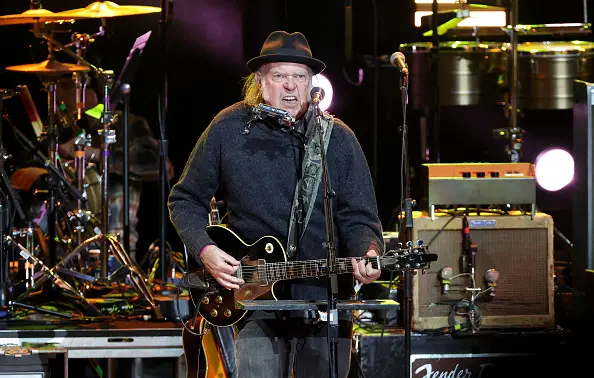
Legendary musician Neil Young has filed a $10 million federal lawsuit against President Donald Trump, alleging copyright infringement stemming from the unauthorized use of his iconic protest anthem, “Rockin’ in the Free World,” at a midterm election campaign rally in Ohio earlier in October.
According to the complaint filed on October 26 in the U.S. District Court for the Eastern District of Virginia, the political action committee known as the Trump 47 Committee played the 1989 track before Trump took the stage at an event in Youngstown, Ohio. The legal action contends that this performance violated not only federal copyright law but also a binding settlement agreement reached six years prior, in which representatives for Trump’s political campaigns explicitly promised to refrain from utilizing Young’s music without a proper license and explicit permission.
The legal battle marks the latest chapter in a long-standing public and legal dispute between the renowned singer-songwriter and Donald Trump over the deployment of copyrighted artistic works at high-profile political functions. Court records show that Young first began publicly objecting to the campaign’s use of his catalog during Trump’s initial presidential run in 2015, when the same song was played during a campaign announcement event. Over the subsequent decade, numerous other artists have similarly voiced opposition to politicians using their music without authorization, but Young’s ongoing legal efforts have established a distinct precedent for holding campaigns directly accountable through copyright litigation and breach-of-contract claims.
In his newly filed complaint, Young elaborates on the thematic core and artistic intent of “Rockin’ in the Free World,” contrasting its satirical critique of American socioeconomic disparities with the celebratory atmosphere of a political rally.
“‘Rockin’ in the Free World’ is a blistering anthem that contrasts the hollow promises of American political rhetoric with the harsh realities faced by the poor, homeless and forgotten,” Young stated in the legal filing, which seeks significant financial relief for copyright infringement. “The lyrics paint vivid street-level portraits—a mother discarding her baby, addicts lost in despair, garbage piling in the shadows of prosperity—while the repeated chorus delivers a savage irony, celebrating freedom that clearly isn’t shared by all.”
The complaint further emphasizes the fundamental philosophical disconnect between the artist’s work and the political platform of the defendant. “In short, the song is the opposite of everything that Donald J. Trump stands for,” Young added.
The lawsuit highlights a key prior legal confrontation between the two parties. Young noted in the court documents that he previously sued Donald J. Trump for President Inc.—a separate corporate entity established by Trump—in 2020 after the song was played at a campaign event without authorization. That earlier lawsuit addressed copyright infringement claims related to “Rockin’ in the Free World” as well as another composition from Young’s extensive catalog. According to the current complaint, that 2020 litigation was ultimately resolved through a confidential settlement, under which the corporate entity vowed to permanently cease utilizing Young’s music at public appearances without securing a valid license and the musician’s express consent.
The inclusion of the prior settlement in the current complaint introduces a potential breach-of-contract dimension to the federal copyright action, potentially complicating defenses centered on campaign venue licensing or public performance rights organizations. Generally, political campaigns obtain blanket performance licenses through organizations such as ASCAP and BMI to cover musical works played at large venues. However, legal experts have increasingly scrutinized whether such licenses adequately shield campaigns when artists explicitly object, or when specific settlement agreements and moral rights arguments—alongside the traditional public display and performance restrictions embedded in venue agreements—come into play.
As the litigation proceeds in the Eastern District of Virginia, the case is expected to draw widespread attention from both the legal community and the entertainment industry, focusing renewed scrutiny on the intersection of copyright law, political campaign management, and the rights of creators to control the public association of their artistic output.







No comments yet. Be the first to join the conversation!