
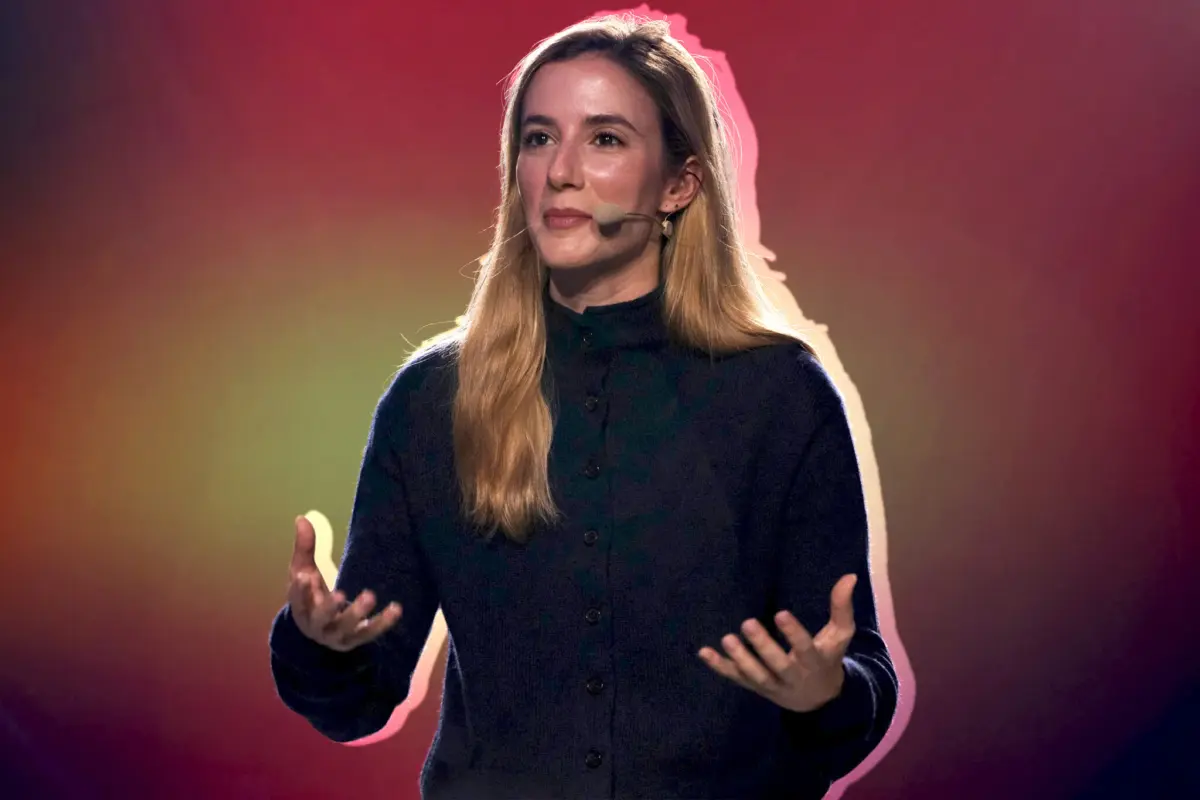
Long before she was managing a multi-billion-dollar financial exchange, Luana Lopes Lara was navigating a world defined by grueling discipline, high-stakes competition, and physical endurance. As a teenager growing up in Brazil, she studied classical ballet at the prestigious Bolshoi Theater School. The environment was notoriously cutthroat, marked by intense rivalries where the pressure to succeed occasionally manifested in extreme ways, such as fellow students hiding glass fragments inside each other’s ballet shoes.
Balancing this rigorous artistic training required an extraordinary schedule. Lopes Lara would attend technical school in the mornings before heading straight to the ballet academy, where her training sessions stretched from the afternoon well into the night. That early exposure to relentless pressure, meticulous focus, and high-performance environments forged a resilient mindset. It ultimately laid the operational and psychological foundation for her future career as a pioneering technology entrepreneur.
Reflecting on her formative years during a recent appearance on the podcast Confession with Ali Partovi, Lopes Lara offered insight into the ambition that has driven her career trajectory. "Since I was very little, I wanted to do big things," she remarked.
That lifelong drive has now culminated in a historic milestone. At just 30 years old, Lopes Lara has officially been recognized as the world’s youngest self-made female billionaire. In December 2025, she claimed the title by unseating prominent figures such as pop superstar Taylor Swift and tech entrepreneur Lucy Guo. According to Forbes, Lopes Lara commands an impressive net worth of $2.6 billion, a fortune amassed largely through her role as the co-founder of Kalshi.
Kalshi has rapidly emerged as a dominant force in modern finance, functioning as a federally regulated prediction market exchange. The platform allows everyday users and institutional participants alike to buy and sell yes-or-no contracts tied to the outcomes of real-world future events. These contracts span a vast array of categories, covering everything from political elections and crucial macroeconomic data releases to weather patterns and major sporting events. Through Kalshi, Lopes Lara is actively working to build a financial ecosystem where people can essentially take positions on the outcome of almost anything happening in the world. As the company’s official platform proudly notes, Kalshi stands out as the first federally regulated exchange in the United States dedicated exclusively to trading on the future outcomes of real-world occurrences.
The Common Trap in Entrepreneurship
Achieving such unprecedented scale and market penetration requires a distinct philosophy regarding risk and corporate culture, lessons that Lopes Lara frequently shares with emerging founders. During her podcast interview, she warned that many intelligent entrepreneurs fall into a predictable and damaging trap when launching their ventures: they become dangerously obsessed with probabilities.
"You can psych yourself out of doing anything," Lopes Lara explained. Emphasizing the necessity of bold action over endless calculation, she added, "I think that going for it, taking the risk, believing that things will work out, is very important."
In Lopes Lara’s view, allowing a startup’s internal culture to become entirely dominated by cold statistical modeling regarding whether the business will survive or fail creates a toxic environment. When employees fixate exclusively on the mathematical odds of success or failure, the workplace transforms into a hyper-reactive ecosystem where the team panics or overcorrects in response to every single piece of new information that crosses their desk.
To counteract this paralysis by analysis, Lopes Lara stresses the importance of deliberate team-building centered on forward momentum. She advocates for surrounding oneself with individuals who possess an inherent drive to construct and create. "It’s important to have a lot of optimistic people who want to build things in the company," she noted, highlighting that optimism and a bias toward action are critical ingredients for navigating the unpredictable early stages of high-growth enterprises.
How She Started Kalshi
The genesis of Kalshi dates back to 2018, rooted in an academic partnership and an everyday cultural observation. Lopes Lara co-founded the company alongside Tarek Mansour, whom she met while they were both undergraduate students. The pair graduated together in 2018, with Lopes Lara pursuing rigorous majors in computer science and mathematics, while Mansour focused on electrical engineering, computer science, and mathematics.
Their paths naturally crossed in shared classes. Known for her academic focus and determination, Lopes Lara consistently sat at the front of the lecture hall. Recognizing her diligence, Mansour sought to emulate her work ethic and began sitting next to her, sparking a professional partnership that would eventually reshape the financial landscape.
The foundational idea for Kalshi, however, emerged from an unexpected place during Lopes Lara’s college years while she was interning at Five Rings, a prominent New York-based trading firm. At the time, social media was saturated with rampant speculation and viral narratives surrounding celebrity entrepreneur and reality television star Kylie Jenner, specifically regarding rumors that she was pregnant.
Recalling the moment that sparked a multi-billion-dollar enterprise during an interview with Bloomberg, Lopes Lara shared, "I was like, ‘I want to make a bet with you on this.’" The fundamental hurdle she encountered in that exact moment was deceptively simple: she realized there was simply nowhere legitimate or structured to place such a wager.
In that minor, everyday consumer curiosity, Lopes Lara identified a massive, unserved market opportunity that extended far beyond celebrity gossip. She recognized that millions of people around the globe held firm, passionate convictions about how future events would unfold, yet the existing financial infrastructure completely lacked an accessible, regulated outlet for expressing those beliefs through market participation.
That realization transformed into Kalshi. What began as an innovative concept to capture public sentiment on current events has since scaled into an economic juggernaut. The company has commanded staggering valuations, with reports indicating a valuation soaring toward $22 billion and continuing to climb rapidly as the platform finalizes massive new funding rounds and eyes future public offerings. By bridging the gap between human curiosity, predictive belief, and regulated financial markets, Luana Lopes Lara has not only redefined modern trading but has cemented her legacy as one of the most remarkable entrepreneurial minds of her generation.









No comments yet. Be the first to join the conversation!