

For decades, the financial trajectory of a working professional is defined by a singular, persistent question: Am I saving enough? Workers meticulously track their 401(k) contributions, adjust their asset allocations, and watch their compound interest grow, all while dreaming of the day they can finally walk away from the daily grind. But financial planners and retirement experts note a stark shift that occurs the moment the career officially ends.
Suddenly, the calculations change entirely. The foundational questions of financial life are no longer about accumulation, but about distribution and defense. Where will the monthly income actually come from? Which specific accounts should be tapped first to minimize a tax burden? How much capital needs to be set aside for annual tax liabilities? When is the optimal time to claim Social Security benefits? And, perhaps most dauntingly for those staring down economic uncertainty, what happens if a sharp market downturn hits the portfolio right after retirement begins?
Many individuals spend years and even decades preparing meticulously for the financial milestone of retirement, yet give far less thought to the mechanics of managing their money once they cross the finish line. The first year of retirement serves as the ultimate reality check, transitioning theoretical plans into daily financial operations. Financial professionals emphasize that navigating this initial twelve-month window successfully requires focusing heavily on a handful of pivotal decisions that will shape the rest of retirement.
Establishing the Retirement Paycheck
For most of a career, a predictable paycheck arrives in a checking account every couple of weeks, managed entirely behind the scenes by an employer’s payroll department. In retirement, however, the retiree becomes the architect of their own cash flow, tasked with creating that regular paycheck independently.
The process begins with a precise calculation of monthly expenses needed to maintain a lifestyle. From that total, retirees must subtract guaranteed income streams, such as Social Security benefits and traditional pensions. Whatever gap remains represents the exact amount that must be drawn from accumulated savings and investments.
Yet, simply knowing the dollar amount is only half the battle; the source of those funds matters profoundly. A retiree might hold a mix of cash savings, taxable brokerage accounts, traditional IRAs, 401(k) plans, and tax-free Roth accounts. Withdrawing a significant sum, such as $50,000, from one of these vehicles instead of another can trigger vastly different tax consequences.
Withdrawals from traditional retirement accounts, for instance, are generally taxed as ordinary income. Conversely, in a taxable brokerage account, taxes are typically owed only on realized capital gains rather than the entire liquidation amount. Meanwhile, qualified withdrawals from Roth accounts remain entirely tax-free.
Financial advisors stress that there is no universal withdrawal hierarchy that suits every household. In certain years, drawing more heavily from a taxable account makes the most strategic sense. In other years, deliberately pulling funds from a traditional IRA can be advantageous. For example, if a person experiences a lower-income window in the gap years between retiring from their career and officially claiming Social Security, proactively taking IRA withdrawals or executing strategic Roth conversions can lower future required minimum distributions, known as RMDs, and grant the retiree greater control over their taxable income bracket down the road.
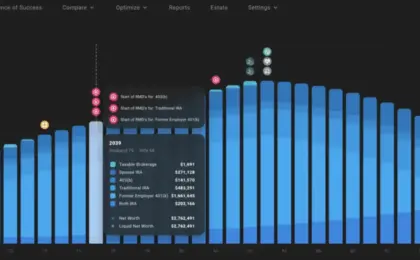
Advanced retirement planning tools can help individuals compare these withdrawal strategies side by side to visualize the long-term impact on tax liability and portfolio longevity. Regardless of the tool used, the guiding principle is intentionality—having a clear financial rationale for every dollar withdrawn, rather than dipping into whichever account happens to be most convenient at the moment. Once a strategy is chosen, retirees often set up automated recurring transfers to their checking accounts, preserving the familiar rhythm of a regular payday.
Navigating a New Tax Routine
Taxes routinely represent one of the most jarring adjustments during the first year of post-work life. During a career, employers automatically withhold federal, state, and local taxes from each paycheck, shielding workers from the complexities of direct tax management.
Upon retirement, income sources multiply and diversify, often including a patchwork of pensions, investment dividends, Social Security, and varying retirement account distributions, each carrying its own distinct tax treatment and withholding rules. Despite leaving the workforce, retirees are still obligated to pay taxes continuously throughout the year. Meeting this obligation may involve electing voluntary withholding on pension payments or IRA distributions, making regular estimated quarterly tax payments, or utilizing a combination of both methods.
This transition requires heightened vigilance for individuals who retire midway through a calendar year. Someone stepping away from their job in June might accumulate six months of regular salary, a performance bonus, or a payout for unused vacation time, followed by several months of retirement account withdrawals. When combined with investment gains or early Social Security benefits, that hybrid tax year can look drastically different from any year that came before or will follow.
Furthermore, these income spikes can have delayed repercussions. Medicare premiums, for instance, are calculated based on a beneficiary’s modified adjusted gross income from two years prior. A high-income retirement transition year can inadvertently trigger Income-Related Monthly Adjustment Amounts, or IRMAA surcharges, once the individual enrolls in Medicare. Fortunately, permanent retirement or a significant reduction in work hours can qualify as a life-changing event, allowing retirees to petition the Social Security Administration to base their surcharges on their more recent, lower income levels.
Experts advise estimating total tax liability well before the end of the calendar year. Adjusting withholding or making an estimated payment proactively is significantly easier than discovering a massive underpayment shortfall the following April. Because taxes withheld from an IRA distribution are generally treated by the IRS as having been paid evenly throughout the year, executing a strategic withdrawal late in the year can sometimes rescue a falling short on quarterly payments. Once the first full tax return as a retiree is filed, it serves as a valuable diagnostic tool, offering a clear picture of how new income streams are actually being taxed.
Deciding When to Claim Social Security
A retirement date and a Social Security claiming date are two entirely distinct milestones, yet treating them as a synchronized decision can be a costly mistake for unprepared retirees.
The monthly financial disparity between claiming ages is substantial. For anyone born in 1960 or later, the full retirement age is 67. An individual entitled to a $2,000 monthly benefit at age 67 would see that amount reduced to about $1,400 if they choose to claim early at age 62, or increased to approximately $2,480 by waiting until age 70. Because Social Security benefits receive annual cost-of-living adjustments for inflation, that gap widens significantly in absolute dollar terms over the course of a lengthy retirement.
Retirees who leave the workforce before age 70 while maintaining adequate personal savings to cover living expenses face a genuine strategic choice. They can opt to claim benefits immediately to reduce the draw rate on their personal investment portfolio. Alternatively, they can draw more heavily from savings during the early retirement years, allowing their guaranteed government benefit to compound and grow larger for the future. Delaying benefits can also carve out a valuable window of low-income years that facilitates strategic Roth conversions and tax bracket management.
For married couples, the decision takes on even greater significance. Under current rules, when one spouse passes away, the surviving spouse retains the larger of the two individual benefits. Consequently, the claiming age of the higher earner impacts not only their own immediate retirement cash flow but also the long-term financial security of the surviving partner, potentially for decades. Health status, overall family longevity, and immediate cash flow needs must all factor into the equation, ensuring that the decision is driven by comprehensive financial planning rather than arbitrary timing.
Managing the Healthcare Gap
For the vast majority of Americans leaving the workforce, health insurance remains the most complex open question. How a retiree handles coverage depends heavily on whether they step away before or after reaching age 65.
Individuals who retire prior to 65 must secure bridge coverage to sustain them until they become eligible for Medicare. Common pathways include utilizing retiree health benefits from a former employer, joining a spouse’s active workplace plan, extending an employer-sponsored plan temporarily through COBRA, or purchasing an individual policy through the Affordable Care Act insurance marketplace. While COBRA allows retirees to maintain their exact workplace coverage, the requirement to pay the full, un-subsidized premium out of pocket can deliver a severe financial shock.
Marketplace coverage, meanwhile, intersects directly with a retiree’s broader financial plan because premium tax credits are tied explicitly to household adjusted gross income. Traditional IRA withdrawals, Roth conversions, and realized capital gains in taxable accounts all contribute to this income figure, meaning that the specific accounts tapped during early retirement can directly influence monthly healthcare costs.
For those aged 65 and older, Medicare takes center stage. The initial enrollment period spans a seven-month window centered around a person’s 65th birthday. Failing to enroll on time—absent qualifying coverage from current employment—can result in permanent late-enrollment penalties that persist for the remainder of a person’s life. This rule applies even if an individual has chosen to delay claiming their Social Security benefits, as Medicare enrollment does not occur automatically in those scenarios. Building healthcare costs into the monthly budget as a distinct, non-negotiable line item remains essential regardless of the path chosen.
Preparing for Market Volatility
A market downturn carries an entirely different psychological and financial weight for someone who is retired and actively withdrawing funds from an investment portfolio compared to someone still accumulating wealth.
Consider an individual who retires with a $1,000,000 portfolio and plans to withdraw $50,000 during the first year to cover expenses. If a sharp market correction occurs shortly after retirement, shrinking the portfolio value to $850,000, the baseline need for living expenses remains unchanged. However, the retiree is now taking withdrawals from a depleted asset base. Furthermore, selling investments after their values have fallen locks in losses and leaves fewer assets behind to participate in the eventual market recovery.
When poor investment returns coincide with ongoing distributions early in retirement, the phenomenon is known as sequence of returns risk. Mitigating this risk requires proactive planning before a downturn strikes. Retirees must evaluate whether their portfolio maintains enough cash and short-term fixed-income reserves to sustain living expenses for a couple of years without forcing the sale of depressed equities. They must also determine which lifestyle expenses offer enough flexibility to be scaled back during a prolonged bear market.
While fundamental expenses like housing, utilities, and groceries cannot easily be eliminated during a down market, discretionary spending—such as major vacations, vehicle purchases, or home remodeling projects—can often be postponed. Total spending habits do not need to be overhauled every time the stock market dips, but maintaining a degree of financial flexibility provides a vital safety valve if a significant economic correction occurs during the vulnerable opening phase of retirement.
Replacing Assumptions with Reality
Ultimately, every retirement plan constructed during a career is built on a foundation of educated assumptions about an entirely new phase of life. The first year of retirement serves as the crucible where those assumptions finally meet reality.
After operating under a new financial routine for six to twelve months, retirees are encouraged to compare their actual spending patterns against their original projections. Rather than fixating on the fluctuations of individual months, individuals should look for broader patterns and systemic trends.
If a household budgeted for an annual expenditure of $80,000 but finds itself on pace to spend $95,000, identifying the underlying drivers of that variance is critical. Conversely, consistently spending less than anticipated can signal that a retiree has more financial freedom than initially realized. Beyond day-to-day spending, retirees should evaluate how their tax strategies, healthcare choices, and investment allocations are performing in practice.
Updating the retirement plan with real-world data allows individuals to determine whether they remain securely on track. Catching a shortfall or an unsustainable spending habit after the first year provides far more operational flexibility and time to course-correct than discovering the discrepancy several years down the line.









No comments yet. Be the first to join the conversation!