
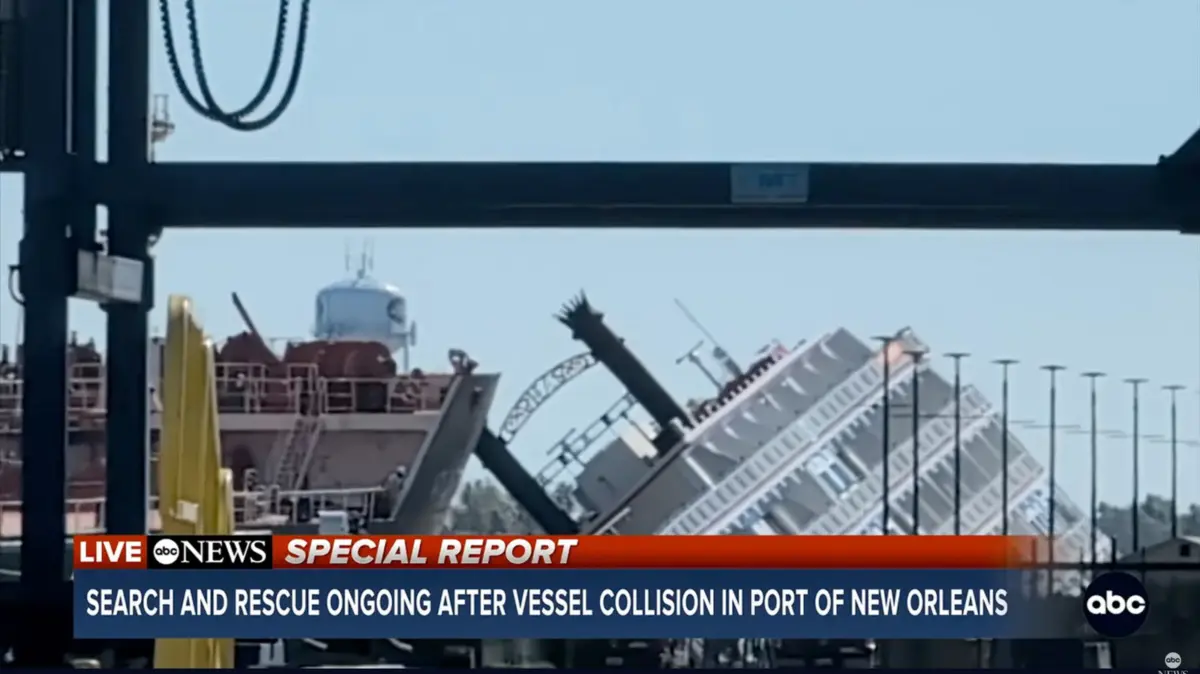
The Mississippi River is facing a partial closure following a dramatic maritime collision in the Port of New Orleans that resulted in an asphalt tanker striking, capsizing, and sinking a docked riverboat. The incident occurred at approximately 12:30 p.m. ET on a Friday, catching passengers and crew members off guard as the vessel was preparing for disembarkation.
According to city and emergency officials, approximately 32 individuals have been transported to nearby medical facilities suffering from non-critical injuries. Miraculously, despite the severity of the collision and the rapid sinking of the vessel, all passengers and crew members have been accounted for, confirming that there were no fatalities resulting from the tragedy. Because the investigation remains an active and evolving incident, the exact total number of injuries sustained during the crash has not yet been definitively finalized.
The collision took place outside 1350 Port of New Orleans Place. In response to the accident, the U.S. Coast Guard swiftly moved to close a significant stretch of the Mississippi River to all vessel traffic, restricting movement between mile markers 93 and 96 to ensure public safety and facilitate emergency response operations.
The vessel involved is the American Heritage, a riverboat operated by American Cruise Lines. At the time of the crash, the riverboat had been docked for about two hours as it prepared to begin passenger disembarkation procedures. Suddenly, the Atlantic Asphalt tanker collided with the stationary ship. Local news outlet WDSU reported that a massive multi-agency emergency response was immediately deployed to the area. Port NOLA Harbor Police, the New Orleans Fire Department, the New Orleans Police Department, the U.S. Coast Guard, and emergency medical personnel rushed to the scene to conduct coordinated rescue and response operations. The speed and efficiency of the rescue efforts have already drawn praise from local authorities, with many officials and witnesses referring to the outcome as a "miracle on the Mississippi."
These river cruises attract elderly passengers
The demographic profile of those on board heightened immediate concerns among state leaders. Louisiana Lieutenant Governor Billy Nungesser told ABC News that he was deeply worried about the victims because these types of river cruises traditionally attract an older demographic of passengers, who may be more vulnerable to physical trauma, shock, and environmental exposure during an emergency.
Following the rescue operations, emergency responders directed rescued passengers into the Port of New Orleans Administration Building. There, medical personnel established triage stations to evaluate victims, provide immediate first aid, and offer support services to those shaken by the ordeal. Adding to the urgency of the medical triage, the U.S. Army Corps of Engineers reported that the water temperature near the shipwreck site was approximately 66 degrees Fahrenheit. While not freezing, water at this temperature is cold enough to induce hypothermia if a person is exposed to it for an extended period, making the rapid extraction of everyone from the water and the immediate shelter provided at the port terminal critical factors in preventing more severe health complications.
As investigators begin the arduous process of determining what went wrong, authorities have noted that there is no confirmed official cause for the crash yet. However, early suspicions and preliminary assessments point toward a potential loss of steering control aboard the tanker. The physical dynamics of the collision were severe; following the initial heavy impact, the American Heritage riverboat rapidly began taking on water. The vessel capsized with alarming speed and now rests heavily on its side directly against the dock.
The gravity of the incident drew top-tier state and federal attention almost immediately. Louisiana Governor Jeff Landry rushed directly to the scene to monitor rescue and containment operations firsthand. While speaking from the site, Governor Landry mentioned that he had already been in direct communication with President Donald Trump regarding the crash. According to the governor, the administration assured him that the state would receive any federal support, resources, or assistance necessary to manage the aftermath of the disaster.
Looking ahead, the U.S. Coast Guard is directing its focus toward clearing the navigational hazards and working alongside specialized salvage assistance teams. These teams are tasked with stabilizing, salvaging, and eventually removing the sunken vessel from the area so that commercial traffic can safely resume along this vital artery of the Mississippi River.









No comments yet. Be the first to join the conversation!