
If you were looking to purchase a sporty two-door coupe back in 2001, your automotive options offered distinct paths depending on your appetite for excitement. You could head down to your local dealership and buy yourself a Porsche Boxster, a celebrated mid-engine roadster that defined open-air performance for the turn of the millennium. Or, perhaps, if you were feeling particularly extravagant, you could have bought yourself two Porsche Boxsters for the exact same amount of money—keeping one painted in a conservative silver for formal occasions and another finished in a brilliant, attention-grabbing bright yellow for weekend cruising. Yet, what could possibly be crazier than spending a small fortune on two nearly identical Porsches? Spending that exact same, eye-watering sum of money on a single Volkswagen.

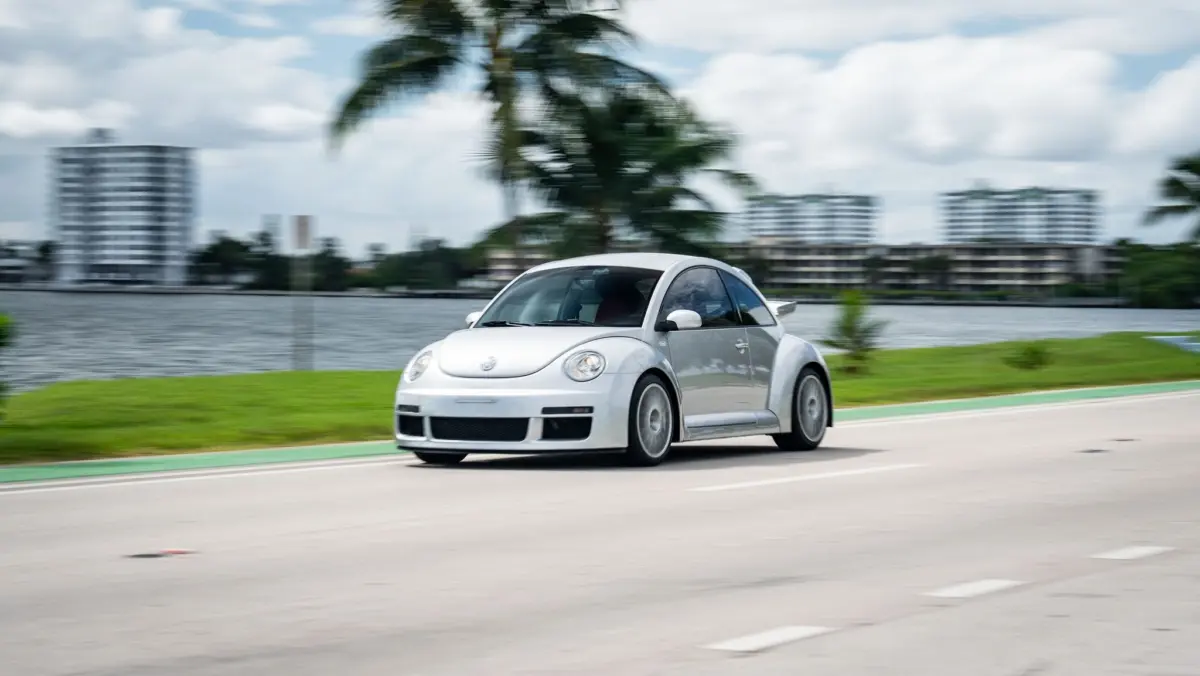
That legendary, wonderfully unhinged Volkswagen is the New Beetle RSi, a vehicle that holds the distinction of being the most expensive Beetle ever sold to the public. Now, an exceptionally well-preserved example with a mere 11,000 miles on the odometer has surfaced on the automotive auction platform Bring a Trailer, offering collectors a rare glimpse into a bygone era of uncompromising engineering.
Numbered as one of only 250 examples sold to the public—with every single production unit finished in a distinct shade of silver—this Pac-Man-shaped wunderbug hails directly from a fascinating chapter in Volkswagen’s corporate history. It was an era when the legendary and occasionally audacious VW boss Ferdinand Piëch was forever greenlighting wild, boundary-pushing projects. Under Piëch’s leadership, the company was famous for doing nutty things like stuffing massive twelve-cylinder engines into Volkswagen-badged luxury executive sedans and aggressively ordering bewildered engineers to design and build the engineering marvel that would become the Bugatti Veyron.

Piëch himself personally owned a New Beetle RSi, though his corporate perk was painted in a striking shade of blue. It was a fitting ride for the man in charge, because the RSi was far more than just a superficial special edition draped over a semi-circular, retro-styled Golf platform. Volkswagen’s skunkworks division created a machine that married potent six-cylinder power with an advanced Haldex all-wheel-drive system. It was exponentially more powerful than ordinary, everyday versions of the New Beetle, and it aggressively set itself apart from its mass-market siblings by featuring genuine carbon-fiber bodywork, heavily flared fenders, and an extremely wide, track-ready 18-inch wheel and tire package.
For the automotive landscape of the early 2000s, this slightly cartoonish-looking Volkswagen was an absolute rocket, particularly when the road started to twist and turn. Armed with immense mechanical grip and the intelligent ability to put power down early on corner exit thanks to its all-wheel-drive system, it drove like a little Pokémon-looking pocket rocket. If only it hadn’t been so eye-wateringly expensive when it was brand new—costing the modern equivalent of roughly $80,000, not even adjusted for inflation—it would have stood as a fiercely credible rival to heavy-hitting performance hatchbacks like the Golf R. Instead, its astronomical price tag ensured that it remained an ultra-exclusive toy for the truly dedicated enthusiast or the well-heeled collector.

Beneath the curvaceous hood lies the beating heart of the beast: a sonorous 3.2-liter VR6 engine. This is the exact same powerplant that later famously animated the fourth-generation Golf R32, instantly cementing its reputation for mechanical character. Factory ratings pegged the output at a healthy 221 horsepower and 236 pound-feet of torque, but the real, undeniable appeal of the VR6 has always been its fantastic, guttural soundtrack. When a driver stirs things up through the mechanical gates of the six-speed manual gearbox, this heavy-breathing Beetle absolutely flies, accompanied by an exhaust note that turns heads from blocks away.
Stepping inside the cabin reveals an interior that is thoroughly awash with exposed carbon-fiber door panels and gleaming aluminum accents. The fixed-back racing bucket seats are particularly incredible, providing deep, uncompromising lateral support for aggressive driving. In a nod to the sheer cornering G-forces the car is capable of generating, Volkswagen’s designers thoughtfully included a sturdy grab bar mounted directly onto the dashboard, giving terrified passengers something solid to cling to when the driver decides to push the envelope.

This specific auction example presents a tantalizing proposition for its next custodian. While the unique carbon-fiber and widebody exterior panels are essentially unobtanium—making minor parking lot mishaps a terrifying prospect—the mechanical underpinnings are mostly shared with other high-performance Volkswagen products that actually made their way to the North American market. This leaves the next owner with a delightful dilemma: should they preserve the car in completely stock, museum-quality condition, or should they contact the mad scientists at Canada’s HPA Motorsports to have them fit one of their ferocious turbocharging kits, which are notoriously capable of pushing the VR6 well past the 500-horsepower mark?
The high-stakes online auction for this extraordinary piece of Volkswagen history is scheduled to close on October 28.








No comments yet. Be the first to join the conversation!