
The collector-car world is filled with all types of blue-chip sure bets, from multi-million-dollar Italian supercars to coachbuilt pre-war classics. Yet, the way traffic actually looked in the past is rarely represented by what you might find meticulously polished and parked on the lawn at Pebble Beach today. Instead, the everyday roads of past decades were filled with plainer cars—modest, economical, and mass-produced vehicles that most often succumbed to the heavy erosion of time, rough usage, and rust. Because these humble commuters were viewed as disposable appliances rather than treasured heirlooms, pristine survivors are exceptionally rare today.
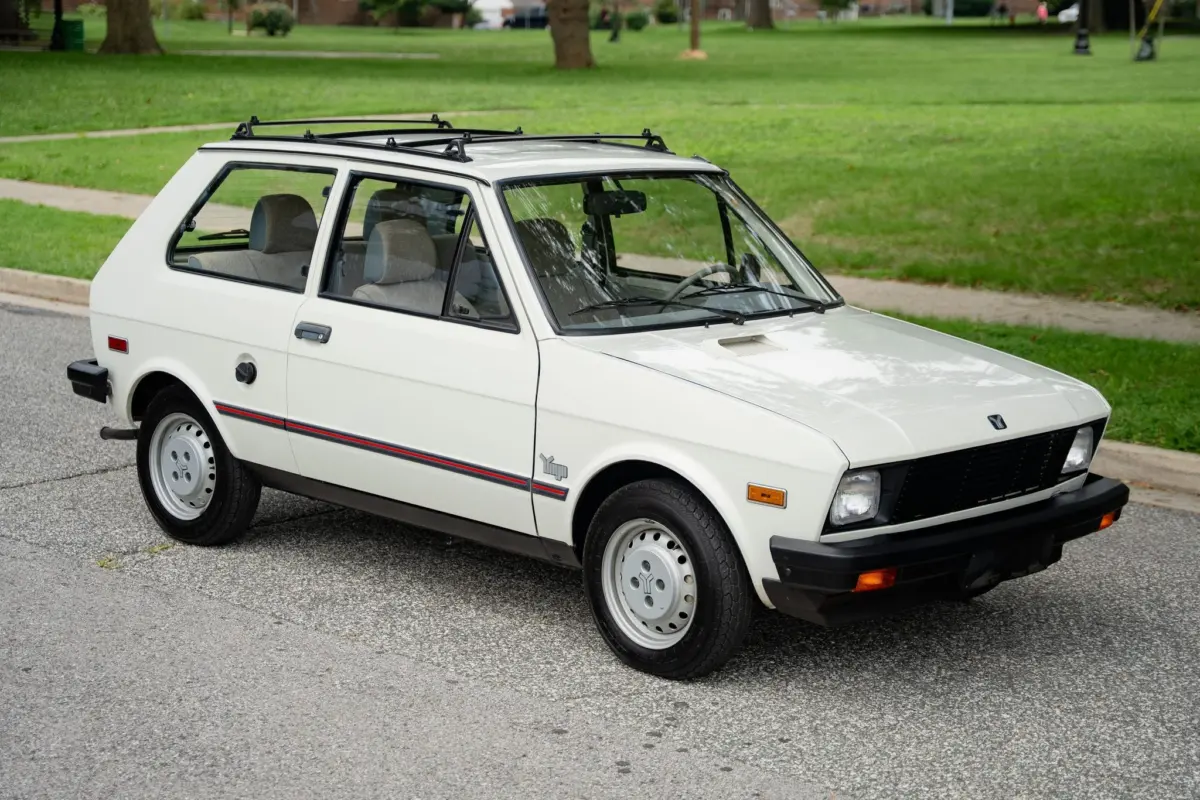
However, a remarkably preserved, highly unusual example of a very ordinary little car has just turned up on the automotive auction platform Bring a Trailer. It is a 1986 Yugo GV finished in white, showing an astonishingly low 121 miles on its odometer. Preserving a collector-grade Yugo requires a distinct sense of humor, and in this case, the car’s previous owner clearly had plenty of it. The hatchback was part of the eclectic collection amassed by the late James G. Robinson, a prominent Hollywood film producer best known for backing notable screwball comedies and crowd-pleasing hits, including the second Ace Ventura movie and Major League II.

Based in Baltimore, Robinson founded Morgan Creek Entertainment and ran it as a successful movie production company for decades. While not every project that came out of the studio was destined for Academy Award glory, the enterprise produced plenty of major commercial hits along the way. For instance, Robin Hood: Prince of Thieves, starring Kevin Costner, drew its share of critical jabs from professional reviewers, but it ultimately powered through the box office to become the second-highest-grossing movie of 1991.
Robinson passed away earlier this year, leaving behind a massive and diverse collection of more than 100 automobiles. Within that garage sat genuine blue-chip automotive royalty, including prized machinery like a classic Mercedes-Benz 300SL roadster. Placed among such vaunted, high-performance company, a humble little Yugo might have seemed like an ordinary farm animal wandering into a barn full of thoroughbred racehorses. Yet, this particular economy hatchback possessed a fascinating personal connection to Robinson’s life and career that set it apart from standard garage finds.
Long before he established himself as a Hollywood power player, Robinson was actively involved in the automotive trade. His business interests included prepping imported cars after they arrived via cargo ship from Europe and even installing U.S.-spec air conditioning systems to meet domestic comfort standards. His company played a direct role in processing many of the early imported Yugos arriving in North America, and Robinson maintained a personal friendship with Malcolm Bricklin, the ambitious entrepreneur responsible for bringing the Yugoslavian hatchback to the United States.

Like a movie panned universally by contemporary film critics, the Yugo was widely derided upon its American debut as cheap, flimsy, and disposable, quickly becoming the ultimate punchline for late-night talk show hosts and automotive satirists. In reality, the car offered honest, if exceedingly basic, transportation for a remarkably low sticker price. Based mechanically on the proven Fiat 128, the Yugo was produced in Yugoslavia by the former state-backed arms manufacturer Zastava. It was introduced to the U.S. market in 1985 by Bricklin, an automotive promoter who also famously earned credit for introducing Subaru to the American driving public.
Featuring a straightforward and practical three-door hatchback layout, this particular Yugo GV comes equipped with a modest 1.1-liter four-cylinder engine generating a mere 55 horsepower. The overall interior and exterior layout is decidedly bare-bones, reflecting the ultra-budget ethos of the brand, though this example is fitted with a cassette deck for in-cabin entertainment, factory air conditioning, and a period-appropriate roof rack. The mechanical specification is similarly straightforward, utilizing disc brakes up front and riding on small 13-inch steel wheels at each corner.
Despite its poor reputation among automotive purists and critics, the Yugo was far from a total commercial failure. More than 140,000 units were sold across the United States alone, while global production totals reached nearly 800,000 vehicles. Although the car was never a critical darling, those sales figures undeniably made the little hatchback a massive commercial success. In many ways, it mirrored the cinematic output of Mr. Robinson, whose films were often dismissed by high-brow critics while packing theaters and delighting mainstream audiences worldwide.

Finding such a clean, ultra-low-mileage example with a direct historical connection to the broader Yugo story is an occurrence that arguably belongs in a dedicated automotive museum. Yet, the projected cost of entry at auction is likely to remain low enough that the car could easily be driven sparingly on sunny weekends and proudly displayed at local or regional car shows. While it may never manage to slip past the exclusive velvet rope reserved for the Pebble Beach Concours d’Elegance, showing up at next year’s Monterey Car Week in a Yugo preserved to this level of pristine factory condition is practically guaranteed to turn heads and spark nostalgic conversations among enthusiasts.
The online auction for this extraordinary piece of automotive and cinematic history concludes on November 17.





No comments yet. Be the first to join the conversation!