
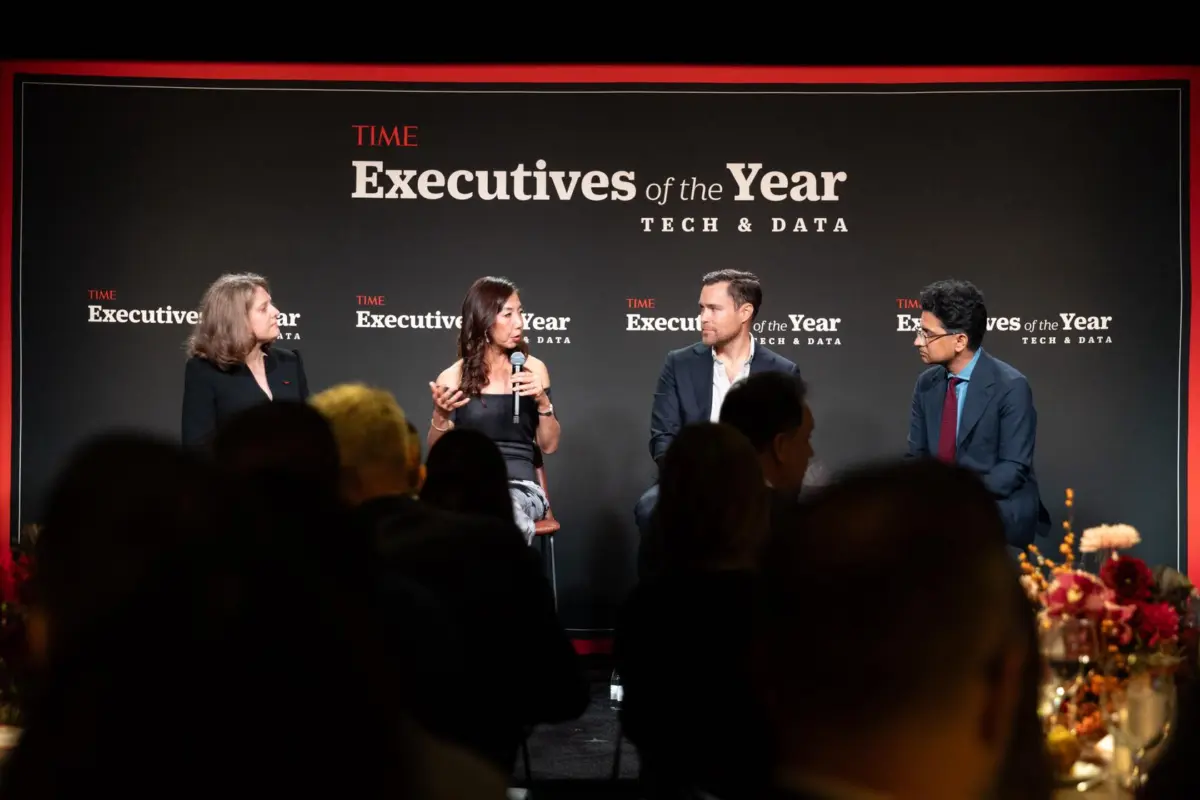
Chief technology officers from some of the world’s leading retail and e-commerce companies gathered in New York City on Tuesday night for a panel discussion at TIME’s Executives of the Year Impact Dinner: Tech & Data. The high-profile event provided a platform for top technology executives to discuss the profound ways emerging technologies, particularly artificial intelligence, have reshaped how modern enterprises operate, scale, and deliver value to consumers in a rapidly evolving digital landscape.
Speaking on the featured panel at the TIME forum were Franziska Bell, chief technology officer and executive vice president of The Home Depot; Fiona Tan, chief technology officer of online marketplace giant Wayfair; and Sam Dozor, chief technology officer of global e-commerce technology company Rokt, which sponsored Tuesday evening’s gathering. Throughout the discussion, the panel explored the delicate balance between rapid technological advancement, the human element in corporate operations, and the overarching goal of improving the end-user experience.
Grounding Innovation in the Consumer Experience
Opening the conversation on how organizations must approach new and emerging technological trends, Franziska Bell emphasized the critical importance of staying firmly rooted in the consumer’s perspective. When evaluating what she described as "the art of the possible," Bell noted that technology should never be adopted for its own sake; rather, it must serve a clear, practical purpose that directly benefits the customer.
To illustrate this philosophy in action, Bell highlighted one of the most innovative AI deployments at The Home Depot: a specialized tool known as Magic Apron. Described as an AI-empowered home improvement expert, the application was developed to assist customers and store associates alike. The tool is capable of helping shoppers locate specific merchandise within vast retail stores, answering detailed technical and how-to questions regarding various products, and even responding intelligently to images uploaded directly by users through their digital devices.
The creation of applications like Magic Apron stems from a systematic approach to identifying and eliminating customer friction. Bell explained that her team constantly evaluates the shopping journey to pinpoint where customers experience frustration or delay, subsequently working to reduce those pain points through smart, intuitive technological solutions. Notably, the Magic Apron tool has already been rolled out across approximately 2,000 stores throughout the United States, signaling a massive integration of artificial intelligence into the traditional brick-and-mortar retail environment.
The Indispensable Role of Human-AI Teams
Despite the extensive deployment of cutting-edge artificial intelligence systems, Bell was careful not to discount the crucial, irreplaceable roles that human employees play alongside technology in the modern workplace. She argued passionately that automation and digital tools should be viewed as collaborative partners rather than replacements for human labor and expertise.
"I’m a huge believer in human-AI teams," Bell told the audience gathered in New York City. "That’s really where the magic happens." By combining the raw processing power, speed, and analytical capabilities of artificial intelligence with human empathy, contextual understanding, and creative problem-solving, companies can achieve outcomes that neither humans nor machines could accomplish entirely on their own.
Navigating Infinite Choices and Cultivating Adaptability
Fiona Tan shifted the conversation toward the unique challenges faced by online marketplaces, focusing on the customer experience at Wayfair and how advanced technology has been leveraged to help consumers navigate an overwhelmingly vast inventory of home goods and furnishings. In digital retail spaces, customers are frequently confronted with an enormous selection of products, making discovery a significant hurdle.
"A lot of times people don’t know what they’re looking for, they can’t describe it, and so perhaps we offer you a journey that will resonate," Tan explained during the panel. She emphasized that digital platforms cannot simply rely on traditional search bars and static catalogs; instead, companies must continually innovate to provide personalized experiences that speak more intuitively to the individual consumer’s unexpressed desires and aesthetic preferences.
When the discussion turned to workforce development and the recruitment of new talent capable of driving these ambitious consumer experience goals while seamlessly integrating AI into daily workflows, Tan underscored the paramount importance of adaptability. She stressed that young job candidates entering the technology sector must possess the flexibility to adjust rapidly to an ever-changing technological landscape where tools, frameworks, and methodologies evolve almost overnight.
Furthermore, Tan noted that cultivating a successful tech-driven organization requires bridging generational divides within the workforce. She advocated for strategic mentorship models that pair younger, highly adaptable digital natives with older, more seasoned employees who possess deep institutional knowledge and long-term experience within their respective companies. This cross-generational collaboration ensures that institutional wisdom is preserved while fresh perspectives drive ongoing digital transformation.
Embracing the Present Moment in Technology Investment
Offering a perspective from the global e-commerce and transaction technology sector, Sam Dozor asserted that the current moment represents a prime, historic opportunity for companies to aggressively invest in technology and artificial intelligence infrastructure. According to Dozor, hesitation is no longer a viable strategy for enterprises hoping to remain competitive in the global marketplace.
"The time is here," Dozor declared during the Tuesday evening panel. "The time is now, and all of us need to live it."
Rokt has actively embodied this philosophy by encouraging its workforce to expand their professional boundaries and explore new types of work enabled by artificial intelligence tools. Dozor shared observations from his own organization, noting the exciting cultural shift happening among technical and creative teams. "It’s amazing to see engineers lean into building product specs and designers writing code," he said, highlighting how AI acts as an enabler for cross-functional collaboration and expanded professional capabilities.
Looking Forward to the Future of Work
Concluding his remarks, Dozor emphasized that maintaining a forward-looking mindset is essential for modern technology companies. Rather than reacting slowly to market shifts or remaining anchored to legacy systems, organizations must constantly anticipate what comes next for their employees and evaluate what new heights they can achieve together.
"Times are changing quickly," Dozor observed, noting that individuals and organizations fundamentally have a choice in how they relate to time, whether they choose to live in the past, the present, or the future. For Rokt and its leadership team, the decision is clear. "We’ve chosen to live six months from now," he concluded.
The TIME Impact Dinner: Executives of the Year: Tech & Data was presented by Rokt, bringing together industry leaders to share insights, debate the trajectory of digital innovation, and explore the intersection of data science, artificial intelligence, and human enterprise.








No comments yet. Be the first to join the conversation!