
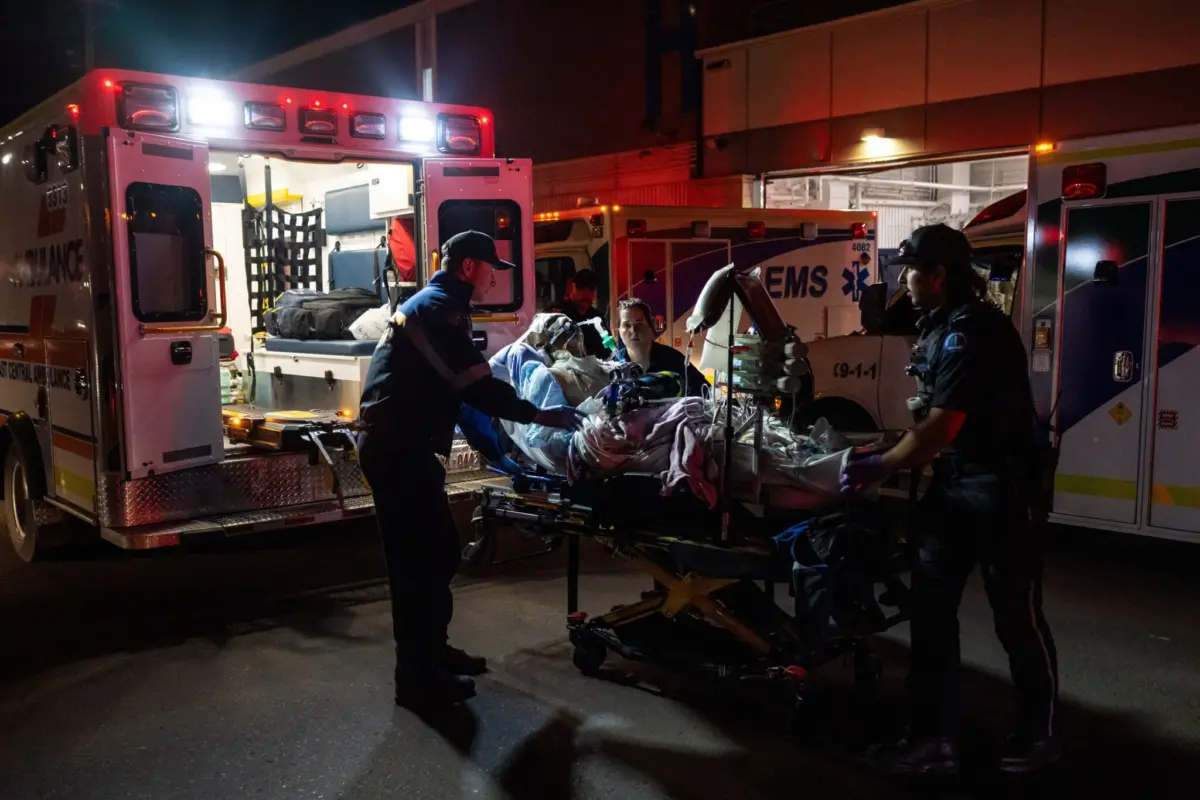
An unexpected and fast-moving fire that erupted during a routine military training exercise at one of Canada’s most prominent army bases has resulted in a devastating loss of life and a massive emergency response. Prime Minister Mark Carney confirmed that four service members died in the tragic incident, which unfolded on the afternoon of October 17 at Canadian Forces Base (CFB) Wainwright in Alberta.
As federal officials, military investigators, and provincial leaders grapple with the magnitude of the disaster, local and regional healthcare systems have been pushed to their limits. Alberta Premier Danielle Smith later provided a grim update, confirming that the total death toll from the catastrophic event had risen significantly, with 39 people killed and at least 19 others left in critical condition. Many of the survivors are currently receiving intensive medical care, with several recovering from severe burns that will demand long-term medical treatment and specialized rehabilitation.
Prime Minister Carney addressed the nation at midday on Sunday, describing the incident as a violent and exceptionally fast-moving blaze that caught personnel off guard during scheduled maneuvers.
"What followed was one of the worst tragedies for forces on Canadian soil in peacetime," Carney stated, reflecting the profound shock rippling through the country’s military and civilian leadership.
Canada’s Minister of National Defence, David McGuinty, similarly underscored the unprecedented severity of the situation in a video statement released on October 17. Describing the event as highly active and delicate, McGuinty admitted the extraordinary nature of the crisis. "I cannot recall an incident like this," he said.
In the immediate aftermath of the tragedy, military officials confirmed that there is currently no indication or evidence suggesting that the fire was the result of an act of terrorism. Federal authorities, including the Department of National Defence, have initiated a comprehensive investigation to determine the exact sequence of events and the root cause of the deadly blaze.
What is Known About the Fire Incident at CFB Wainwright
According to an official statement released by the Canadian Armed Forces, the fire ignited within the designated training area of CFB Wainwright during the late afternoon hours. What may have begun as a localized ignition quickly escalated into a widespread emergency. Driven by severe meteorological conditions, the flames spread rapidly across the terrain.
Local authorities in the surrounding region quickly recognized the escalating threat. In a Facebook update published on the evening of the incident, the district administration noted that the high winds significantly accelerated the movement of the fire, allowing the flames to break past the boundaries of the military base and push directly into the adjacent Municipal District of Wainwright.
Subsequent updates from local authorities indicated that emergency personnel and firefighting crews managed to bring the blaze under control and hold its perimeter. However, the human cost of the rapid spread had already proved catastrophic. The Canadian Armed Forces stated that further specific details regarding casualties and personnel would be officially released only after the next of kin had been properly notified.
Minister McGuinty did not immediately speculate on what might have triggered the initial spark, emphasizing that a thorough and rigorous investigation would be launched to uncover the facts. Following the incident, McGuinty traveled directly to Edmonton, maintaining continuous communication with both Prime Minister Carney and Premier Smith.
The timing of the disaster coincided with a period of intense domestic focus on Alberta. Prime Minister Carney had recently returned to Ottawa following a visit to his home province of Alberta, where local residents are preparing for a consequential vote to determine whether they wish to begin the complex legal process of potentially separating from Canada. Despite the high political tensions surrounding the province, the disaster at CFB Wainwright immediately united leaders across the political spectrum in grief and a shared commitment to emergency response.
What is CFB Wainwright?
Canadian Forces Base Wainwright stands as one of the nation’s busiest and most vital military installations. Situated more than 100 miles southeast of Edmonton, the capital of Alberta, the base serves as a cornerstone for tactical preparation within the Canadian Armed Forces.
CFB Wainwright is home to both the Canadian Manoeuvre Training Centre and the 3rd Canadian Division Training Centre. Because of its expansive terrain and robust infrastructure, it serves as the preferred training ground for army field force units stationed across Western Canada, preparing them for a wide spectrum of operational demands.
"Our country depends on the women and men of the Canadian Armed Forces," Prime Minister Carney remarked during his Sunday address. "And CFB Wainwright is where the women and men of our armed forces learn to do the hardest things this country can ask of anyone."
Military experts have noted the unique and high-stakes nature of the training conducted at the facility. Retired Major-General Denis Thompson, speaking in an interview with CBC on Sunday, detailed the rigorous environment typical of Wainwright. He explained that training exercises often involve large formations that bring together infantry foot soldiers and heavy artillery in large-scale, live-fire scenarios, occasionally incorporating air-dropped munitions.
"You’re trying to put that together in order to conduct complex operations in as safe an environment as possible, but remember we’re talking about live fire, here, to do things like breaching obstacles, which are extremely difficult," Thompson explained.
Wainwright Mayor Bruce Pugh shared his firsthand perspective with CBC, recounting that he heard the familiar sounds of cannon fire and weapon discharges from the base prior to the realization that an emergency was unfolding. While such sounds are a normal part of daily life near the military installation, the abrupt silence that followed, quickly succeeded by the mobilization of emergency services, signaled that something was drastically wrong.
Mayor Pugh also pointed to environmental factors that exacerbated the danger, noting that October had been unusually dry, which, combined with the strong winds, created hazardous conditions across the region.
Prior to the disaster, base records published by the Town of Wainwright in October 2025 indicated that the installation employed roughly 1,300 military and civilian personnel, including approximately 1,070 active military members. The surrounding town of Wainwright is home to more than 6,600 residents, a population count that excludes personnel living directly on the base.
The relationship between the military base and the local civilian community is deeply integrated. "We have neighbors who are either serving or former members of the Canadian Armed Forces," Pugh told CBC. "We’re integrated, our kids play on the same hockey teams, attend the same schools."
Hospitals Declare "Code Orange"
As the scale of the disaster became clear, regional healthcare infrastructure was immediately mobilized to handle the influx of trauma patients. According to reports from CBC, hospitals in Edmonton declared a "Code Orange" alert—a critical designation strictly reserved for external disasters or mass casualty incidents.
"This would be the largest mass casualty event that we have seen in this community," Mayor Pugh confirmed to CBC, highlighting the unprecedented strain placed on local medical resources.
Pugh offered high praise for the first responders and healthcare workers at the local facility, which acted as the initial triage center for the wounded. "Our local health care facility was the reception area for those casualties," he explained, noting the immense psychological and physical toll on those involved. Speaking of the first responders who arrived at the scene, he added, "They were witness to things that you would pray that you never see, or that if you do, it would be a once-in-a-lifetime experience of service."
In response to inquiries from media outlets, Alberta Health Services issued a brief statement on Sunday afternoon, noting that officials were actively working to gather comprehensive information and would provide updates as soon as verified data became available.
Prime Minister Carney commended the rapid, coordinated response of emergency personnel, healthcare workers, and military leaders on the ground as the crisis unfolded. "Canadians come together in crisis," Carney said on Sunday.
The Prime Minister indicated that further official statements from leadership stationed at Wainwright would be released as the investigation progresses. As the community and the nation mourn the loss of service members and rally around the injured, the investigation into the exact triggers of the CFB Wainwright fire remains ongoing.








No comments yet. Be the first to join the conversation!