
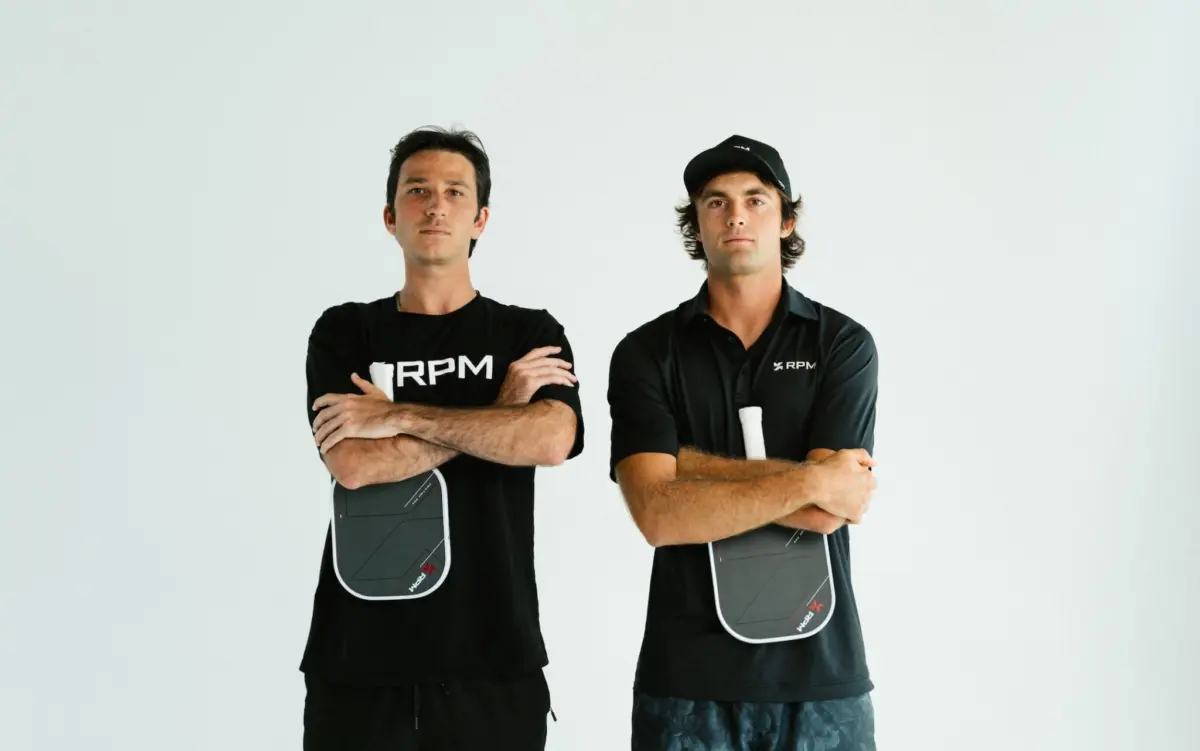
James Ignatowich was still winning matches, but he was profoundly unhappy with the equipment in his hands. As a four-time Professional Pickleball Association (PPA) champion and a former world No. 2 player, Ignatowich spent a significant amount of his downtime calling his longtime friend Marwan Abaza simply to vent about his dissatisfaction. The two friends shared a history that stretched back to a South Florida tennis tournament when they were approximately 12 years old. Over the years, their lives took athletic and academic paths—Abaza went on to play Division 1 tennis and later pursued studies in computational data science—yet their childhood dream of eventually launching a business together remained a persistent topic of conversation.
Eventually, those venting sessions evolved from complaints into a concrete plan. Ignatowich told Abaza that the market’s shortcomings needed to be fixed, prompting the pair to finally take the entrepreneurial plunge. Last September, despite this being the first commercial venture for both founders, they officially launched RPM Pickleball. Crucially, the company was built entirely without outside funding, relying purely on the duo’s vision and bootstrapping efforts. Just one year later, the brand’s financial trajectory has surpassed expectations. RPM Pickleball is currently on pace to pull in $31 million in annual sales, having achieved a milestone of $4.5 million in revenue during the previous month alone. To date, the company has successfully distributed more than 35,000 paddles to customers across 100 countries worldwide.
The extraordinary and rapid ascent of RPM Pickleball boils down to a fundamental discovery: the founders identified a glaring void in a sport that has otherwise experienced explosive, mainstream growth over recent years. Historically, the pickleball market suffered from a lack of differentiation. Beginners and touring professionals were essentially forced to use the exact same equipment, and those paddles were predominantly engineered with the casual beginner in mind.
For Ignatowich and Abaza, this dynamic stood in stark contrast to the sport of tennis, which they both knew intimately from their youth. In tennis, the manufacturing philosophy operates in reverse. Elite racquet makers intentionally design and engineer their products for the absolute best players in the world first. Everyday recreational players then purchase those exact same racquets because of the powerful psychological and functional desire to use what the professionals trust on tour. Recognizing this missing paradigm in their new sport, Ignatowich and Abaza decided to flip the script. "We decided to make a paddle that was made for pros," Ignatowich explains, identifying the precise positioning that would separate their brand from legacy competitors.
Translating that professional-grade vision into physical products required an intensely hands-on approach to manufacturing and product development. Rather than simply outsourcing design work from a distance, the founders spend approximately half of the year physically stationed on factory floors in China. In these facilities, they actively fine-tune foam densities, monitor heating times, and obsess over dozens of other micro-details that casual observers might overlook. Through this rigorous, iterative process, they have successfully developed multiple patent-pending technologies designed to optimize the performance, touch, and power of their equipment.
Abaza affectionately refers to himself and his co-founder as "paddle connoisseurs," noting that their deep competitive backgrounds allow them to provide overseas manufacturers with a level of precise, granular feedback that a traditional, bureaucratic corporation simply cannot replicate.
Yet, this obsessive pursuit of elite quality introduced its own distinct set of operational challenges. The single biggest headache for the young company has simply been keeping up with relentless consumer demand. Because of their commitment to high-end specifications and meticulous production standards, RPM Pickleball found itself grappling with severe inventory shortages, remaining backordered for roughly half of its entire first year in business. "We were always dealing with angry customers that were waiting," Ignatowich admits, reflecting on the growing pains of scaling a bootstrap enterprise amid unprecedented market appetite.
Looking toward the horizon, the founders are already evaluating where the next major commercial opportunities lie within the broader racquet sports and pickleball ecosystem. Drawing comparisons to more established athletic industries, Ignatowich points out that training tools represent a wide-open frontier. While sports like golf boast a massive, highly lucrative market dedicated exclusively to practice aids and specialized training technology, the world of pickleball currently offers virtually nothing of comparable sophistication. Capitalizing on this insight, Ignatowich is already actively exploring the creation of a brand-new venture focused entirely on filling that specific training and development void.










No comments yet. Be the first to join the conversation!