
As federal policy shifts toward stricter community engagement mandates, states across the country are preparing for a major overhaul in how safety-net programs evaluate participants. The Supplemental Nutrition Assistance Program (SNAP)—the primary federal aid initiative designed to combat food insecurity among low-income households—has long incorporated work requirements as a fundamental condition of participation for specific individuals. However, starting January 1, 2027, or even sooner at the discretion of individual state options, a sweeping 44 states will also be required to condition Medicaid eligibility on meeting newly enacted work requirements. This mandate will apply directly to adults enrolled in the Affordable Care Act (ACA) Medicaid expansion group and participants in certain waiver programs.
Federal legislation outlines mandatory exclusions from these upcoming work requirements, most notably for individuals classified as "medically frail." To qualify for this specific medical frailty exemption, a recipient must satisfy a two-pronged test: they must possess a qualifying medical condition and concurrently demonstrate that this condition directly impairs their ability to fulfill the mandated work requirements. The Centers for Medicare & Medicaid Services (CMS) recently released detailed information regarding a potential framework that states can utilize to verify these medical frailty exclusions. Yet, adoption of this specific approach remains entirely optional for states, leaving a thick cloud of uncertainty surrounding the exact administrative processes state agencies will ultimately implement to handle verification.
In light of these pressing administrative uncertainties regarding how state Medicaid programs will verify the medical frailty exemption, valuable lessons can be gleaned by examining how SNAP has historically managed remarkably parallel challenges. Just as Medicaid will soon exempt medically frail individuals, the SNAP program exempts participants who are deemed unable to work due to physical or mental limitations. While approaches to verifying a participant’s ability to work vary widely among state SNAP agencies, these procedures may soon undergo significant transformations. Recent federal reconciliation laws now require states to absorb a portion of SNAP benefit costs if their payment error rates exceed established thresholds. Although the SNAP framework offers instructive insights for Medicaid administrators, fundamental differences in how each program determines general eligibility mean that Medicaid verification protocols will inevitably diverge from SNAP practices in several critical ways.
How Have States Historically Determined Ability to Work for the SNAP Program?
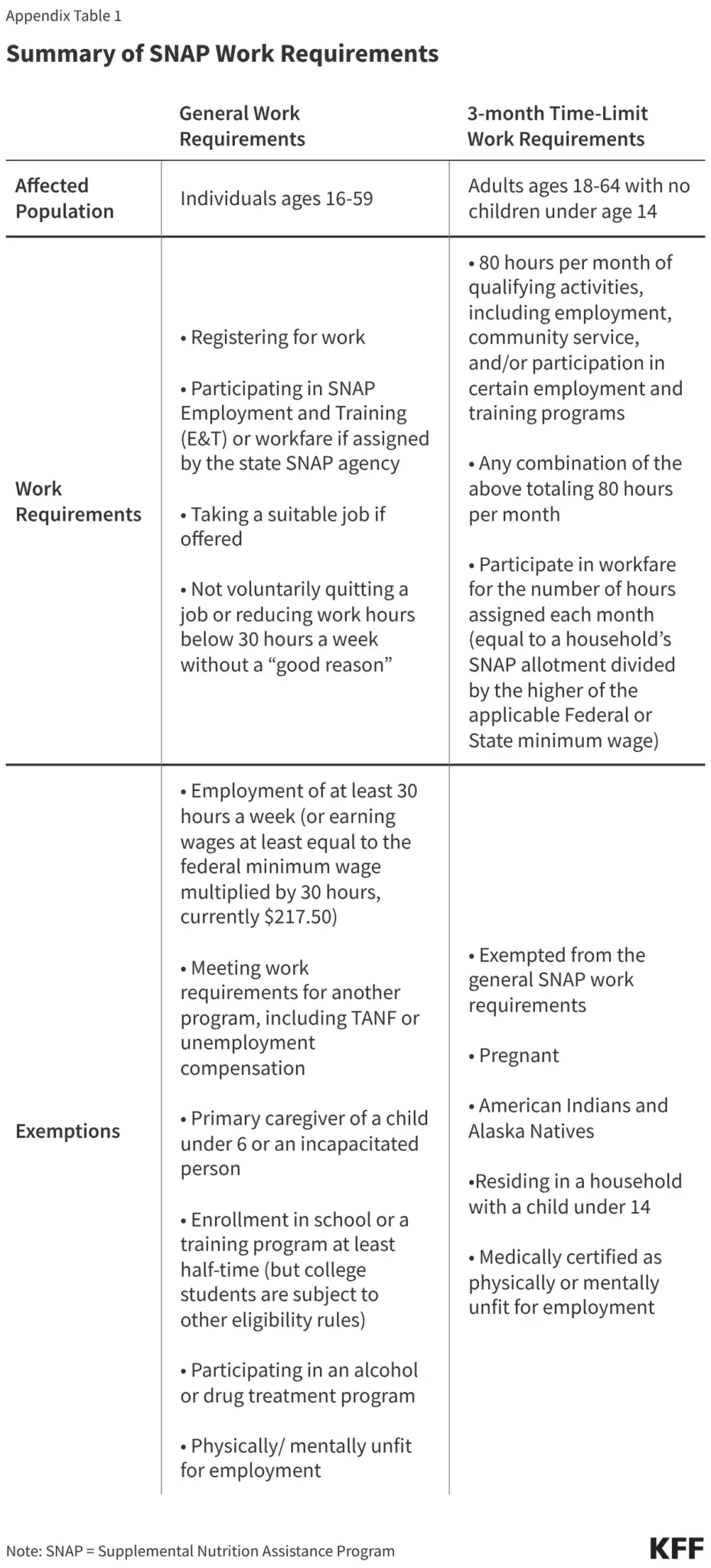
State agencies have long enjoyed substantial flexibility in how they define the statutory exemption for individuals deemed "physically or mentally unfit for employment." Under current federal guidelines, most adults under the age of 65 participating in SNAP must satisfy general work requirements. These baseline rules obligate enrollees to register for employment, accept any suitable job offer, participate actively in SNAP Employment and Training (E&T) or workfare programs if assigned by the state agency, and refrain from voluntarily quitting a job or reducing their weekly work hours below 30 hours without a legally recognized "good reason."
Furthermore, time-limited work requirements apply rigidly to certain able-bodied adults who do not qualify for a statutory exemption. These individuals must work, participate in a work program for at least 80 hours per month, or fulfill designated workfare hours simply to maintain their SNAP benefits for more than three months within a cumulative 36-month period.
Federal regulations purposefully leave it to individual state agencies to define physical and mental fitness and establish localized procedures for verifying the general work requirement exemption. Rules governing time-limited work requirements offer only slightly more specific parameters, clarifying that an individual is exempt if they are medically certified as physically or mentally unfit for work. Because of this broad regulatory discretion, exact definitions vary widely across state lines. Several states maintain notably expansive definitions of physical or mental limitations, choosing to include chronically homeless individuals or survivors of domestic violence when those difficult life circumstances severely impact their physical or mental well-being. Furthermore, states are federally mandated to exempt individuals who receive temporary or permanent disability benefits, including Supplemental Security Income (SSI), Workers’ Compensation, Department of Veterans Affairs benefits, Railroad Retirement, developmental disability services, or private disability insurance, though administrative practices regarding how states document and verify this information vary significantly.
A mandatory component of both the initial SNAP application and the subsequent recertification process is a scheduled phone or in-person interview with an eligibility caseworker who screens enrollees for potential exemptions. As of 2023, the majority of states report screening for physical or mental limitations right at the initial application phase, while others prefer to explore these potential limitations during the mandatory caseworker interview prior to SNAP certification. Over half of state agencies also report granting their frontline staff a significant degree of discretion regarding the types of physical or mental limitations that can be considered for exemptions. For instance, direct visual observations made by eligibility workers during interviews, such as noticing that an applicant relies on an oxygen tank, can serve as a sufficient basis for granting an exemption determination.
When assessing whether an applicant is "obviously unfit" for employment, state practices diverge sharply. Some jurisdictions invariably require formal medical documentation of an individual’s physical or mental limitations, whereas many other states willingly accept simple client statements or only demand third-party verification when an eligibility worker finds the situation unclear or questionable. Evaluations of SNAP work requirement exemption processes indicate that some frontline caseworkers favor mandatory documentation because it reduces personal administrative burden and minimizes personal responsibility in making subjective calls, thereby increasing institutional consistency. However, consistently requiring formal medical documentation inevitably inflates administrative workloads for vulnerable enrollees, already overstretched healthcare providers, and eligibility workers who must meticulously process the paperwork and frequently request additional clarifications. Enrollees are systematically reevaluated for exemption status at recertification intervals every six to twelve months, though evaluations show that information collected during recertification typically mirrors the baseline data gathered during the initial application.
When a participant’s unfitness to work is not immediately obvious to an eligibility worker, states are required to obtain a formal statement from a licensed medical professional to verify exemption status. Nevertheless, internal state procedures for collecting these provider attestations vary dramatically. Some states go so far as to demand specialized provider forms for every single individual seeking an exemption, while others accept a broad range of professional documentation, including standard written statements or even direct phone calls between healthcare providers and eligibility workers. Crucially, healthcare providers are rarely given detailed regulatory guidance on how to assess functional fitness for work, meaning their individual determinations of who qualifies for an exemption inherently vary.
States may also choose to make sweeping changes to their SNAP verification protocols in response to a newly enacted federal mandate requiring most states to absorb a portion of SNAP benefit costs tied directly to their payment error rates. Beginning in October 2027, the reconciliation law mandates that states pay a percentage of total SNAP benefit costs if their payment error rate—a metric primarily measuring administrative overpayments and underpayments rather than intentional fraud—rises above 6%. The state’s financial share scales upward as the error rate increases, up to a statutory cap. Prior to this new fiscal pressure, state SNAP verification procedures reflected a delicate balancing act between maintaining program integrity to avoid fiscal penalties and minimizing administrative hurdles for participants. Facing much larger financial liabilities tied to error rates, states are now rebalancing these priorities. For example, to actively prevent administrative errors and dodge associated fiscal penalties, Arizona recently instituted stricter requirements for additional documentation in areas where the state previously accepted client statements unless explicitly deemed questionable.
How May the Medicaid Process Compare to SNAP?
In sharp contrast to traditional SNAP administrative processes, the upcoming Medicaid framework for verifying individuals who qualify for the medical frailty exclusion will require state agencies to exhaust all available electronic data sources before requesting documentation directly from individuals or healthcare providers. Medicaid programs possess historical claims and encounter data that traditional SNAP operations typically do not leverage.
An interim final rule released by federal authorities instructs states to utilize claims and encounter data spanning the preceding 12 months to attempt automated verification of medical frailty status prior to reaching out to the enrollee. CMS has outlined a tiered medical frailty framework that enables states to identify individuals as medically frail using claims data alone in the first tier, combining claims data with encounter or supplementary data in the second tier, or deploying an individualized manual process requiring additional documentation in the third tier where state data files are absent or insufficient. While this structured tiered approach will successfully automate the verification of many enrollees, data limitations—such as a lack of historical files for new applicants and recent enrollees, or providers inconsistently coding medical conditions using state-recognized codes—mean that states will still require supplemental documentation for a significant portion of the population.
Similar to SNAP operations, states will ultimately rely heavily on healthcare providers to verify individuals’ ability to work and establish Medicaid medical frailty status, particularly in scenarios where electronic claims or administrative data remain unavailable. Because the Medicaid program does not incorporate mandatory face-to-face interviews, eligibility caseworkers will play a far less pronounced role in the initial Medicaid verification process. However, in states where SNAP and Medicaid programs are jointly administered, or where robust data-sharing agreements exist between the two programs, Medicaid agencies may be able to utilize relevant information originally collected through SNAP interviews and verification workflows.
When unable to verify medical frailty status automatically through existing data systems, states will likely need to rely on direct confirmation from treating providers to substantiate qualifying medical conditions and verify an individual’s inability to participate in community engagement activities. Current federal interim rules offer minimal detail regarding the precise information states must collect from providers. Without additional prescriptive guidance, individual states are expected to develop divergent forms and collect varied datasets, mirroring the historical fragmentation observed in SNAP. Some states may choose to streamline operations by utilizing a single unified provider attestation form for both Medicaid and SNAP exemptions; North Carolina, for instance, has already designed a comprehensive provider attestation form capable of establishing eligibility across both benefit programs. Just as in SNAP, relying on medical providers to determine work capacity without standardized clinical assessment guidelines inevitably fosters inconsistency across evaluations.
Starting in January 2028, a state’s legal ability to accept self-attestation within the Medicaid program will become significantly more restricted than long-standing practices permitted under SNAP. While states vary widely in their use of client statements to establish unfitness for work within SNAP, federal rules merely require them to pursue further verification if the initial statement is questionable; federal regulations do not impose a blanket ban on accepting client statements. Conversely, the newly established Medicaid rule strictly curtails reliance on self-attestation beginning in January 2028. The regulation permits states to accept self-attestation throughout the entirety of 2027 only in instances where no reliable electronic data or documentation is accessible. However, as of January 1, 2028, states are prohibited from accepting self-attestation of medical frailty status more than once during an individual’s continuous enrollment period. For subsequent renewals, states must verify medical frailty through available administrative data or require formal documentation from individuals, initiating a considerably more time-consuming verification process. Prior to the publication of the interim final rule, public polling indicated that the vast majority of states had expressed strong interest in utilizing self-attestation as a primary verification method for the medical frailty exclusion.
State-level Medicaid medical frailty verification policies will inevitably diverge, with administrative decisions profoundly influenced by the looming threat of federal financial penalties. Operating under sparse federal guidance, individual states are poised to adopt radically different operational models to implement the medical frailty exemptions. The Medicaid rule explicitly warns that states will be deemed noncompliant if federal audits reveal a pattern of frequently approving individuals as medically frail without sufficient evidentiary support demonstrating that the underlying condition actually impairs their capacity to work. Fearing punitive financial audits, state administrators face a difficult balancing act: they must operationalize the medical frailty exclusion in a manner that safeguards the state budget against fiscal penalties and restrains administrative overhead, all while avoiding wrongful coverage denials for vulnerable individuals who genuinely qualify for the exemption.
Compounding these challenges, states are tasked with implementing these complex Medicaid eligibility and enrollment policy shifts simultaneously as they brace for major structural changes to the Medicaid Payment Error Rate Measurement (PERM) program. These upcoming PERM modifications will heighten the financial consequences of eligibility error rates exceeding 3%. These broader regulatory pressures are expected to heavily influence how state administrators weigh the necessity of mitigating fiscal risk against the escalating administrative burden of mandatory documentation across all Medicaid eligibility determinations.






No comments yet. Be the first to join the conversation!