
The newly filed legal challenge joins two existing lawsuits currently pending against the controversial arch project. Together, these legal battles form a mounting wall of opposition that tests the absolute limits of President Trump’s executive power to dramatically remake the physical landscape and architectural identity of Washington, D.C., during his second term.
Describing the ambitious construction project as “flagrantly unlawful,” the lawsuit points directly to the Commemorative Works Act. That federal statute explicitly mandates explicit Congressional authorization for any memorials or monuments erected on federal land within Washington, D.C., and its surrounding environs. Furthermore, the complaint alleges severe violations of the Administrative Procedure Act, the National Environmental Policy Act, and the National Historic Preservation Act. The plaintiffs argue that the Administration fundamentally failed to adequately assess the comprehensive environmental and visual effects of the project, while also neglecting to conduct the required federal and local consultations before pushing the initiative forward.
“In their rush to break ground on the Arch, Defendants have made only half-hearted gestures at complying with these requirements,” the lawsuit, filed by Virginia Attorney General Jay Jones and D.C. Attorney General Brian L. Schwalb, claims. “Perhaps recognizing that the project is legally indefensible, Defendants have made clear that they will attempt to outrun judicial review.”
The legal resistance reflects deep regional concerns over federal overreach and the preservation of historic public spaces. In a public statement provided to the Washington Post, Virginia Attorney General Jones emphasized the gravity of the legal undertaking.
“The Commonwealth has a solemn duty and a profound interest in preserving the dignity of this sacred place,” Jones said. “We will vigorously litigate to protect its sanctity and honor the legacy of those who made the ultimate sacrifice.”
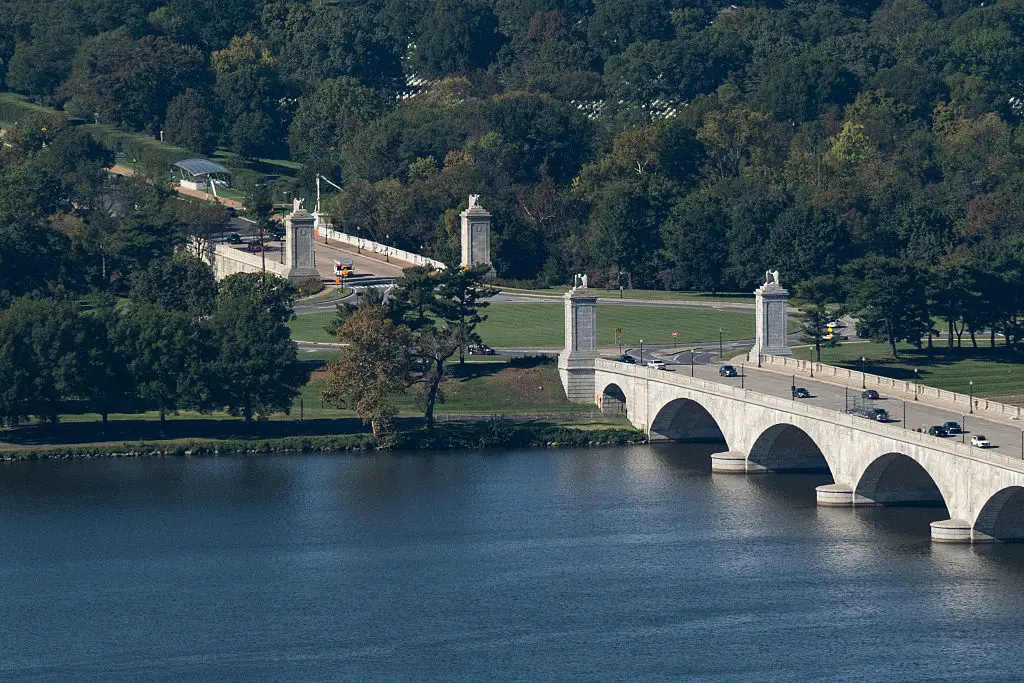
In stark contrast, the federal administration has maintained that the project possesses firm legal footing rooted in historical precedent. In a June 17 court filing submitted for Lemmon v. Trump—a separate, independent lawsuit originally filed by concerned citizens back in February—the Administration argued that Congress had already authorized construction at the designated site back in 1925. According to government attorneys, lawmakers approved foundational plans for the Arlington Memorial Bridge nearly a century ago that explicitly included provisions for two monumental columns, though those specific architectural features were ultimately never constructed at the time.
In the Lemmon litigation, a coalition comprising three Vietnam War veterans and a prominent architectural historian contend that the immense 250-foot arch would severely obstruct and block historically significant reciprocal views stretching between the Lincoln Memorial and the sacred grounds of Arlington National Cemetery. Those plaintiffs have similarly insisted that a project of this scale requires fresh, explicit congressional authorization rather than relying on a century-old, unrealized design concept.
The friction intensified further when the Arlington County Board formally entered the legal fray by filing its own lawsuit on October 8. Arlington County officials argued that the heavy construction operations would severely disrupt vital regional roadways critical for emergency medical and municipal services, while also exerting a significantly detrimental effect on the adjacent Arlington National Cemetery.
Faced with mounting pushback from local governments, historical preservationists, and veterans, the Administration sought to reframe the project through the lens of national security. Trump announced last month that he had personally agreed, following a formal request from the Department of Defense, to incorporate a fully functional military complex directly into the planned triumphal arch structure. This unexpected integration would reportedly house advanced facilities for tactical drones and specialized sniper positions.
This national security justification was reinforced in sworn declarations submitted to the court on October 28 by Defense Secretary Pete Hegseth and Homeland Security Secretary Markwayne Mullin. Both cabinet officials asserted that the arch serves a vital strategic purpose in the modern security landscape of the capital.
“The arch is a generational national defense opportunity to mitigate these evolving threats,” Hegseth wrote in his official court declaration.
The administrative timeline for the project is rapidly converging. The National Capital Planning Commission (NCPC), a federal review panel, is scheduled to convene to consider final approval for the arch’s specific site selection and detailed building plans. The commission includes several members appointed by President Trump, and its chairman has publicly indicated his intention to support the project, according to reporting by the Washington Post.
Simultaneously, the Department of the Interior must formally issue its final authorization and publish the necessary public notices. The Administration has informed the presiding court that these final administrative steps could be completed simultaneously on November 5, immediately clearing the path for heavy construction equipment to break ground that very same day. On Friday, the Department of Justice explicitly affirmed to the court that construction operations could commence immediately upon the completion of those administrative milestones.
However, U.S. District Judge Tanya Chutkan has expressed deep skepticism regarding the Administration’s hurried timeline during court proceedings.
“What’s the harm to the government to wait 3 or 4 months? What’s the rush to put this arch up?” Judge Chutkan asked during a Friday hearing for the Lemmon v. Trump case.
Observing that the underlying legal questions are exceptionally complex, Chutkan indicated that she would carefully evaluate the plaintiffs’ legal standing over the weekend and issue a swift, expeditious ruling. Representatives for TIME reached out to the White House for official comment regarding the newly filed joint lawsuit by Washington, D.C., and Virginia.
What Could These Lawsuits Mean for Trump’s Other Renovation Projects?
The proposed triumphal arch stands as only one component of a broader, highly ambitious series of architectural and infrastructural projects introduced by President Trump during his second term. These initiatives are explicitly aimed at reshaping the physical and symbolic identity of Washington, D.C., in his vision. Other prominent efforts include the controversial demolition of the White House East Wing to construct a massive new presidential ballroom, the planned 15-month closure and extensive overhaul of the historic East Potomac golf course, and sweeping federal plans to restore and rename the iconic Kennedy Center.
During Friday’s court hearing, Deputy Assistant Attorney General Robert Stander pointed to a notable precedent from the Supreme Court. He cited the high court’s 5-4 decision rendered in August, which permitted the controversial White House ballroom construction to push forward while underlying litigation continued to wind its way through the lower courts. In that ruling, the conservative majority reasoned that the petitioning preservation groups had failed to adequately demonstrate the immediate, concrete harm legally required to sustain a preliminary injunction.
“It’s the same thing,” Stander argued before Judge Chutkan, suggesting the legal dynamics surrounding the arch mirror those of the ballroom dispute.
Judge Chutkan, however, pushed back against the comparison, noting that the ongoing legal battles possess distinct characteristics and involve different legal arguments.
“The ballroom case differs in significant respects,” Chutkan noted, specifically highlighting the localized traffic congestion and public safety hazards uniquely raised by municipal plaintiffs in the arch litigation.
Furthermore, Judge Chutkan voiced direct skepticism regarding the Administration’s sudden reliance on a national security rationale to defend the arch. She pointed out that when President Trump originally announced the monumental project, its stated purpose was explicitly framed around celebrating the United States’ upcoming 250th semiquincentennial anniversary.
“This is the first time the government has proffered a national security aspect to this case,” the judge observed.
The fierce dispute over the triumphal arch contributes to an increasingly contentious national debate regarding the executive branch’s frequent invocation of national security powers to bypass traditional regulatory hurdles and justify sweeping domestic policy decisions.
Parallel legal challenges targeting other capital renovation projects, such as the ongoing litigation surrounding the East Potomac golf course, have raised similar foundational questions regarding the strict limits of executive authority. In those cases, plaintiffs have consistently argued that existing federal law explicitly requires express congressional authorization before any permanent structures can be erected on federal public grounds within the District of Columbia.
For now, the immediate focus remains fixed on the federal judiciary, where a ruling is expected imminently to determine whether the courts will step in to halt the project before heavy construction machinery can move onto the site in the coming days.







No comments yet. Be the first to join the conversation!