
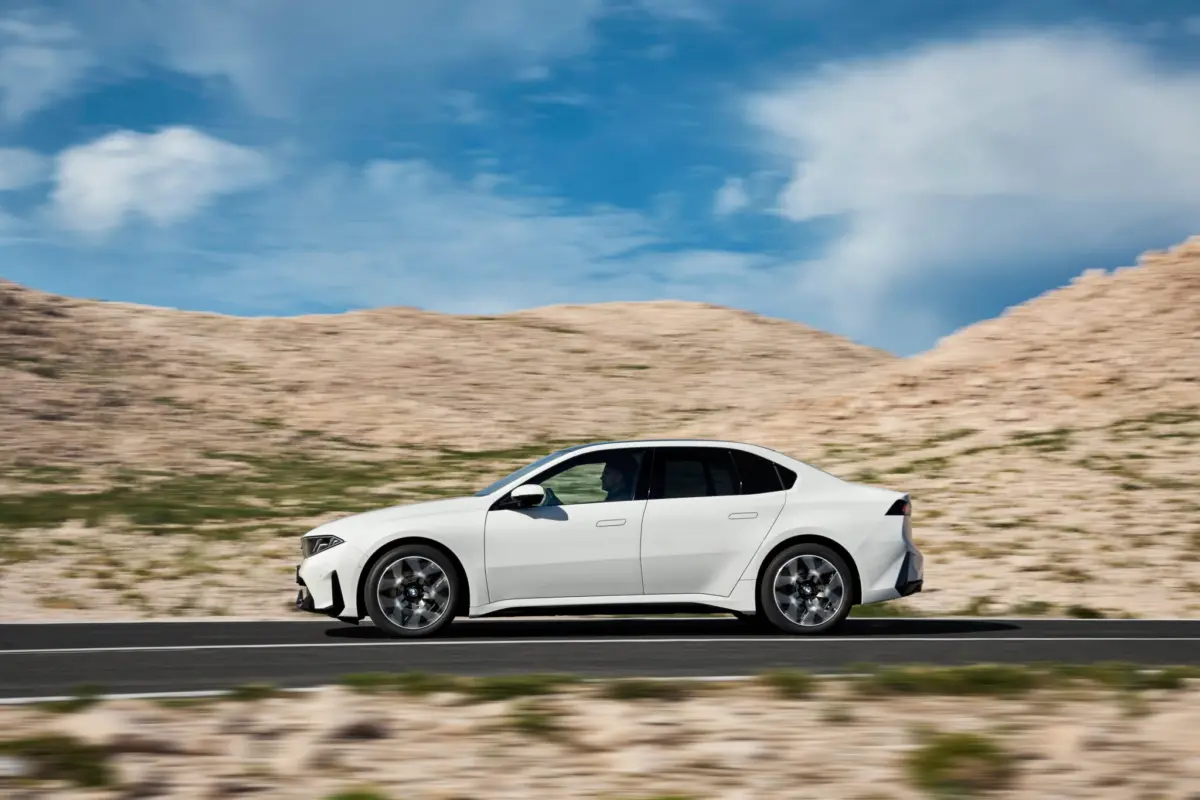
When automakers build electric vehicles using platforms shared with internal-combustion engines, compromises are almost always part of the equation. BMW experienced this firsthand with models like the i4 and its gas-powered 430i counterpart. To package a battery-electric powertrain within the 430i’s existing body architecture, BMW had to limit the overall battery size while relying on air springs to manage the significant weight gains inherent to electrification. Recognizing these concessions, BMW chose a radically different path for its next-generation electric 3-series, ensuring that the new i3 stands apart from its gasoline stablemates rather than merely mimicking them.
The Munich-built BMW i3 50 xDrive sedan shares almost nothing structurally with the new Dingolfing-made M350 and 330 gasoline models. Aside from the front grille, mirror housings, and potentially the door handles, nearly every sheet-metal stamping and internal framework component is unique. This bespoke approach is immediately evident in the vehicle’s footprint, highlighted by a 1.5-inch stretch in the wheelbase, alongside incremental increases in overall height and width. Total length differs by only a fraction of an inch, yet the visual and spatial dynamics tell a completely different story.
Without the packaging constraints of fitting a bulky inline-six engine under the hood, designers were able to push the i3’s cabin further forward and introduce a more steeply raked windshield. While BMW’s unified Neue Klasse design language effectively masks these structural differences at a glance, keen-eyed observers may still spot the slightly steeper hood contour and the shorter gap between the front wheels and the leading edge of the front doors.
Adjusting the wheelbase and vehicle height was an engineering necessity to accommodate the specific electric drivetrain layout BMW envisioned. The result is an EV package that outshines the older i4 concept entirely. Propulsion is handled by a current-excited synchronous rear motor generating 322 horsepower and 321 pound-feet of torque—the same style of electric motor found in the i4. However, the i3’s front axle features a redesigned 165-horsepower, 188-pound-foot induction motor. This strategic alteration delivers superior efficiency by minimizing mechanical drag when the front motor is disengaged, paying efficiency dividends even at sustained highway speeds.
Accounting for traditional EV powertrain output calculations, the i3 50 xDrive delivers a robust combined output of 463 horsepower and 476 pound-feet of torque. This substantial power reserve launches the electric sedan from zero to 60 mph in an estimated 4.2 seconds, putting it squarely in performance territory while maintaining everyday usability.

Unlike the limitations faced by the i4, the i3’s energy storage system is entirely uncompromised. The massive liquid-cooled lithium-ion battery pack boasts an impressive 112 kWh capacity, dwarfing the i4’s 84-kWh unit. Although official EPA ratings are still pending, testing estimates point toward a remarkable 450 miles of driving range. This projection slightly exceeds BMW’s internal targets, mirroring the real-world overachieving nature seen in the related electric iX3 SUV, which shares its core powertrain architecture with the sedan.
Charging capabilities match the battery’s enormous capacity. Thanks to an advanced 800-volt electrical architecture, the i3 can accept peak DC fast-charging rates of up to 400 kilowatts, provided drivers can locate infrastructure capable of supporting such speeds. A North American Charging Standard (NACS) port comes standard from the factory, accompanied by an included adapter for SAE Combo charging stations.
Out on the road, the i3 demonstrates remarkable chassis tuning, even without opting for the available M adaptive dampers. The vehicle exhibits a taut, controlled ride quality that avoids harshness. Because the heavy battery pack is mounted low in the chassis, the car feels exceptionally planted through corners. Engineers incorporated just enough roll stiffness to keep body lean disciplined without introducing abrupt impacts or head toss that could disrupt passenger comfort during spirited driving.
Much of this dynamic composure stems from BMW’s advanced "Heart of Joy" computing system. This centralized computer coordinates steering parameters, friction braking, regenerative braking, and throttle inputs in a fraction of the time required by previous software architectures. Brake-based rear differential simulation—a feature that can sometimes feel artificial in other applications—operates with silk-smooth precision, mimicking an electronically controlled mechanical limited-slip differential. Brake pedal response is notably crisp, and the robust regenerative braking capacity handles the vast majority of routine deceleration smoothly via magnetic resistance.
If there is one area where the i3 leaves room for further refinement, it is steering feel. While the helm is direct and accurate, it lacks some of the rich road feedback and tactile connection found in the gas-powered M350 model. This differentiation may very well be intentional on BMW’s part, leaving space for the upcoming, performance-focused i3 M60 variant to deliver a sharper edge.

Inside the cabin, the i3 avoids the divisive steering wheel designs featuring unconventional vertical spokes, especially when equipped with the optional M Sport steering wheel that relocates controls to more traditional positions. BMW’s innovative Panoramic Vision head-up display system functions exceptionally well in the i3, projecting a dash-spanning information strip across the base of the windshield. Because the hood sits slightly taller yet features a steeper rake, this display remains clearly visible above the steering wheel rim without obstructing the driver’s forward view of the road.
The central infotainment interface utilizes the same expansive 17.9-inch touchscreen found in the M350, sharing its strengths and minor ergonomic quirks. While the display is visually striking and naturally angled toward the driver, certain climate functions—such as vent adjustments—would benefit from traditional manual controls or physical buttons rather than touchscreen menu navigation. Opting out of the traditional secondary head-up display is easy to justify, given how much driving data is already integrated cleanly into the base of the windshield via the Panoramic Vision strip.
Overhead, a soaring panoramic glass roof floods the cabin with natural light while preserving generous headroom for occupants. Rear-seat accommodations offer slightly more space than the M350 gas sedan, though foot space underneath the front seats can feel restricted if front passengers lower their seats all the way to the floor. While official U.S. trunk volume figures are pending, preliminary data from Germany places the cargo hold at 15 cubic feet, lagging behind the M350 gasser by a mere single cubic foot.
The BMW i3 50 xDrive is scheduled to arrive in showrooms during the first quarter of 2027, launching alongside the traditional gas-powered 3-series lineup. With a starting base price of $62,850 for the 50 xDrive model, the electric sedan presents a compelling value proposition relative to its feature set. By combining long-distance range, rapid charging speeds, and traditional BMW driving dynamics, the new i3 possesses the mechanical depth and character necessary to attract a new generation of buyers to the electric vehicle segment.










No comments yet. Be the first to join the conversation!