
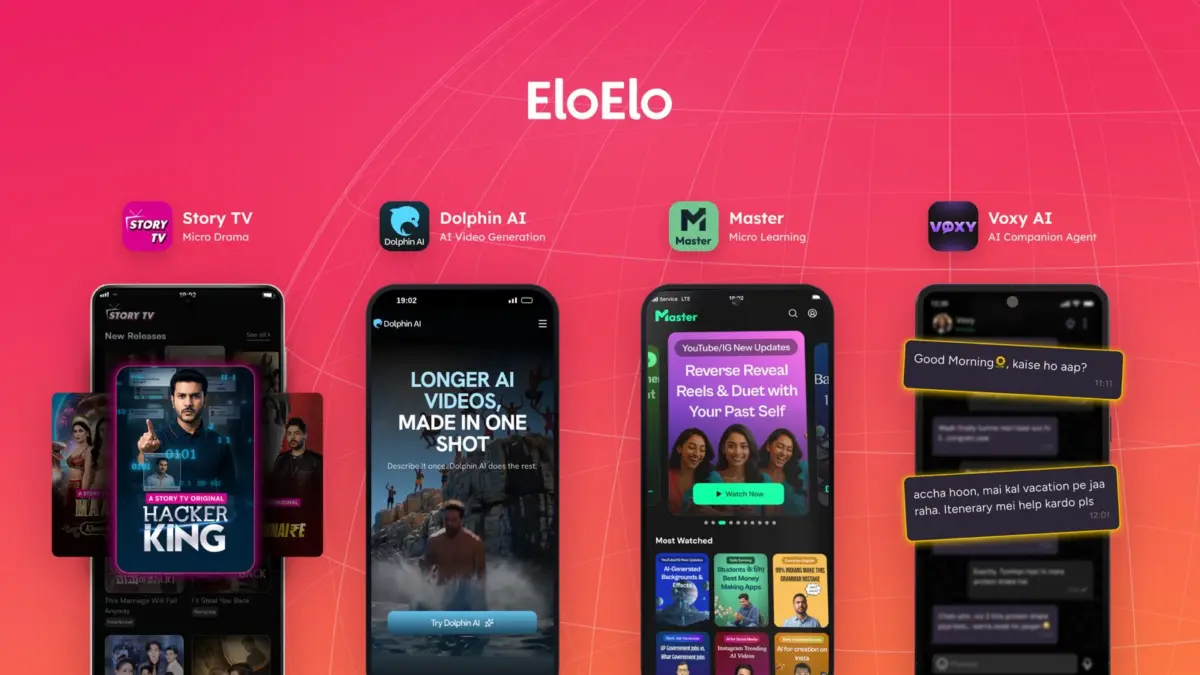
The microdrama phenomenon is officially reshaping India’s digital entertainment landscape. More than 118 million users now watch serialized, bite-sized video formats every single month, signaling a massive cultural shift in how the country consumes media. At the forefront of this explosive growth is Story TV, a flagship app operated by EloElo, which has rapidly emerged as one of the dominant players in the sector. According to recent market analysis from firms like Sensor Tower, the platform boasts over 33 million active users, capturing the attention of venture capitalists and major media conglomerates alike.
Capitalizing on this immense scale and the broader shift toward verticalized video consumption, EloElo has successfully raised $80 million in a Series C funding round. The investment was co-led by Hornbill Capital and entertainment giant NBCUniversal, with additional participation from MIT Investment Co. and existing backers including Play Ventures, Kalaari Capital, Waterbridge Ventures, and Griffin Gaming Partners. This latest injection of capital brings EloElo’s total fundraising to an impressive $130 million, propelling the company to a valuation of $500 million.
The rise of serialized microdramas is not confined to India. As mobile users worldwide spend increasingly large portions of their day on platforms hosting verticalized videos, short-form narrative content has surged in popularity across multiple geographies, including the United States and China. The format has drawn global star power, with high-profile Hollywood celebrities such as Issa Rae, James Franco, and Kim Kardashian actively investing in, producing, and starring in microdrama projects.
In India, however, the market opportunity is particularly pronounced. Driven by an expansive internet population exceeding one billion people and a historically deep-seated national appetite for entertainment, the country’s microdrama sector is on a steep upward trajectory. Industry analysts estimate that the ecosystem is well on its way to crossing $3 to $4 billion in annual revenue by 2030. Reflecting this consumer appetite, dedicated vertical streaming apps—including Story TV, Kuku TV, and Quick TV—ranked among the most heavily downloaded video streaming applications across India over the past year.
Founded in 2020 by former Flipkart executive Saurabh Pandey, Story TV has scaled rapidly, building a robust catalog of more than 5,000 titles spanning six languages. Speaking with tech publications about the app’s reception, Pandey noted that the snackable nature of the content drives remarkable user engagement, with audiences logging an average of 95 minutes per day on the app across multiple sessions.
"I fundamentally believe that the next billion users will probably not grow up on a diet of watching television; they will grow up on a diet of watching content on their phones, right? And this content has to be, and this entertainment, designed very differently," Pandey explained. "It’s not going to be appointment viewing. It’s going to be within certain slots throughout the day. And a lot of this was earlier solved for short clips, but serialized storytelling was never solved."
While Pandey acknowledges that there will always remain a dedicated space for traditional big-screen viewing shared with family and friends, he firmly maintains that the vast majority of future entertainment consumption will take place on mobile devices.
Despite the explosive growth, platforms in the microdrama space operate in a hyper-competitive environment. They must continually vie for attention against massive incumbent ecosystems like YouTube, Instagram, and TikTok, where creators post free content, and where major tech platforms are increasingly experimenting with episodic vertical reels. To stand out from user-generated platforms, Pandey emphasizes the critical importance of high production quality. EloElo has focused heavily on strategic industry partnerships to bolster its content pipeline, such as a high-profile collaboration with veteran Indian TV production company Balaji Telefilms to co-produce original micro-dramas.

Story TV employs a tiered subscription model offering monthly, quarterly, and yearly plans to unlock premium episodes, alongside a selection of ad-supported free content. However, industry reports indicate that advertising-supported video on demand (AVOD) models in the microdrama sector are significantly less lucrative than direct consumer subscriptions.
Monetization remains a persistent hurdle within the Indian digital economy. While consumers readily flock to free content, converting those users into paying subscribers is a challenge. Data from analyst firm Redseer indicates that while more than 40 million people in India have paid for a microdrama at least once, only 15 million to 17 million maintain monthly subscriptions. Furthermore, a separate survey conducted by Ormax Media suggested that up to 72% of consumers have never spent money on microdrama content.
AI and Other Bets
To feed the voracious consumer demand for fresh narratives, microdrama platforms are increasingly turning to artificial intelligence to streamline production workflows and scale content creation. While competitors like Google-backed Kuku utilize AI to optimize operational efficiency, and others like Dashverse’s Shortfree experiment with generative video models to produce serialized clips, EloElo has taken a distinct approach with its proprietary Dolphin AI platform.
Initially developed as an internal tool to enhance video creation, EloElo is now preparing to make Dolphin AI widely available to external creators and marketers. The software functions as an advanced editor equipped with templates and multi-modal capabilities capable of generating images, audio, and video content. The company envisions the tool being utilized not only for entertainment production but also for commercial marketing campaigns and digital advertisements.
While several Indian platforms have rolled out AI assistants to accelerate their creator pipelines, Pandey stresses that human creativity remains irreplaceable. He views artificial intelligence not as a replacement for human storytelling, but as a high-speed vehicle that requires expert navigation.
"My belief in involving AI is that AI is a really fast race car where AI is the engine, but you need an extremely capable Formula One driver to be on the steering wheel," Pandey said. "That, for me, is the creative director or the showrunner. AI is supposed to work with them, augmenting their skill set. AI can help write stories, but so far the best stories I have loved have all had a very high human x AI element to it."
Beyond its flagship microdrama app, EloElo operates a diversified portfolio of mobile products. These include Master, a vertical video learning application that competes with platforms like Seekho and Kuku’s Guru, as well as an AI companion app named Voxy AI. Combined, the company’s ecosystem serves more than 40 million monthly active users, with the vast majority concentrated on Story TV.
Headquartered with a team of 240 employees, EloElo plans to utilize its fresh capital infusion to aggressively expand its artificial intelligence and machine learning research divisions. A substantial portion of the newly raised funds will also be directly funneled into producing a wider array of original titles to cement the company’s competitive edge in India’s fast-evolving entertainment market.







No comments yet. Be the first to join the conversation!