
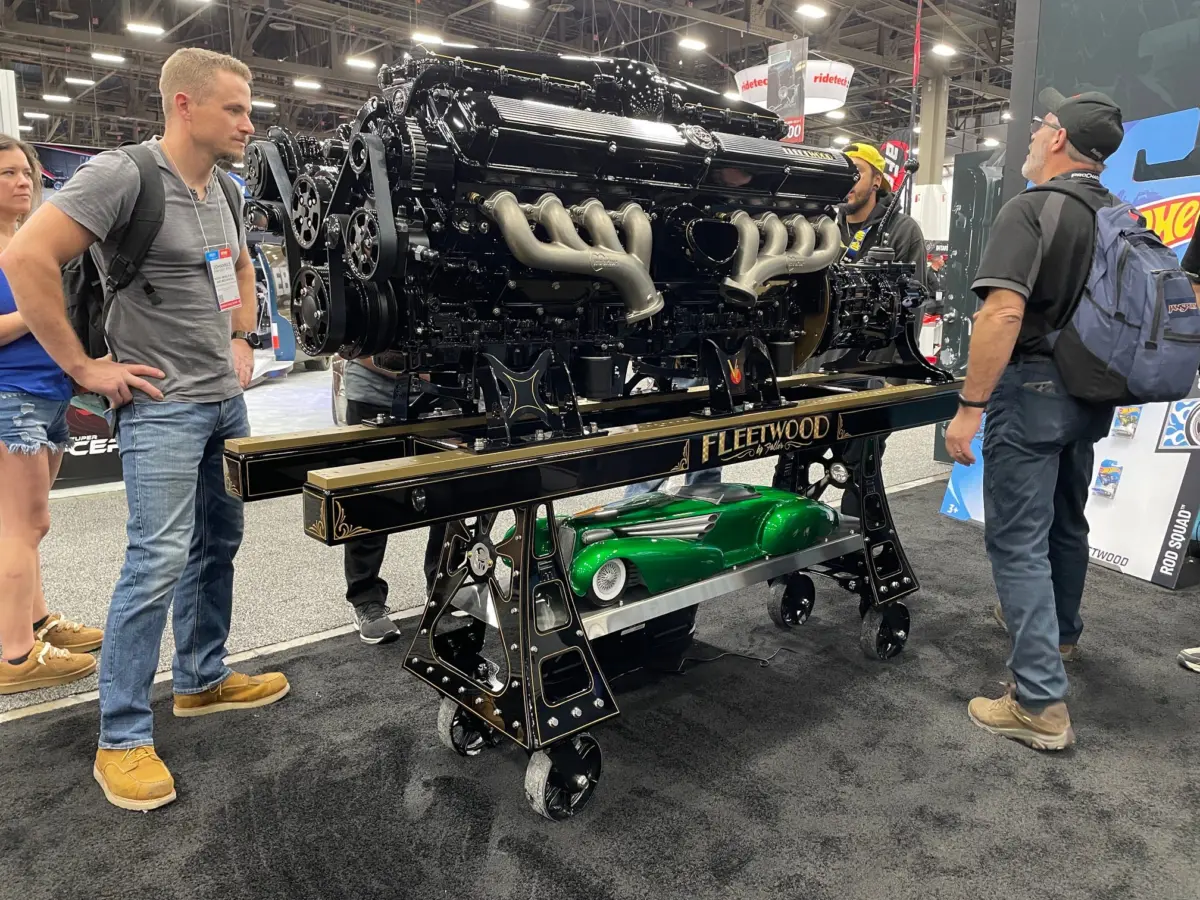
“If you have two V-8s that are exactly in the same timing, your pistons aren’t firing properly; it can rip itself apart—not good.”
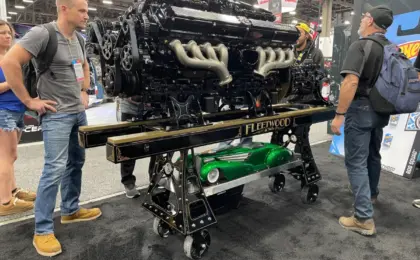
That concise warning from builder Bryan Fuller cuts straight to the heart of one of the most formidable challenges in modern custom automotive fabrication: physically joining a pair of GM LS3 V-8 engines to create a massive, 854-cubic-inch V-16 monster. Rated to produce in the neighborhood of 1,200 horsepower, this extraordinary powertrain is not merely a bench-built exercise in excess. It is the beating heart of an ambitious, ultra-exclusive one-off custom roadster commissioned by an unnamed, well-heeled client with direct input from Hot Wheels designers.
The design of the imposing 19.5-foot-long custom roadster draws deep inspiration from automotive history, echoing the stately grandeur of the 1938 Cadillac V-16 Series-90. Yet, true devotees of vintage coachbuilding heritage will quickly recognize the spiritual lineage of the 1937 Cadillac V-16 Hartmann Cabriolet—an ultra-rare run of just two vehicles originally crafted in Switzerland for an elite clientele. Recreating that level of pre-war presence in the 21st century required far more than a striking silhouette; it demanded a completely bespoke mechanical foundation capable of delivering effortless, multi-cylinder power.

Before a single wheel could turn, Fuller and his team had to confront a daunting matrix of engineering hurdles, including precise ignition timing, sophisticated cooling, optimized fuel delivery, custom air induction, structural unity, and harmonized power output. Getting sixteen individual cylinders to fire in a complementary, non-destructive sequence is a monumental feat of mechanical engineering that separates whimsical garage builds from world-class fabrication.
The solution to the ignition timing riddle required staggering the rear engine back by roughly 45 degrees. This clever geometric adjustment allows the tandem V-8 powerplants to cycle through their strokes in the proper, balanced firing order of a true V-16. Remarkably, a single starter is engineered to spin both engines simultaneously.
Mating the torque output of two high-performance V-8s presented another significant mechanical hurdle. The team achieved this by employing a giubo joint—commonly known as a flex disc. This specialized flex joint consists of a durable rubber or urethane center flanked by robust metal mounting plates on either side, effectively linking the rear of the front engine to the front of the rear engine while absorbing minor operational vibrations and misalignments. Meanwhile, the structural connection between the two V-8 blocks is firmly secured by a trio of CNC-machined plates: one positioned squarely in the center valley, and one bolted to each of the lower left and right sides.

Despite its exotic configuration, ignition is handled through a relatively traditional approach utilizing two separate engine control computers and individual spark plug wires. As Fuller noted, the GM LS3 is a widely understood and heavily supported platform; years of aftermarket development and tuning experience with the standard LS3 V-8 made this aspect of the monumental build significantly more manageable.
Cooling, however, required an integrated approach as the only major system shared directly between the two blocks. A high-capacity Meziere water pump generates the substantial fluid pressure required to force coolant through both engine blocks concurrently. The fluid then exits through a custom dual-outlet manifold before routing into a single, oversized radiator to shed heat. Air induction is managed via a heavily modified Holley intake manifold, a system that will undergo further refinement as the powertrain transitions from the display stand into the final body structure.
Downstream of the massive engine block, the drivetrain relies on a heavy-duty Tremec T-56 Magnum transmission. This gearbox was meticulously optimized by Bowler Performance Transmissions, a process that included polishing the internal components alongside a series of custom modifications to handle the immense torque output. True to the standards of high-end professional fabrication, premium ARP hardware is utilized extensively throughout the assembly. Even the custom powertrain display table supporting the engine was built from scratch to showcase the mechanical assembly.

At this stage, the completed V-16 engine rests patiently while the Roadster Shop finalizes the custom chassis framework. Once that foundational work is complete, the team will begin the intricate process of merging the chassis, body, and powertrain to create a fully operational, rolling work of art.
Just how long that complex integration process will take remains to be seen. In the meantime, the monstrous V-16 engine serves as an arresting conversation piece, commanding attention as it sits proudly on its custom display stand, hinting at the extraordinary machine yet to hit the road.






No comments yet. Be the first to join the conversation!