

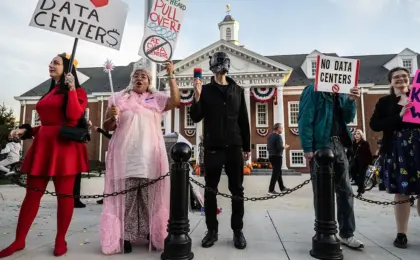
As concerns regarding mass surveillance and data privacy continue to intensify across the United States, at least 10 local governments and police departments have moved since this summer to curb, restrict, or entirely end their use of Flock Safety technology. This mounting backlash is part of a broader, increasingly visible wave of public resistance against the rapid deployment of advanced artificial intelligence technologies, which also encompasses public friction over data center construction booms, facial recognition systems, and other automated monitoring tools.
Founded in 2017, Flock Safety specializes in selling surveillance software and hardware infrastructure. Its product ecosystem includes automated license plate readers (ALPRs), aerial drones, and microphone-based edge-computing acoustic devices designed to detect gunshots and other sharp sounds. Supporters argue that these tools provide vital assistance in solving crimes, such as locating missing persons or recovering stolen vehicles. Today, more than 100,000 Flock cameras are deployed in communities nationwide.
However, over the past three months, a wave of municipalities has voted to sever ties with the company. Jurisdictions including Monroe, Ohio; Newburgh, New York; Richmond, Virginia; Hopkinton, Massachusetts; New Bedford, Massachusetts; and Lansing, Michigan, have all initiated moves to terminate their existing contracts with Flock. Concurrently, police departments in East Bridgewater and Grafton, Massachusetts, have announced plans to halt their reliance on the cameras. In Texas, residents of League City recently voted down their police department’s continued use of Flock’s license plate readers during a local election, prompting preparations for the physical removal of the devices.
The objections raised by communities are multifaceted, ranging from broad civil liberties and privacy worries to complex questions regarding how data is managed, stored, and shared with outside entities, as well as procedural concerns about how the technology is initially procured.
In Asheville, North Carolina, the police department lost access to the surveillance network after the city council voted to terminate its contract in August. Similarly, the El Paso County Sheriff’s Office in Colorado announced in September that it would discontinue its use of Flock cameras. Asked for comment by reporters, the El Paso County Sheriff’s Office pointed to a public statement issued by Sheriff Joseph Roybal, who asserted that stepping away from the technology was the correct path forward for the county.
"We have the tools, training, and experience to locate and apprehend criminals without relying on Flock cameras," Sheriff Roybal stated in the release.
Tatiana Rice, a senior director for U.S. legislation at The Future of Privacy Forum, noted that the swift and widespread resistance to Flock is hardly surprising and serves as an indicator of growing public skepticism toward emerging technologies. Rice pointed out that Flock becomes a natural lightning rod for public frustration because its sensors and cameras are physically visible to drivers along everyday roadways, drawing a direct parallel to how massive data centers have become physical touchstones for community resentment against the tech industry writ large.
"A camera at the end of your street is tangible in a way that everyday sharing and selling of personal data online is not," Rice explained.
At the state level, policymakers have also begun drawing lines. This summer, Florida barred license plate readers from operating along state highway roads, while Texas temporarily paused state funding designated for Flock-related initiatives. These legislative actions have similarly underscored mounting anxieties over data privacy lapses and documented instances of technological misuse.
Such misuse has proven to be a tangible liability for the company and client agencies alike. In August, a police officer in Brentwood, Missouri, faced accusations of utilizing Flock’s license plate readers to stalk his ex-wife amid ongoing divorce proceedings. A month later, an East Texas police officer was sentenced to a multi-year prison term after being convicted of using Flock database records to track and monitor his ex-girlfriend and her family members.
Another escalating source of public controversy involves how federal immigration enforcement and investigative agencies have gained access to local surveillance feeds. A prominent example unfolded in March when Ithaca, New York, passed a formal resolution to terminate its municipal contract with the Flock Group.
In its legislative resolution, the city cited proven instances of Flock Safety infrastructure being leveraged by federal personnel for intelligence purposes without explicit authorization from local contracting authorities. The city’s review indicated that, whether intentionally or through corporate negligence, Flock had permitted U.S. Immigration and Customs Enforcement (ICE) and the Bureau of Alcohol, Tobacco, Firearms and Explosives (ATF) to utilize query results from state and local ALPR databases to investigate and target immigrants across the country.
In response to these criticisms, Flock issued a formal defense of its operations. "Every day, police departments across the country are using Flock technology to solve serious crimes, locate suspects, find missing people, and make a measurable impact on public safety," the company stated. "While we respect every community’s decision, removing a tool that is actively helping solve violent crimes and protect communities moves public safety backward. Every Flock customer owns its data and controls who it is shared with and how it can be used. Flock does not sell data and does not have a contract with ICE."
To address these concerns, Flock announced in August that it would shorten the default storage window for data collected by new customers from 30 days down to seven days. Furthermore, the company instituted a policy requiring agencies to input a specific case code into the system before they are permitted to execute searches within the database.
The mounting public friction surrounding automated license plate readers mirrors the ongoing political battles over data center expansion across the country. Adam Schwartz, a senior staff attorney at the Electronic Frontier Foundation—a digital rights advocacy nonprofit that has closely monitored Flock’s operations—noted that many municipalities adopted the technology several years ago under the radar, leaving residents largely unaware that surveillance apparatuses were being installed in their neighborhoods.
Schwartz compared this lack of public visibility to the way large data centers frequently materialize in communities before local residents fully grasp the scope of the projects. He explained that municipal police departments often independently elect to deploy Flock cameras with minimal oversight or debate from elected city councils. For instance, in South Windsor, Connecticut, local reporting revealed that a network of Flock cameras went live last year without prior public warning or a formal municipal vote. By October, the town reversed course, voting decisively to deactivate and remove the equipment.
"Grassroots activists across the country have been demanding that city councils exercise their procurement power to refuse to pay for ALPRs," Schwartz said, emphasizing the authority of local councils to dictate municipal acquisitions. He noted that activists have spent years fighting these installations and that "many city councils are listening."
Despite the wave of cancellations, the primary argument advanced in favor of technologies like Flock remains anchored in crime reduction and neighborhood safety. Consequently, many local governments are opting against total bans, choosing instead to implement strict regulatory guardrails, narrow the scope of use, or evaluate alternative vendors.
In Cleveland, Ohio, for example, city leaders voted this summer to extend their contractual relationship with Flock while simultaneously enacting stringent restrictions on immigration-related database searches. Cleveland also restricted direct access to the intelligence database exclusively to the city’s internal police department, severing feed access previously granted to the Northeast Ohio Regional Fusion Center, a regional intelligence entity that had initially been looped into the network.
"They are used and needed for investigative purposes," city officials remarked when asked about the decision. They added that the Department of Public Safety is actively reviewing responses to a recent request for proposals (RFP) submitted by alternative vendors offering comparable ALPR technology.
As communities demand a greater voice in navigating these technological trade-offs, the broader national conversation shows no signs of cooling. Tatiana Rice observed that while these security tools offer legitimate public safety capabilities, communities are increasingly determined to ensure those benefits do not come at the expense of fundamental civil liberties. The future of municipal surveillance technology is projected to remain a high-stakes political flashpoint, particularly as federal lawmakers engage in legislative battles in Washington.
In September, President Donald Trump expressed verbal support for Flock’s technology, stating that he favored it "because of law enforcement," even as a Reuters public opinion poll published that same month revealed that a larger share of Americans viewed the technology unfavorably rather than favorably.
On Capitol Hill, legislative efforts to regulate the industry have gained bipartisan momentum. In September, Representative Thomas Massie, a Republican from Kentucky, introduced a bill known as the Flock-Off Act, designed to block the distribution of federal funds for purchasing "Flock-style surveillance" systems while mandating nationwide safeguards. Shortly after, in October, Senator Bernie Sanders, Representative Alexandria Ocasio-Cortez, and Senator Jeff Merkley jointly unveiled the Ban Flock Act, a legislative package aimed at halting the proliferation of AI-driven public surveillance cameras across the United States.









No comments yet. Be the first to join the conversation!