

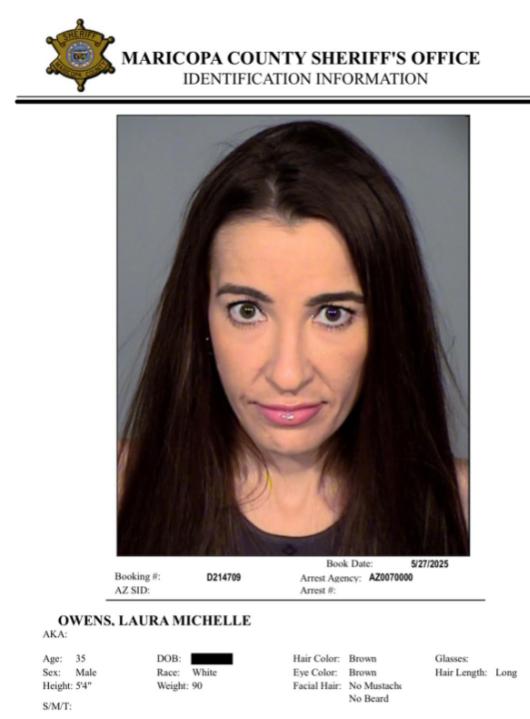
In a case that has drawn intense national attention and highlighted a rare form of criminal prosecution, Scottsdale, Arizona podcaster Laura Owens has been sentenced to 30 days in jail and seven years of probation following her guilty plea to felony charges stemming from an elaborate pregnancy fraud scheme.
The sentencing, which took place in October in Maricopa County Superior Court, concludes a legal battle that involved multiple victims, forged medical documents, and a connection to reality television. Owens pleaded guilty in August to felony counts that included fraudulent schemes and artifices, perjury, and identity theft.
The criminal proceedings brought to light a bizarre sequence of events in which Owens attempted to manipulate several men, most notably Clayton Echard, who starred in Season 26 of ABC’s hit reality television series The Bachelor. According to court records and statements from investigators, Owens went to extraordinary lengths to convince her targets that she was carrying their children, utilizing everything from altered medical imaging to self-administered hormones.
During her sentencing hearing, Owens addressed the court and expressed remorse for her actions. She stated that she was “profoundly, profoundly sorry for the pain, distress and expense” that she had caused her victims, a group that extended beyond Echard to include other men targeted by her complex web of deception.
The investigation into Owens began after she filed legal paperwork for paternity and child support against Echard. The two had engaged in a single brief intimate encounter on May 20, 2023. According to Gregg Woodnick, a Phoenix-based attorney representing Echard, that encounter did not even involve sexual intercourse. Despite this, Owens claimed she was pregnant with twins fathered by the former reality star, initiating legal maneuvers that eventually prompted the presiding family court judge to refer the matter to prosecutors for a criminal fraud investigation.
Investigators soon uncovered the depth of the deception. Owens was accused of stealing an ultrasound photo from an online source and digitally altering it to make it appear as though she was carrying children. Beyond the digital manipulation, authorities found that she had injected herself with hormones in an attempt to trigger false positive results on home pregnancy tests. She even went so far as to record and distribute video content designed to visually fake the progression of a pregnancy.
The case has also thrust Owens further into the media spotlight. She was previously the subject of a 2026 podcast titled Love Trapped, and her story is set to reach an even wider audience through a forthcoming four-part documentary based on the podcast, scheduled to stream on Peacock in 2027. Representatives for the Maricopa County Attorney’s Office declined to comment on the outcome of the case, and Christian Lueders, Owens’ most recent defense attorney, did not return requests for comment.
Access to Hormones

The legal and psychological mechanisms behind pregnancy fraud are rarely scrutinized in a criminal courtroom, largely because such cases seldom result in formal charges. Gregg Woodnick, the attorney representing Clayton Echard, notes that pregnancy fraud can generally be characterized as a form of “short-term extortion.”
According to Woodnick, perpetrators frequently target individuals who possess significant financial resources and who have compelling personal reasons to avoid the public exposure of a sexual infidelity or a brief romantic fling. Because the stakes often involve reputations and private lives, victims are frequently reluctant to come forward.
“It’s unbelievably rare to get a prosecution like this because you need a victim who is willing to reveal intimate details about his life,” Woodnick explains. “Usually, men are embarrassed by what happened.”
Legal scholars who study fertility fraud and bioethics point out that the phenomenon extends beyond simple extortion. Jody L. Madeira, a law professor at the Indiana University Maurer School of Law who specializes in these fields, notes that cases of pregnancy fraud can manifest in various ways, including complex extortion plots or even crowdfunding campaigns initiated to raise money for a nonexistent baby. Furthermore, Madeira explains that some perpetrators fake pregnancies only to subsequently fake a miscarriage, manipulating those around them to garner emotional sympathy and support for a fabricated loss.
Madeira observes that existing state laws addressing fraud and theft by deception are generally robust enough to allow for the prosecution of a faked pregnancy. However, law enforcement agencies and prosecutors typically decline to pursue these matters unless there is tangible, forged evidence generated in direct pursuit of a larger, systemic scheme.
Compounding the issue is the relative ease with which individuals can acquire the biological tools necessary to sell the illusion. Madeira notes that there is surprisingly easy access to hormones that simulate the chemical markers of pregnancy, a trend driven in part by an underground market for fertility drugs utilized by women genuinely trying to conceive.
Single Brief Encounter
The intersection of brief personal encounters and complex legal fallout is central to understanding how Owens managed to sustain her deception for as long as she did. Beginning with her brief encounter with Echard in May 2023, Owens built a narrative that quickly escalated from personal claims to formal legal actions. By filing for paternity and child support, she leveraged the state’s family court system to validate her claims, forcing her target to defend himself legally against a fabrication.
It was only when the family court scrutinized the details of the claims that the cracks in Owens’ story became apparent, leading directly to the criminal referral. While civil family courts frequently deal with contested paternity and child support matters, the introduction of forged ultrasounds, manipulated home tests, and identity theft pushed the situation far beyond the boundaries of standard domestic litigation, transforming a private dispute into a criminal matter prosecuted by the state.
Intimate Relationships
The rarity of criminal prosecutions for pregnancy fraud is not merely a reflection of victim embarrassment or evidentiary hurdles; it is also deeply rooted in how the legal system approaches matters of romance, dating, and family life. Jill Hasday, a professor specializing in domestic violence and family law at the University of Minnesota Law School, has extensively researched these dynamics.
In her 2019 book, Intimate Lies and the Law, Hasday examines the historical and modern reluctance of courts and legislatures to provide legal remedies for deception occurring within dating, marriage, and family life. The legal system has traditionally maintained a deliberate distance from intimate relationships, operating under the principle that state intervention in personal affairs should be minimized.
Hasday notes that even in cases involving other forms of reproductive fraud—such as a partner lying about being on birth control pills—courts tend to prioritize the support of children who are ultimately brought into the world, even if those children were conceived through deceit. In cases of pregnancy fraud, the dynamic is different because there is no actual child to support. Yet, despite the absence of a child, courts and legal institutions still frequently display a marked hesitation to become involved in policing the truthfulness of romantic partners.
“If a court is convinced that in fact there wasn’t a real relationship, it is more likely to treat it as fraud,” Hasday explains.
At the same time, Hasday emphasizes that pregnancy fraud frequently fails to be taken seriously within the broader legal system and society at large because observers are quick to blame the victims. A common public refrain is that the targets of such schemes “should have known better” or were simply foolish to fall for the manipulation.
This victim-blaming serves a psychological purpose for the public, but it obscures the sophisticated nature of the crimes being committed. As Hasday points out, perpetrators often employ carefully constructed falsehoods, forged medical documentation, and calculated psychological manipulation that can deceive almost anyone.
“It’s very comforting to believe that only the naive and stupid can fall for pregnancy fraud,” Hasday says, “but anyone can be deceived.”









No comments yet. Be the first to join the conversation!