
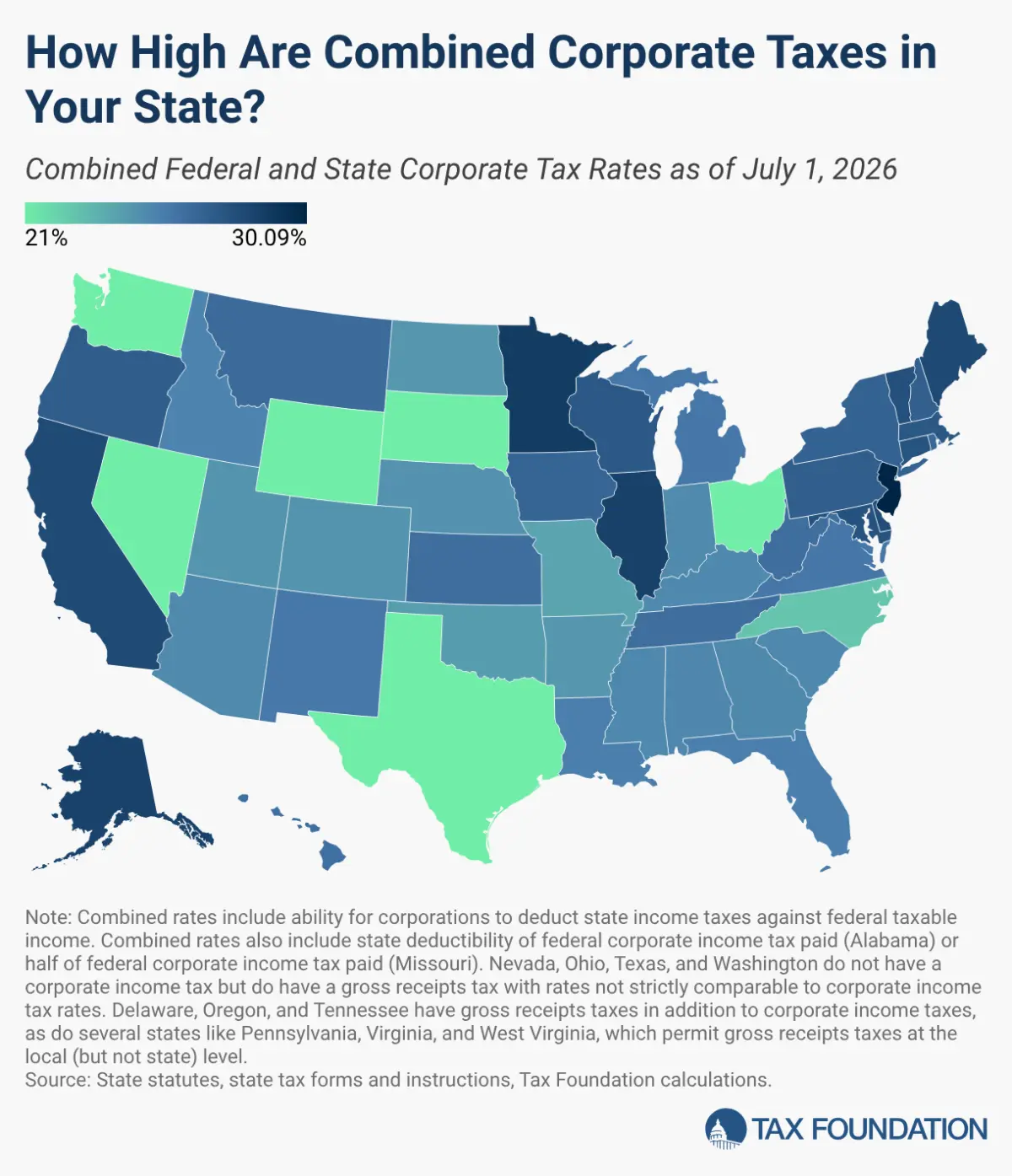
When examining the total tax burden borne by corporations operating across the United States, looking at federal policy alone offers only half the picture. Corporations subject to federal taxation face a baseline corporate income tax rate of 21 percent. However, the true financial impact of corporate taxation requires factoring in a complex mosaic of state-level policies, which vary dramatically across jurisdictions in their structures, rates, and mechanisms.
Currently, forty-four states, alongside the District of Columbia, levy their own taxes on corporate income. These state-level top marginal rates exhibit a wide spread, stretching from a modest 2.0 percent in North Carolina up to a substantial 11.5 percent in New Jersey. The structural design of these state taxes also varies significantly. Thirteen states utilize a graduated corporate income tax structure, where rates increase as a company’s taxable profits rise. Meanwhile, the vast majority—31 states plus the District of Columbia—employ a flat rate on corporate income, applying a single percentage regardless of the total profit generated.
Beyond standard corporate income taxes, several states take alternative approaches to taxing business activity. In Nevada, Ohio, Texas, and Washington, corporations are not subject to traditional corporate income taxes at all. Instead, these states levy gross receipts taxes. Gross receipts taxes are applied directly to a company’s total gross sales, without allowing deductions for typical business expenses such as employee compensation, the cost of goods sold, or general overhead. Unlike a standard retail sales tax, a gross receipts tax is assessed directly on businesses and applies to transactions at every single stage of the production process. This multi-stage application frequently leads to tax pyramiding, where the tax is compounded at each level of production before the final product ever reaches the consumer.
The landscape becomes even more intricate in states that choose to combine tax methodologies. Delaware, Oregon, and Tennessee impose both a traditional corporate income tax and a separate levy on gross receipts. Furthermore, some states introduce a municipal layer to the equation; Pennsylvania, Virginia, and West Virginia authorize gross receipts taxes at the local level, adding another variable for businesses operating within their borders. At the opposite end of the spectrum, two states—South Dakota and Wyoming—stand out by levying neither a corporate income tax nor a gross receipts tax at the state level, offering a starkly different tax environment for incorporated entities.
When federal and state policies are combined, the total tax liability for corporations shifts considerably depending on geographic location. New Jersey currently maintains the highest combined corporate income tax rate in the nation at 30.1 percent, driven by its high top marginal state rate compounded with federal obligations. Several other states also push the envelope on combined rates; in Alaska, Illinois, Maine, and Minnesota, corporations face combined corporate income tax rates that meet or exceed 28 percent. Conversely, the six states that forgo a state corporate income tax entirely—Ohio, Nevada, South Dakota, Texas, Washington, and Wyoming—limit their corporate income tax burden to the baseline federal rate of 21 percent, though four of these states offset the lack of an income tax with their statewide gross receipts taxes.
To fully understand how these taxes interact, tax analysts also examine the interplay between federal and state tax deductions. Corporations are generally permitted to deduct state corporate income tax payments against their federal taxable income. This deduction effectively lowers the net federal corporate income tax rate. For example, a corporation subject to Rhode Island’s flat 7 percent corporate income tax can deduct that state tax payment against the 21 percent federal corporate income tax. This deduction reduces the effective federal rate to 19.53 percent, resulting in a total combined tax rate of 26.53 percent rather than a simple sum of the two individual rates.
Conversely, a small number of states provide relief by allowing corporations to deduct federal corporate income tax payments against a portion of their state corporate income tax liability. Alabama stands out by permitting the full deductibility of federal corporate income tax liability against state tax liability, while Missouri permits a 50 percent deduction of federal corporate income tax liability. These rare provisions further reduce the effective corporate income tax rate faced by businesses operating within those borders.
When averaging across all jurisdictions—including the states that impose no corporate income taxes whatsoever—the average combined state and federal corporate tax rate in the United States sits at 25.5 percent. This figure underscores that while the federal statutory rate is fixed at 21 percent, state-level additions play a critical role in shaping the financial realities of domestic and international businesses.
Tax policy experts emphasize that evaluating the economic health and competitiveness of a state requires looking closely at both federal and state-level corporate tax burdens. Because corporate income taxes represent one of the most economically damaging methods for governments to raise revenue—often discouraging capital investment, slowing wage growth, and reducing overall productivity—policymakers frequently view corporate tax reform as a vital pathway for enhancing regional competitiveness and fostering broad economic growth that benefits both enterprises and the workforce.











No comments yet. Be the first to join the conversation!