
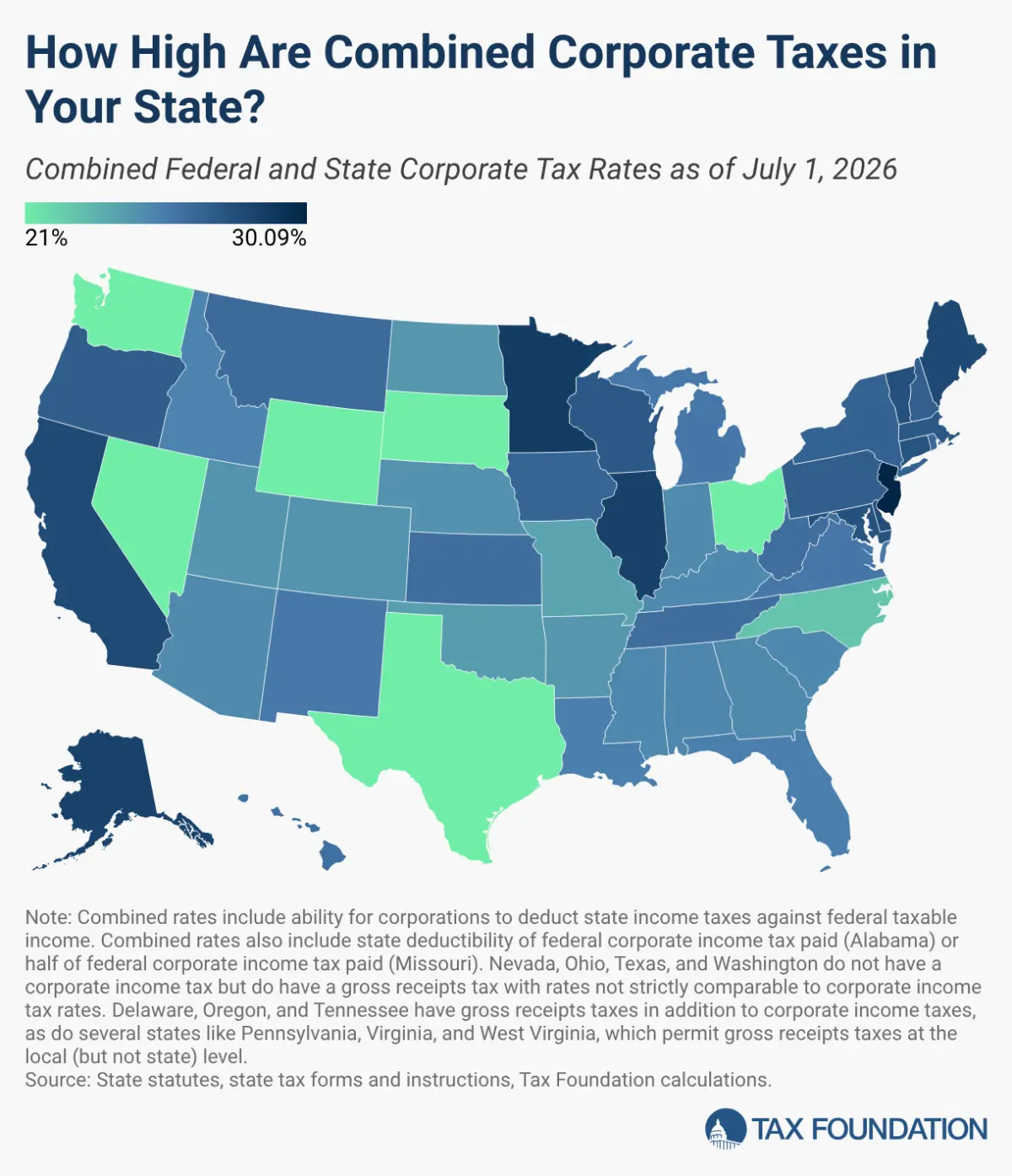
When corporations evaluate their tax burdens in the United States, looking at a single figure rarely tells the whole story. While the federal government levies a flat corporate income tax rate of 21 percent, the vast majority of U.S. states layer their own taxes on top of this baseline. Forty-four states and the District of Columbia impose taxes on corporate income, with top marginal rates spanning a wide spectrum from a modest 2.0 percent in North Carolina to a hefty 11.5 percent in New Jersey.
The structural approaches to state-level corporate taxation vary significantly across the country. Thirteen states utilize graduated corporate income tax rates that increase as a company’s profits rise, while 31 states and the District of Columbia opt for a flat rate. Beyond traditional income taxes, the tax code features alternative systems. In Nevada, Ohio, Texas, and Washington, corporations are subject to gross receipts taxes rather than corporate income taxes. Meanwhile, Delaware, Oregon, and Tennessee take a hybrid approach, imposing both a tax on corporate income and a separate levy on gross receipts. Furthermore, Pennsylvania, Virginia, and West Virginia authorize gross receipts taxes at the local municipal level, even though they do not levy them statewide. At the other end of the spectrum, just two states—South Dakota and Wyoming—refrain from levying either a corporate income tax or a gross receipts tax.
These overlapping tax layers mean that the total tax burden on businesses can climb substantially depending on where a company operates. When combining federal and state obligations, New Jersey holds the title for the highest combined corporate income tax rate in the nation at 30.1 percent. Several other states also push total rates near the top of the scale; corporations in Alaska, Illinois, Maine, and Minnesota face combined corporate income tax rates at or above 28 percent. Conversely, the six states that levy no state corporate income tax—Ohio, Nevada, South Dakota, Texas, Washington, and Wyoming—are subject only to the 21 percent federal rate, though four of these exceptions offset the lack of an income tax by implementing statewide gross receipts taxes.
To fully understand how these taxes impact corporate balance sheets, analysts must look at how federal and state tax liabilities interact. Under the tax code, corporations are generally permitted to deduct state corporate income taxes paid against their federal taxable income. This deduction effectively lowers the corporation’s federal tax liability. For example, a corporation subject to Rhode Island’s 7 percent flat corporate income tax can deduct those state payments against the 21 percent federal corporate income tax. This deduction reduces the effective federal rate to approximately 19.53 percent, resulting in a combined overall rate of 26.53 percent.
In a few unique instances, the deduction process flows in the opposite direction or offers mutual relief. Two states allow corporations to deduct a portion or all of their federal corporate income tax liability against their state corporate income tax obligations. Alabama stands out by allowing full deductibility of federal corporate income tax liability against state liability, while Missouri permits a 50 percent deduction of federal corporate income tax liability. These provisions provide meaningful relief, lowering the effective corporate income tax rates faced by businesses operating within those jurisdictions.
Taking all 50 states and the District of Columbia into account—including those that impose no corporate income taxes at all—the average combined state and federal corporate tax rate in the United States sits at 25.5 percent. Economists and policy experts emphasize that analyzing these figures requires a comprehensive view of both federal and state levies, as corporate taxes remain one of the most economically damaging methods for governments to raise revenue. Because corporate taxes directly influence business investment, hiring, and expansion, many tax policy researchers point to corporate tax reform as a prime opportunity for states to enhance their economic competitiveness and stimulate long-term growth that benefits both enterprises and workers alike.











No comments yet. Be the first to join the conversation!