
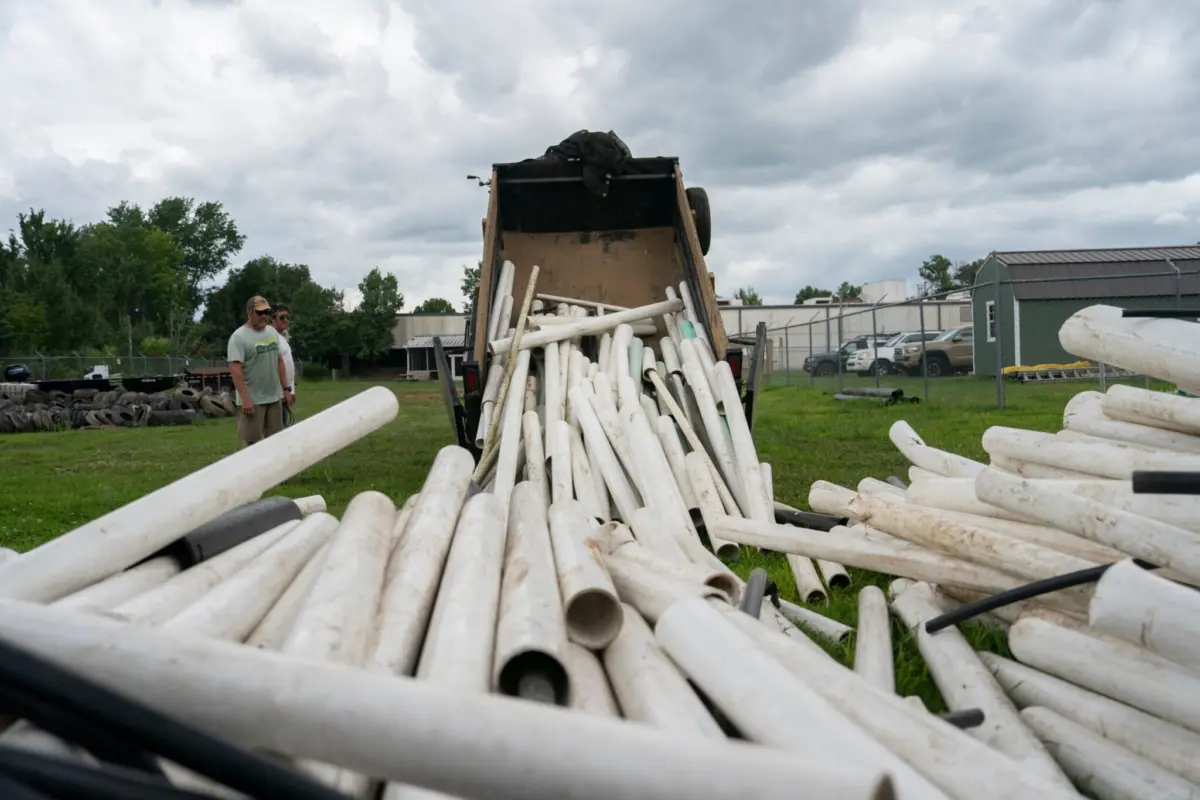
Piled high on eroding river banks, wedged deeply into the roots of uprooted sycamores, embedded in thick riverbed sediment, and jammed underneath massive logs, the remnants of a catastrophic natural disaster still litter the waterways of western North Carolina. In many locations, these industrial fragments are tangled into towering mounds of debris reaching up to two stories high, a persistent visual scar stretching across the landscape.
More than two years after Hurricane Helene tore through the region, leveling forests, bulldozing residential homes, and washing every imaginable object—from family cars to household refrigerators—into local waterways, the arduous task of environmental remediation continues unabated. Along the iconic French Broad River, a waterway internationally celebrated for its roaring whitewater rapids and scenic beauty, one specific item dominates the landscape and overshadows all other forms of trash: massive quantities of PVC pipes that were swept away from a major manufacturing facility located just north of Asheville during the height of the storm.
As the Atlantic hurricane season brings new tropical threats, the stubborn presence of these industrial PVC pipes serves as a stark, tangible reminder that the catastrophic damage wrought by major weather events can disrupt ecosystems, communities, and daily lives for many years after the floodwaters finally recede.
"Just the amount of time and energy that we put into removing all this pipe is exhausting," said Jon Stamper, operations director at MountainTrue, a regional environmental nonprofit leading cleanup efforts across several western North Carolina rivers heavily impacted by Hurricane Helene. "We still have stretches of river that haven’t been touched."
MountainTrue estimates that its specialized field crews have pulled hundreds of thousands of individual PVC pipes from the river system so far. While the vast majority of this recovered plastic has been hauled off to local landfills, an untold number of pipes continue to litter the riverbanks and channel over a 70-mile stretch, extending all the way downstream to a large lake situated near the Tennessee border.
The sheer scale of the industrial debris has created logistical and corporate accountability challenges. Canada-based IPEX, the multinational manufacturer that owned the facility, has declined to publicly disclose the exact number of pipes that were stored outdoors at its Woodfin, North Carolina, industrial site prior to the storm. The company has also withheld the results of a corporate-funded environmental assessment detailing the volume of plastic that remains trapped in the river, citing the information as "commercially sensitive."
Local and corporate officials have previously acknowledged that roughly 60 percent of the PVC pipes stored outdoors at the site—which is precariously sandwiched between active railroad tracks and the rushing waters of the French Broad River—were swept away by the historic 2024 flood. While a significant portion of those escaped pipes was recovered in the immediate aftermath of the disaster, the remaining subterranean and riverside debris is extensive.
To help address the ongoing crisis, IPEX has agreed to provide MountainTrue with $500,000 in funding directed toward continued cleanup operations on the French Broad River, a financial contribution that will allow the nonprofit’s specialized crews to sustain their grueling fieldwork into the coming year. Meanwhile, a $10 million state grant originally awarded to MountainTrue in 2025 to spearhead debris removal across several western North Carolina waterways was scheduled to expire in December but has since been officially extended through February.
Despite these infusions of capital, environmental advocates emphasize that the recovery operation has a long and difficult road ahead. MountainTrue estimates that it has already expended approximately 50,000 work-hours and more than $1.5 million exclusively on pipe removal along the French Broad River. In certain heavily impacted pockets of the waterway, PVC pipe comprises an astonishing 80 percent of all physical debris. Environmental scientists note that this massive influx of foreign plastic poses immediate physical hazards to commercial rafters and recreational kayakers, alters natural water flows, and fundamentally disrupts aquatic ecosystems.
" petani and industrial manufacturers understand the ongoing challenge," said IPEX CEO Colleen Pritchett. "We recognize that recovery efforts are complex, they’re resource-intensive, and it’s constantly shaped by the river conditions."
The Epic Flood Took Everyone by Surprise
Hurricane Helene struck western North Carolina in late September 2024, unleashing historic amounts of rainfall that exceeded 30 inches in several mountainous areas. The deluge triggered catastrophic landslides, toppled millions of trees, pushed commercial and residential buildings completely off their foundations, and choked vital waterways with vegetative and man-made debris.
At the IPEX manufacturing facility, an engineered earthen berm represented the primary physical barrier separating towering stacks of manufactured pipe from the adjacent French Broad River. Company representatives explained that facility planning had accounted for a theoretical 100-year flood event—statistically defined as a flood having a 1 percent probability of occurring in any given year—and management had proactively moved inventory out of the mapped flood zone as a precaution.
However, the unprecedented meteorological conditions generated by Hurricane Helene produced a flood event roughly ten times worse than the benchmark 100-year projection.
"We secured the site as best we could, and we sent people home a day before the flooding was expected," said Johnny Drummond, vice president of manufacturing for IPEX. He noted that the facility leadership simply did not anticipate a catastrophic 1,000-year flood, a rare hydrological event with a 1-in-1,000 chance of occurrence in any single year.
The disaster forced the factory to close its doors for several months following the storm, resulting in corporate financial losses that CEO Colleen Pritchett described as "well over $100 million." In the time since the disaster, the company has invested more than $100 million to repair, rebuild, and structurally strengthen its manufacturing facilities. IPEX is currently studying innovative engineering solutions to better contain outdoor pipe inventory during potential future floods—a protective measure that MountainTrue and local community advocates had publicly urged the company to implement for months.
Although a vast array of miscellaneous flood debris remains scattered throughout the local river systems alongside the industrial plastic, the PVC pipes are so ubiquitous that they define the cleanup experience.
"There are places where you go that it makes up almost everything that we remove," said Stamper, who transitioned to his role at MountainTrue after previously working as a whitewater river outfitter. Today, Stamper oversees ten distinct field crews totaling approximately 100 workers. Many of these field personnel are former commercial river guides and local fishing guides who tragically lost their primary livelihoods when the hurricane devastated the regional outdoor recreation economy.
Extracting the pipes from the environment is an exceptionally vexing challenge because the rigid and flexible plastics have intertwined with massive quantities of organic debris and become deeply embedded in the riverbed. In some areas, aquatic life, including native fish species and macroinvertebrates, have taken up biological residence inside the hollow tubes. Furthermore, Stamper expressed deep concern regarding the long-term environmental and public health repercussions of leaving the plastic in the water. As PVC is exposed to the elements, it naturally degrades, becomes brittle, and fragments into microplastics that can persist indefinitely in the aquatic food web.
"We want to avoid that stuff sitting there forever and just slowly deteriorating and breaking into smaller and smaller pieces," Stamper explained. "Some of the pipe that’s been sitting out since Hurricane Helene that has been exposed to the sun all the time is getting to the point where you could crack it when you grab it."
Removing Pipes Is Tedious and Sometimes Dangerous
The physical reality of the cleanup operation presents daily hazards for the workers on the water. Some of the recovered materials consist of straight, rigid plastic tubing, while others are massive flexible coils that have completely unraveled under immense pressure. These items are frequently buried beneath massive logjams and other mixed debris, forming dense, unstable mounds stretching up to 20 feet high.
Cleanup crews often refer to these treacherous obstacles as "jungle gyms," requiring workers to carefully climb, scale, and balance across unstable timber and plastic piles just to access and dismantle the wreckage, according to Jemima Filiss-Cook, who leads cleanup operations in Madison County, where the concentration of pipe debris is highest.
Filiss-Cook noted that many crew members were actively cleaning up the river independently before MountainTrue formally hired them, finding a sense of community and shared healing through what she described as "trauma bonding" over the shared regional tragedy.
The physical demands of the job have naturally attracted avid outdoorspeople, including experienced rock climbers and mountaineers, because the debris removal is regarded as a tedious and highly technical process that requires immense physical endurance and comfort working in rugged environments, according to Anna Alsobrook, MountainTrue’s French Broad Riverkeeper.
Field crews must use specialized power saws to cut longer, unwieldy sections of pipe into smaller, manageable chunks. These pieces are then loaded onto motorized watercraft, transported downstream to designated landing zones, and finally transferred onto heavy trucks for transport to regional landfills. While the vast majority of the recovered plastic is discarded due to structural compromise, MountainTrue coordinates the redistribution of select pipes that remain in good structural condition to local community members for creative reuse projects, given the current lack of viable commercial recycling pathways for industrial PVC.
"I truly don’t think anybody else could do this work except for our debris team members," Alsobrook said, emphasizing that workers must possess the advanced boat-handling skills required to safely navigate turbulent whitewater rapids while heavily laden with a boat full of dense plastic pipe and heavy industrial saws.
During the initial emergency response phase, the primary operational objective was removing submerged and floating pipes that posed an immediate safety hazard, physical entrapment risk, or navigational obstacle to recreational tubers and kayakers. Today, much of the remaining focus centers on extracting stranded debris trapped within expansive floodplains and along remote riverbanks, particularly around sharp riverbends and corners where materials remain acutely vulnerable to being swept away by the next major high-water event.
Stamper noted that the hidden scale of the remaining pollution becomes unmistakably apparent every time local water levels fluctuate, revealing previously submerged or hidden caches of industrial plastic.
MountainTrue is actively pursuing additional grant funding from governmental and philanthropic sources to extend its environmental remediation program once current state and corporate funding streams are exhausted. Given the sheer volume of material and the difficult terrain, Stamper cautions that eradicating every trace of the disaster will likely take years of sustained labor.
"We’re going to do our best as long as the funding allows," Stamper said. "लेकिन there’s going to be pipe out there that we can’t get ever."











No comments yet. Be the first to join the conversation!