
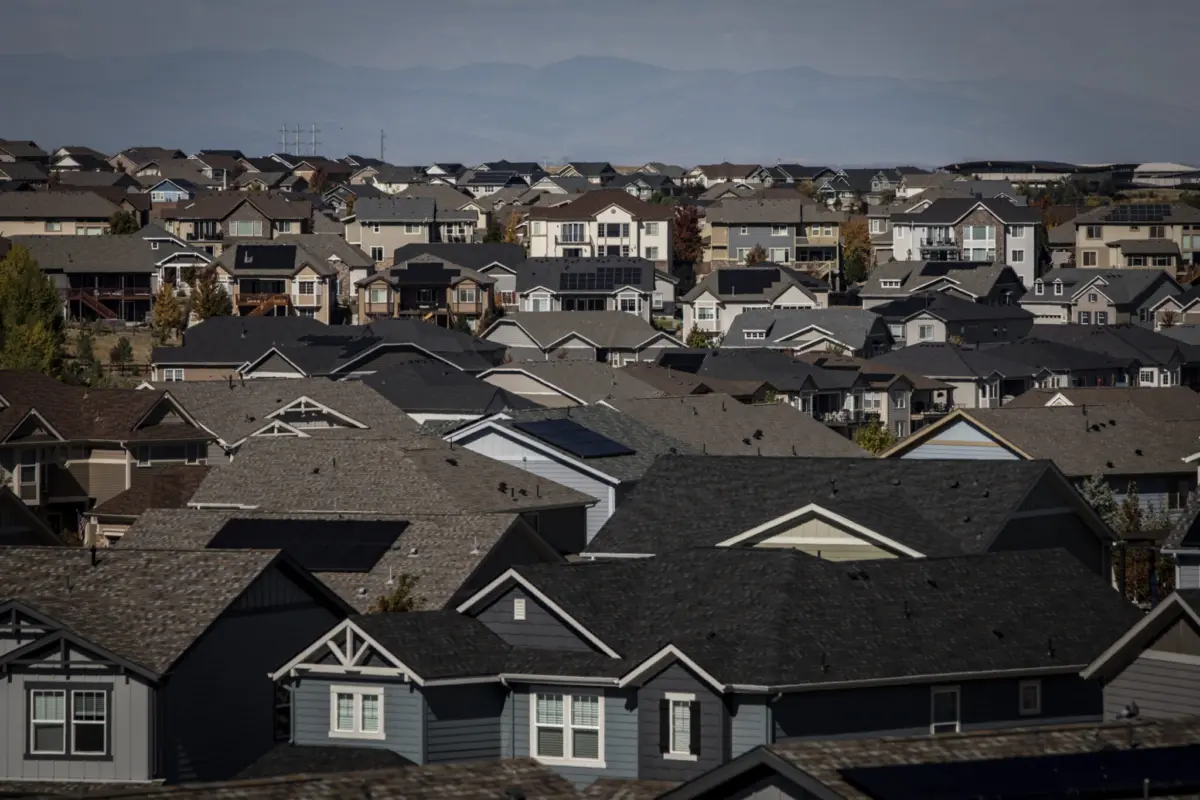
Home insurance rates have risen so dramatically over the last decade that the average premium now exceeds the average property-tax bill in two-thirds of US counties, according to a comprehensive analysis published by Bloomberg Intelligence.
The findings point to the central role that soaring insurance costs are playing in the broader housing affordability crunch. This ongoing financial squeeze is putting immense pressure on household budgets nationwide while helping shape the political battle lines ahead of upcoming elections. Insurance rates are being pushed upward, analysts note, by a combination of inflationary pressures and increasingly extreme weather events linked directly to climate change.
Across the United States, homeowner policies averaged at the county level have climbed by an inflation-adjusted 45% over the past decade. However, some states are experiencing much steeper jumps. In Nebraska, for instance, average home insurance rates have surged by a staggering 79%.
To capture a complete picture of weather-related household financial burdens, Bloomberg Intelligence analysts also estimated the portion of auto insurance premiums directly related to extreme weather. When those auto insurance costs are added to home insurance premiums, the combined financial burden is now higher than property taxes in 75% of the nation’s counties.
Regional weather patterns are heavily driving these geographic disparities. Hailstorms and severe winter weather are pushing up rates particularly fast across the Midwest and Mountain West, led by states like Colorado, Utah, and Minnesota. Meanwhile, Southeastern states traditionally maintain some of the country’s lowest property taxes. In those regions, soaring insurance premiums can now easily run two and a half to four times the local property tax levy. Conversely, Northeastern and Western states, along with major metropolitan areas, historically pay much higher property taxes. In those high-tax areas, the impact of rising insurance premiums represents a smaller overall percentage of the total property tax bill.
A broader property-tax revolt has been steadily brewing around the country as homeowners struggle with various municipal levies. Yet, on average, homeowners are now paying a county-level average of 14% more for home insurance alone than they are for property taxes—a figure that jumps to 30% when auto insurance is factored into the equation, writes Andrew John Stevenson of Bloomberg Intelligence. The escalating frequency and severity of hail damage are notably driving up auto insurance costs throughout the Great Plains and the Upper Midwest.
The Bloomberg Intelligence analysis draws upon a wide array of public data sources, including the US Census Bureau, state-level insurance regulators, and federal weather and transportation agencies.
These findings arrive at a critical juncture as local governments grapple with entirely new disaster-related stressors on their municipal budgets. This fiscal strain is intensifying as the federal government under the Trump administration increasingly weans states off traditional federal disaster recovery funding. Historically, the federal government has paid for approximately 90% of disaster recovery costs over the past two decades. However, the ratio of federal to local funding is now rapidly approaching an even 50-50 split.
To illustrate this significant shift, Stevenson highlights stark differences in recent historical examples. Following Hurricane Harvey in 2017, Texas received roughly $23 billion in federal funds compared to $4 billion in local spending. By contrast, in the aftermath of the Los Angeles fires in January 2025, the federal government provided California with $2.6 billion, while Californians themselves were forced to shoulder $3.5 billion in local and state spending.
This policy shift represents a very daunting proposal for local governments and municipal budgets, according to Stevenson, primarily because local municipalities simply do not have that kind of capital readily available on hand to deploy on an ad hoc basis. Ideally, local leaders would prefer to spend those limited funds on improving community infrastructure rather than repeatedly replacing wiped-out public infrastructure.
The scale of natural disasters has grown exponentially over recent decades. Disasters in 2025 reached a five-year average of $156 billion in annual losses, representing a tenfold increase compared to the 1985 figure when adjusted for inflation, according to a tracking database maintained by the research nonprofit Climate Central. The net macroeconomic effect of these mounting costs is likely to place severe pressure on municipal bond ratings as local economies are forced to divert capital toward immediate disaster recovery rather than long-term economic growth.
For individual homeowners, the financial squeeze extends beyond rising annual premiums. Deductibles have also been steadily climbing across the board, making families personally responsible for a much larger share of recovery spending before insurance coverage finally kicks in. This leaves households with significantly less disposable income to spend on local commerce, such as dining out at restaurants or attending sporting events—activities that traditionally provide vital local sales tax revenue.
Despite the steep financial hurdles, insurance remains no less necessary in the face of larger, more frequent, and more destructive disasters, according to Alexandra Glickman, global practice leader for real estate and hospitality at Arthur J. Gallagher & Co. Property owners must actively prepare, remain acutely aware of changing environmental risks, and ultimately be willing to pay the necessary premium to secure proper coverage, she noted.
You cannot necessarily stop Mother Nature, Glickman said, but homeowners can protect their investments and make it home safely by taking the right preventative precautions and securing adequate financial protection.











No comments yet. Be the first to join the conversation!