
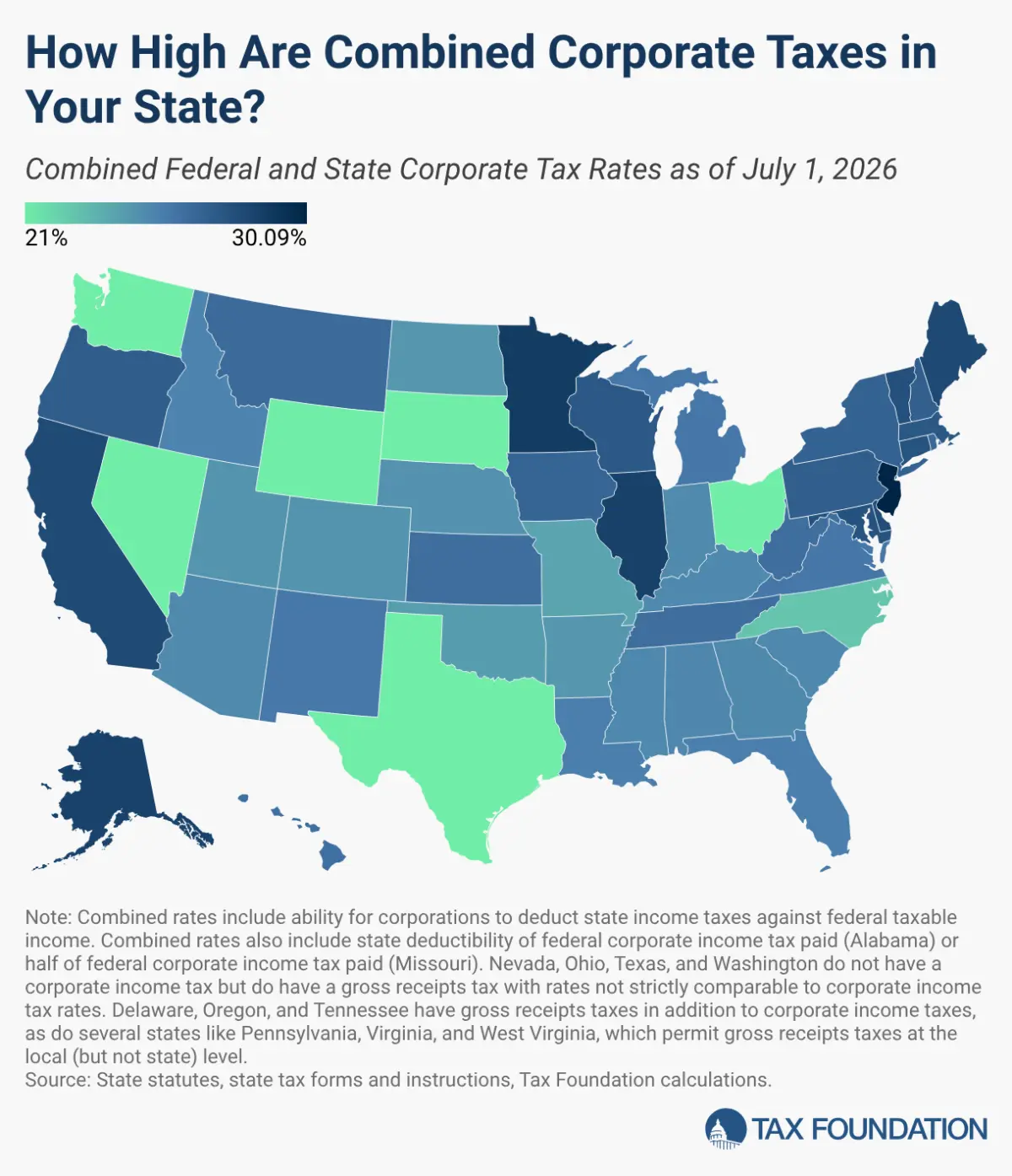
When corporations evaluate their tax obligations in the United States, they must look far beyond the standard federal statutory rate. While the federal government levies corporate income taxes at a flat 21 percent, the true tax burden is shaped by a complex, overlapping web of state-level policies, deductions, and alternative business levies that vary dramatically across the country.
Understanding this multi-layered tax environment is essential for analyzing corporate competitiveness, investment decisions, and state-level economic growth. Across the United States, corporate income taxes remain a critical tool for generating public revenue, yet they are also widely recognized by economists as among the most economically damaging ways to fund government operations. As policymakers continually seek ways to balance state budgets while fostering attractive business climates, examining how federal and state taxes interact provides crucial insight into the broader American economy.
The Foundation: Federal Rates and State Income Tax Diversity
At the core of the corporate tax system is the federal corporate income tax, which has stood at 21 percent following major federal legislative reforms. However, businesses rarely operate in a purely federal vacuum. Forty-four states, alongside the District of Columbia, levy their own taxes on corporate income, creating a diverse patchwork of state-level fiscal policies.
These state top marginal rates vary significantly, stretching from a modest 2.0 percent in North Carolina to a steep 11.5 percent in New Jersey. The structural design of these state taxes also differs widely. Thirteen states employ graduated corporate income tax rates, where tax liability increases as a company’s profits rise. Conversely, 31 states and the District of Columbia opt for a flat rate structure, applying a single percentage to all taxable corporate income regardless of scale.
Beyond traditional corporate income taxes, several states utilize alternative mechanisms to tax business activity. In Nevada, Ohio, Texas, and Washington, corporations are subject to gross receipts taxes rather than traditional corporate income taxes. Gross receipts taxes are applied directly to a company’s gross sales without allowing deductions for standard business expenses, such as employee compensation, the cost of goods sold, and overhead expenditures. Unlike a standard retail sales tax, a gross receipts tax is assessed directly on businesses and applies to transactions at every stage of the production process, a phenomenon known as tax pyramiding that can significantly compound the tax burden along supply chains.
The fiscal architecture gets even more intricate in other jurisdictions. Delaware, Oregon, and Tennessee impose both a traditional corporate income tax and a separate levy on gross receipts. Meanwhile, Pennsylvania, Virginia, and West Virginia do not levy statewide gross receipts taxes, but they permit local municipalities to implement them. At the other end of the spectrum, two states—South Dakota and Wyoming—stand out by levying neither a corporate income tax nor a gross receipts tax at the state level, relying instead on other revenue sources to fund public services.
Combining Federal and State Tax Burdens
To accurately gauge the tax pressure a corporation faces, analysts must calculate the combined tax rate, which aggregates federal and state obligations. When combining these layers, the overall tax burden can climb substantially higher than the federal baseline.
New Jersey claims the highest combined corporate income tax rate in the nation at an imposing 30.1 percent. Several other states also push corporations past the 28 percent threshold on combined rates, including Alaska, Illinois, Maine, and Minnesota.
On the opposite end, six states—Ohio, Nevada, South Dakota, Texas, Washington, and Wyoming—levy no state corporate income tax. Corporations operating exclusively within these jurisdictions face only the federal corporate income tax rate of 21 percent, although four of these states offset their lack of an income tax by imposing statewide gross receipts taxes. Factoring in all 50 states, including those that impose no corporate income taxes at all, the average combined state and federal corporate tax rate across the United States sits at approximately 25.5 percent.
The Mechanics of Tax Deductibility
The calculation of corporate tax liability is further modified by intergovernmental tax deductibility rules. Under current tax structures, corporations are generally permitted to deduct state corporate income tax payments against their federal taxable income. This deduction effectively lowers a company’s effective federal corporate income tax rate.
To illustrate how this mechanism functions, consider a corporation operating in Rhode Island. The state levies a corporate income tax at a 7 percent flat rate. Because a corporation can deduct this state tax payment against its 21 percent federal corporate income tax liability, the federal rate is effectively reduced to 19.53 percent. When combined with the state levy, the resulting overall rate for a corporation in Rhode Island comes to 26.53 percent rather than a simple additive 28 percent.
In a rare reverse arrangement, two states allow corporations to deduct federal corporate income tax payments against a portion of their state corporate income tax liability. Alabama permits full deductibility of federal corporate income tax liability against its state liability, while Missouri permits a 50 percent deduction of federal liability. These unique provisions serve to lower the effective corporate income tax rate faced by businesses operating within those state borders, offering a partial cushion against the cumulative weight of federal and state taxation.
Economic Implications and Future Reform
The structure of corporate taxation remains a central focus for policymakers, economists, and business leaders alike. Because corporate income and gross receipts taxes can discourage capital investment, reduce wage growth, and prompt businesses to shift operations to more favorable jurisdictions, they are frequently scrutinized as areas ripe for modernization.
Tax policy experts, including researchers at organizations like the Tax Foundation, argue that reforming or reducing corporate tax burdens represents one of the most promising avenues for states to enhance their economic competitiveness. By lowering barriers to business expansion, state lawmakers can encourage domestic investment and foster job creation that ultimately benefits both companies and the broader workforce. As state legislatures continue to evaluate their fiscal health and long-term economic strategies, the interplay between federal baselines, state income taxes, and alternative gross receipts levies will remain a critical factor in shaping the American business environment.











No comments yet. Be the first to join the conversation!