
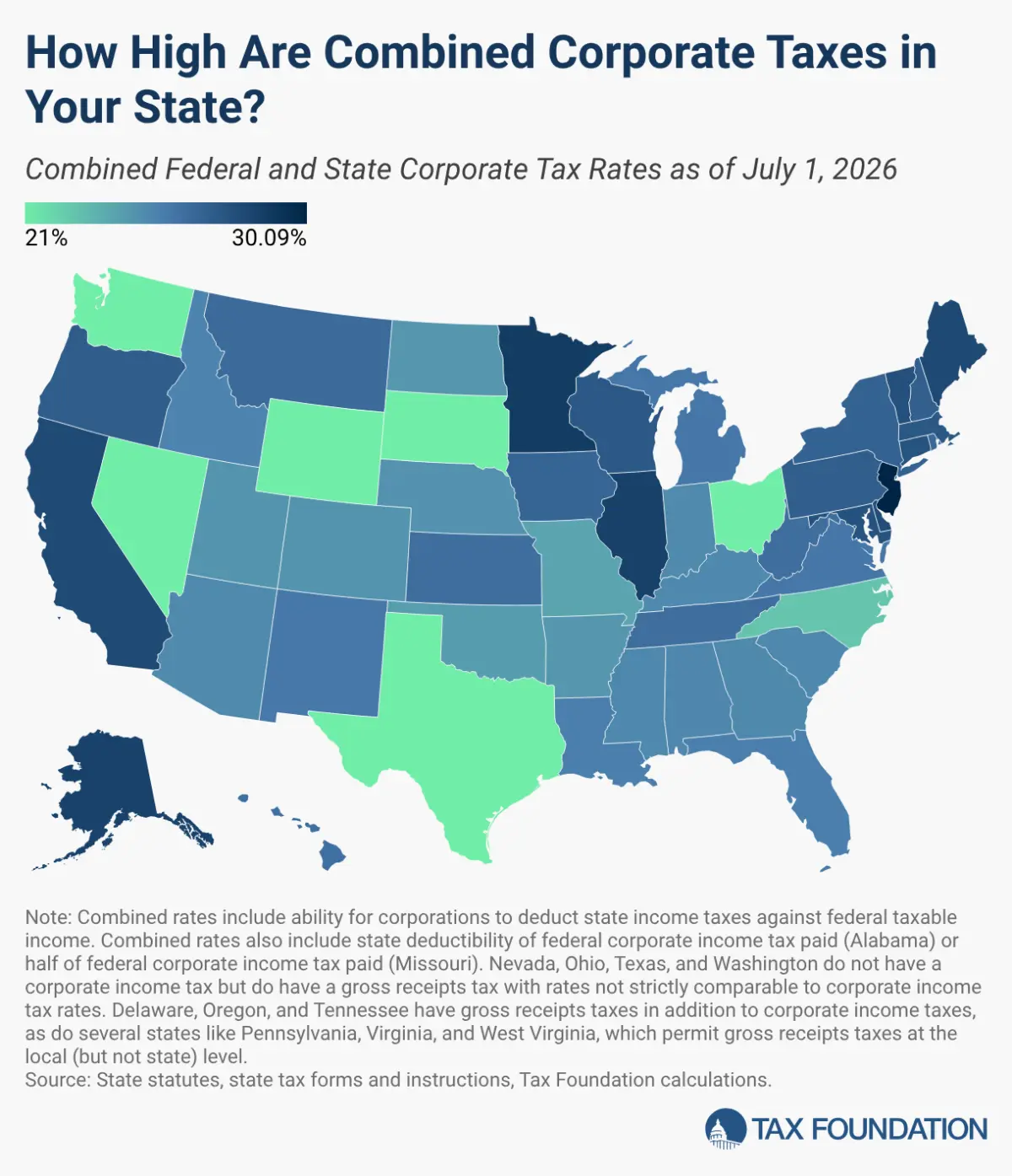
When examining the overall tax burden borne by businesses operating within the United States, evaluating a combination of federal and state-level levies is essential for a complete financial picture. Corporations in the United States currently pay federal corporate income taxes levied at a standard flat rate of 21 percent. However, the broader tax reality for American businesses is far more complex, as forty-four states and the District of Columbia also levy taxes on corporate income, creating a diverse patchwork of fiscal obligations across the country.
Top marginal rates for state corporate income taxes vary significantly from one jurisdiction to another, ranging from a modest 2.0 percent in North Carolina to a high of 11.5 percent in New Jersey. The structural design of these state-level taxes also differs widely. Thirteen states currently levy graduated corporate income tax rates, meaning the rate increases as a company’s profits grow. Meanwhile, thirty-one states and the District of Columbia have opted for a flat rate on corporate income, applying a single percentage regardless of the total earnings reported by the firm.
A corporate income tax is levied by federal and state governments on business profits. It is important to note that many companies are not subject to the corporate income tax because they are organized as pass-through businesses. For these entities, income is reportable under the individual income tax rather than the corporate level. For traditional corporations, however, the state-level policies introduce considerable variation in how business profits are taxed depending on the state of incorporation or operation.
Beyond standard corporate income taxes, several states utilize alternative mechanisms to raise revenue from businesses. In Nevada, Ohio, Texas, and Washington, corporations are subject to gross receipts taxes instead of corporate income taxes. Furthermore, Delaware, Oregon, and Tennessee take a hybrid approach, imposing both a traditional tax on corporate income and a separate levy on gross receipts. Meanwhile, Pennsylvania, Virginia, and West Virginia do not impose statewide gross receipts taxes, but they do levy these taxes at the local level. On the opposite end of the spectrum, two states—South Dakota and Wyoming—levy neither a corporate income tax nor a gross receipts tax at any level of government.
Gross receipts taxes operate differently than standard corporate income or sales taxes. A gross receipts tax is applied to a company’s gross sales, without any deductions allowed for typical business expenses, such as employee compensation, the cost of goods sold, and overhead costs. Unlike a traditional retail sales tax, a gross receipts tax is assessed directly on businesses and applies to transactions at every stage of the production process. This cascading nature often leads to tax pyramiding, where the tax is levied multiple times on the same final product as it moves through various stages of production and distribution.
When combining federal and state obligations, the overall tax burden shifts dramatically depending on geography. The state with the highest combined corporate income tax rate in the nation is New Jersey, reaching an effective combined rate of 30.1 percent when factoring in federal interactions. Several other states also impose heavy aggregate corporate tax burdens. In Alaska, Illinois, Maine, and Minnesota, corporations face combined corporate income tax rates at or above 28 percent. Conversely, six states—Ohio, Nevada, South Dakota, Texas, Washington, and Wyoming—levy no state corporate income tax, meaning businesses in these states face only the federal tax rate of 21 percent, though four of these states compensate by levying statewide gross receipts taxes.
Calculating the final tax liability is further complicated by the interaction between federal and state tax codes. Corporations are generally permitted to deduct state corporate income tax paid against federal taxable income, which effectively lowers the federal corporate income tax rate. Taxable income is defined as the amount of income subject to tax after all allowable deductions and exemptions have been applied, differing from and remaining less than a firm’s gross income.
To illustrate how this deduction works in practice, consider a corporation subject to Rhode Island’s corporate income tax, which is levied at a 7 percent flat rate. Because the firm can deduct the state tax paid against the 21 percent federal corporate income tax, its federal rate is reduced to 19.53 percent. When combined with the state levy, the resulting aggregate rate is 26.53 percent rather than a simple arithmetic sum of the two rates.
In a small number of instances, states also offer relief by allowing corporations to deduct federal corporate income tax liabilities against a portion of their state corporate income tax obligations. Alabama stands out by allowing full deductibility of federal corporate income tax liability against state liability, while Missouri permits a 50 percent deduction of federal corporate income tax liability. These provisions effectively lower the overall corporate income tax rate faced by businesses operating within those specific state borders.
When averaging across all jurisdictions, including the states that impose no corporate income taxes at all, the average combined state and federal corporate tax rate imposed in the United States sits at 25.5 percent. This figure reflects a significant reduction from historical averages following federal tax reform, but state-level variations continue to play a major role in corporate financial planning.
A tax is broadly defined as a mandatory payment or charge collected by local, state, and national governments from individuals or businesses to cover the costs of general government services, goods, and activities. However, economists note that when examining tax burdens on businesses, careful attention must be paid to both federal and state corporate taxes. Public finance research consistently indicates that corporate taxes are among the most economically damaging ways for governments to raise revenue. Because of this, reforming corporate tax structures remains a promising area for states looking to increase their economic competitiveness, foster a more favorable business climate, and promote long-term economic growth that ultimately benefits both companies and the workers they employ.











No comments yet. Be the first to join the conversation!