
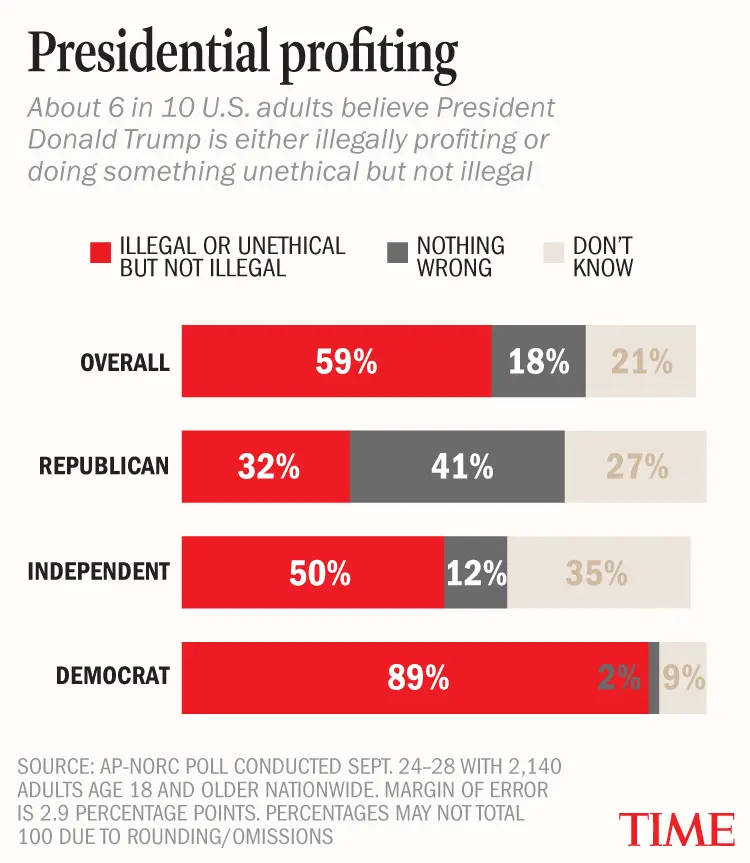
A striking majority of Americans believe that President Donald Trump is profiting off the presidency either illegally or unethically, according to a new AP-NORC poll. The findings, published Tuesday, also illustrate that the President is widely perceived as prioritizing his private business ventures above the needs of the country as a whole.
According to the nationwide poll, which surveyed 2,140 adults between September 24 and 28, four in 10 respondents believe the President has done something illegal while in office. Another 18% see his actions as unethical, even if they do not cross the line into illegality.
The survey reveals deep skepticism regarding the President’s priorities. A majority of respondents—56%—said that Trump has prioritized his personal business interests "a lot." By contrast, only 23% said he has prioritized the country overall. Furthermore, just 11% believe he has prioritized "people like them," while fully half of respondents said Trump has not prioritized people like their demographic at all.
Partisan divides remain a defining feature of these perceptions. Republicans were much more likely than Democrats or Independents to say that the President prioritized the country overall. However, even the ruling party’s base was not without criticism or uncertainty. Only about 1 in 10 Republicans surveyed said Trump had done something illegal, with most indicating either that he had done nothing wrong or that they simply did not know enough to judge the matter.
Independent experts point to a dramatic surge in presidential wealth as a primary driver of these public concerns. "It’s fairly unprecedented how much wealth increase this President has gotten in the past two years," Raymond La Raja, a professor at the University of Massachusetts Amherst and co-director of the UMass Poll, tells TIME.
La Raja points to last year’s financial developments, when a business tied to the royal family of the United Arab Emirates (UAE) invested half a billion dollars into Trump’s crypto ventures. The massive transaction immediately raised conflict-of-interest questions from watchdog organizations and lawmakers alike. According to his latest annual financial disclosure released on June 30, Trump earned more than $1.4 billion from these digital asset and cryptocurrency ventures last year alone.
"It’s really a structural conflict-of-interest that he is regulating policies that directly benefit his family—and it’s also incentivizing not just Americans, but foreign entities, like the United Arab Emirates, to invest in his family’s projects," La Raja says. "So that’s really worrisome."
A separate UMass Amherst poll, conducted in August, points to broader public anxieties regarding government corruption as a whole. That survey showed that 75% of respondents perceived a "great" amount of corruption within the federal government. More notably, 53% ranked the presidency itself as the "most corrupt institution in government," placing it above the Supreme Court, Congress, and the broader federal bureaucracy.
In that same UMass poll, a majority of respondents (54%) stated it was "definitely" corrupt for any public official to use their official office to benefit themselves or their family financially, even if doing so technically remained legal. Another 29% said such actions were "probably" corrupt.
Why Trump’s wealth and the economy could matter in the midterms
La Raja argues that the degree to which everyday constituents care about a politician’s personal enrichment, or view it as fundamentally unethical, often depends heavily on how the broader national economy is performing.
"If you look at other countries when there’s some time when there’s somebody who’s perceived as corrupt, people are more likely to tolerate it if the economy is booming," he says, pointing to international examples like Hungary. "लेकिन when the promise of prosperity is not showing up for the electorate, then they start to say, ‘What’s going on?’ And that’s when corruption looms larger."
Economic sentiment surrounding the current administration remains fragile. Just 28% of 2,275 respondents approved of Trump’s handling of jobs and the economy, according to a Financial Times/Focaldata poll released Tuesday. Meanwhile, consumer prices were up 3.4% in August compared to a year earlier, according to the latest figures available from the U.S. Bureau of Labor Statistics.
Economists note that two primary sources of price pressure have been the administration’s sweeping tariffs and the ongoing U.S. war with Iran. The Federal Reserve Bank of New York estimates that tariffs alone added 2.9 percentage points to consumer goods inflation by February. Simultaneously, the military conflict has driven up fuel prices, sharply raising operational costs for industries and supply chains that rely heavily on diesel.
"[Trump] promised a better economy, and now inflation is up," La Raja notes. "There’s a war, and importantly, the war is linked to inflation."
The release of the AP-NORC poll comes less than a month before the midterm elections, a high-stakes electoral battle where the Republican Party is looking to hold onto its narrow majorities in both the House and the Senate. Political analysts are viewing the upcoming midterms not just as a standard referendum on Trump’s executive leadership, but as a test of whether individual Republican candidates’ connections to the President will help or harm them at the ballot box.
"Presidential approval often serves as a political anchor in midterm elections—meaning dissatisfaction with Trump could extend to Republican candidates down the ballot, particularly among independents and suburban voters," Brandon Rottinghaus, a professor of political science at the University of Houston, tells TIME. "Even Republicans who are personally popular may find it difficult to separate themselves from perceptions of the President."
According to Rottinghaus, concerns surrounding presidential self-enrichment are not entirely unique to Trump. In fact, a 2023 AP-NORC poll asking respondents about former President Joe Biden’s handling of his son’s overseas business dealings triggered similar concerns regarding conflicts of interest, which also broke sharply along partisan lines.
"But Trump’s extensive business interests have made the issue particularly visible," Rottinghaus continues. "Historically, voters have often judged presidential ethics through a partisan lens, with supporters more willing to excuse questionable conduct and opponents more likely to interpret it as evidence of broader problems with presidential accountability."
How much income did Trump report in 2026?
As public scrutiny intensifies, administration defenders have pushed back, arguing that the President actually made significant personal sacrifices by returning to public service for a second term.
"There’s no financial gain like the past Presidents have had. It’s cost him to be in office," Homeland Security Secretary Markwayne Mullin told attendees at an October 1 rally in Durant, Oklahoma.
However, federal disclosure forms paint a different financial picture. According to his sprawling 927-page financial disclosure for 2025, Trump’s total reported revenue reached an astonishing $2.2 billion. By comparison, his total reported revenues for the previous year, 2024, sat closer to $622 million.
That massive financial spike can be attributed largely to the $1.4 billion windfall he received from his family’s various crypto ventures. This included more than $550 million generated from World Liberty Financial token sales—amounting to roughly nine times the revenue he earned from the exact same token sales in 2024.
Beyond the digital asset space, Trump’s family business, the Trump Organization, has actively capitalized on his second term by expanding its real estate, golf, and licensing footprint throughout the Middle East. This expansion includes new projects in Saudi Arabia and Qatar, two nations that have assumed central roles in U.S. foreign policy amid the ongoing war with Iran. Filings from July show that these regional deals alone garnered approximately $14 million.
The close overlap between Trump’s private business empire and the presidency may extend well beyond the conclusion of his time in the White House.
Representatives for the President have proposed building a permanent retreat for future U.S. presidents on land adjacent to the Trump International Golf Club in West Palm Beach. Under the proposed arrangement, the club would cover the cost of the lodging and provide government access completely free of charge, while Trump’s family business would continue to operate the adjoining golf course. Local municipal officials are currently weighing the plan, which has the potential to transform the private club into a permanent hub for influential political visitors long after Trump’s presidency ends.








No comments yet. Be the first to join the conversation!