
Databases have historically been built to serve one of two distinct masters. On one side, analytical databases help modern businesses spot critical macro trends, run complex business intelligence queries, and answer sprawling data-driven questions. On the other side, operational databases quietly store the endless day-to-day records of corporate transactions, managing everything from incoming e-commerce orders to real-time financial payments.
For decades, maintaining this hard architectural line between transactions and analytics was simply a matter of course for enterprise IT departments. But the Munich-based database engine startup CedarDB is challenging that long-held dogma. According to Moritz Sichert, the company’s co-founder and CEO, CedarDB’s unified approach to handling both operational workloads and analytical processing has gained sudden, urgent relevance with the rapid rise of agentic AI.
CedarDB has been quietly in the making for the last decade, but its current commercial momentum stems directly from the modern headaches faced by enterprise companies. Many corporate data stacks were originally engineered to store years of transaction history efficiently, yet they remain notoriously sluggish when forced to quickly answer complex, spontaneous analytical questions asked in natural language about that very same data.
Bridging Academia and High-Performance Hardware
CedarDB’s questioning of the traditional divide between analytical and operational queries is the direct byproduct of an uncompromising corporate focus on raw efficiency. The company is a spinout from the Technical University of Munich, tracing its technical lineage back to Umbra, a sophisticated database research project built entirely from scratch to beat legacy database engines at sheer processing speed by making the absolute most of modern computer hardware.
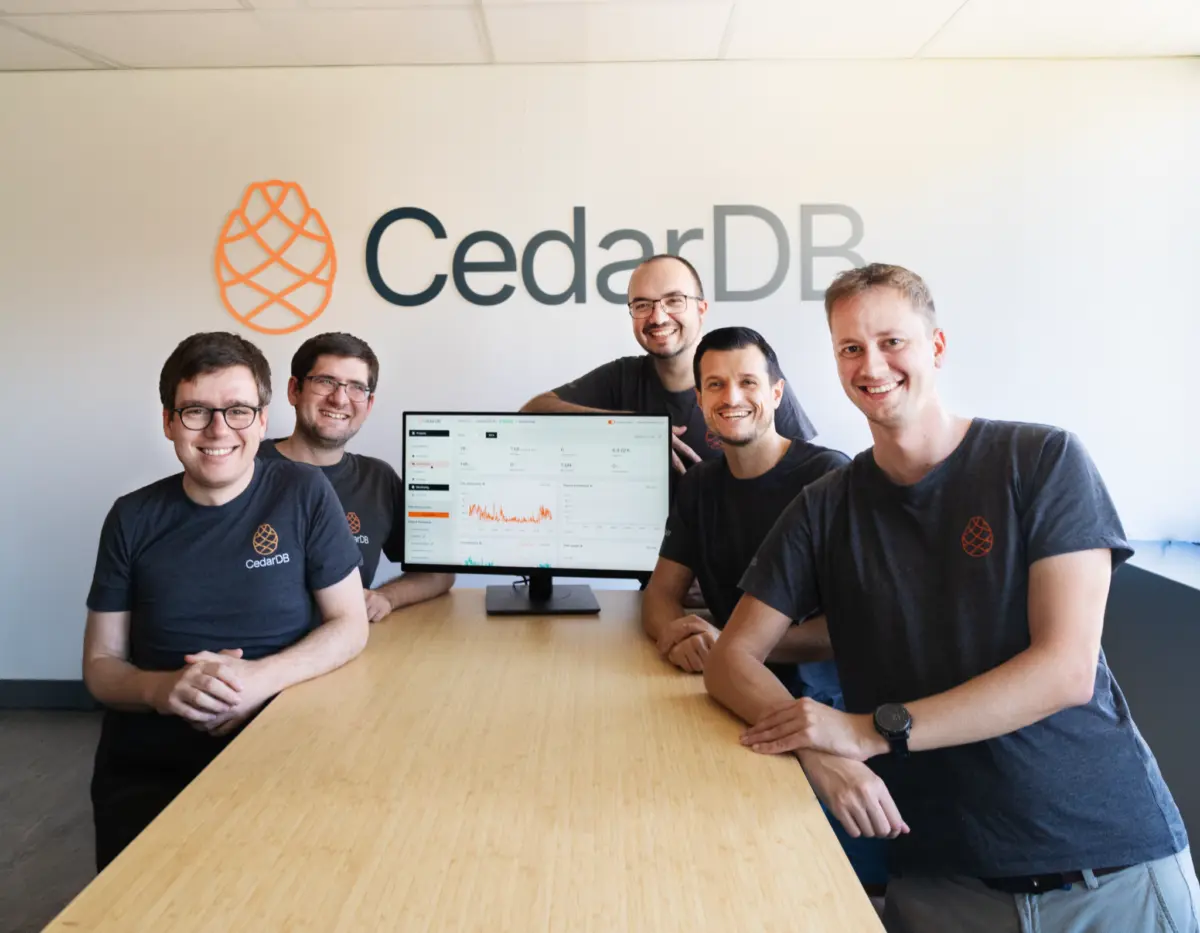
With five original Umbra researchers stepping up as its co-founders, CedarDB inherited that high-performance philosophy. The startup promised significantly faster query performance without demanding more CPUs, processing power, or bloated memory footprints—and crucially, without requiring massive infrastructure overhauls or rewrites from customers. In particular, the engineering team made sure that CedarDB was fully compatible with PostgreSQL, the immensely popular open-source relational database management system.
According to Sichert, maintaining strict compatibility with PostgreSQL plays a vital role in keeping customer switching costs reassuringly low. Because of this compatibility, users do not need to rebuild their existing applications from the ground up just to take the new database engine for a spin. Moreover, this design choice carries an unintended but powerful modern advantage: CedarDB naturally follows the exact same logic and syntax structures that large language models are most familiar with as a direct result of their extensive pre-training regimens.
That architectural decision is just one of several calculated choices that proved remarkably fortunate in retrospect, Sichert noted. But building the company was hardly a matter of pure luck. In a detailed company blog post, co-founder Christian Winter outlined the core engineering and business priorities that the team established right after leaving the sheltered environment of academia, highlighting critical goals such as uncompromising reliability, robust fault tolerance, and seamless compatibility with popular industry tools.
Not all of the strategic answers were immediately obvious to the young startup team. For instance, the founders engaged in intense internal debates over whether they should rush to launch a fully managed cloud offering right out of the gate. Ultimately, they chose a measured path, rolling out CedarDB Enterprise as an on-premise offering alongside a free version known as the CedarDB Community Edition. Both options were formally announced in May of last year, coinciding with the revelation that the company had successfully secured a €5.3 million seed funding round, which is approximately equivalent to $6 million USD.
Stepping Onto the Startup Battlefield
The cloud offering, however, was merely delayed rather than permanently abandoned. After conducting rigorous beta testing cycles with eager users who had patiently signed up for its early access waitlist, the company announced the limited availability of CedarDB Cloud on stage at TechCrunch Disrupt. There, the fledgling German startup found itself competing head-to-head with 20 other ambitious early-stage companies vying to win the conference’s prestigious Startup Battlefield competition.
Deploying a fully managed, cloud-hosted version of the database engine is widely expected to help CedarDB expand its user base far beyond the boundaries of large enterprises that prefer on-premise infrastructure. It will also better position the startup to compete against massive industry heavyweights, such as Databricks, a dominant data and AI company that appears to have independently reached the exact same strategic conclusion as the small European team.
At its annual Data + AI Summit, the American data giant explicitly cited the dawn of the "agentic era" as the primary catalyst behind the launch of LTAP, a brand-new data architecture explicitly designed to unify transactions, analytics, streaming data, and operational records onto a single copy of storage residing directly within the data lake.
While it remains far too early to predict just how disruptive these architectural shifts will ultimately prove to be for the broader enterprise software market, Sichert interprets Databricks’ aggressive move as yet another validation that surging market demand exists for the exact kind of unified performance CedarDB provides.
At present, the startup plans to service its initial wave of cloud users with its lean current team of just 14 people. However, Sichert anticipates that the company will need to significantly scale up its headcount once customer traction accelerates further. Looking ahead, that anticipated operational growth is precisely where the founders expect to initiate their next major fundraising cycle.











No comments yet. Be the first to join the conversation!