
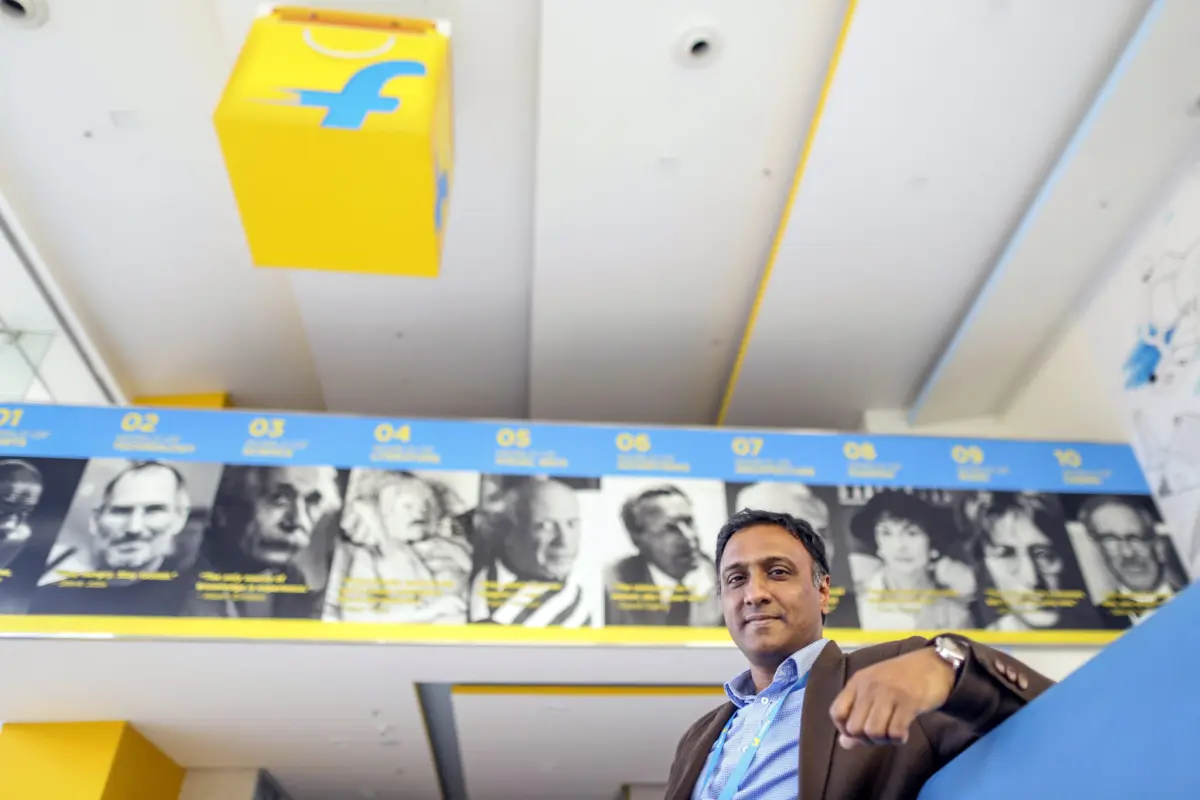
Flipkart, the Walmart-owned Indian e-commerce giant, is stepping up its preparations to break into India’s fiercely competitive food-delivery market, setting the stage for a high-stakes showdown against the established duopoly of Zomato and Swiggy. The Bengaluru-based company is entering a punishing sector that has previously repelled high-profile entries from global tech heavyweights like Amazon and Google, both of which ultimately retreated after failing to capture sustainable market share.
According to people familiar with the matter, Flipkart has significantly ramped up internal testing of its food-delivery service. The trial, which initially involved only a few hundred corporate employees, has now expanded to upwards of 8,000 internal users as the company fine-tunes its operational readiness ahead of a planned public launch. As part of these preparations, Flipkart has deployed a dedicated fleet of delivery riders through its in-house logistics arm, Ekart. These riders operate completely separately from the personnel who handle the company’s quick-commerce deliveries, establishing an independent operational framework for the new culinary vertical.
Within Flipkart’s main shopping app, the employee-only food-delivery service appears as a distinct, dedicated tab alongside existing features such as its "Minutes" quick-commerce offering and its travel booking services. To power the menu selection, Flipkart is drawing on restaurant inventories listed through the Open Network for Digital Commerce (ONDC)—a government-backed digital network designed to seamlessly connect online buyers and sellers across disparate platforms—as well as establishments that the company has signed up directly through independent partnerships.
On the streets of Bengaluru, the southern Indian technology hub where Flipkart maintains its corporate headquarters, early signs of the public rollout are already visible. Delivery riders wearing distinct jerseys bearing "Eat-in by Minutes" branding have been spotted actively fulfilling orders across various neighborhoods, signaling that the closed beta testing is rapidly evolving into real-world validation.
As Flipkart pushes forward with its operational expansion, it is targeting a market that external financial analysis indicates is expanding at a rapid pace. According to estimates from brokerage firm Bernstein, India’s online food-delivery sector is growing at an annual rate of 18% to 20%. Despite this robust growth trajectory, online delivery still accounts for just over 15% of the country’s broader, multi-billion-dollar food-services industry. Bernstein notes that Zomato—which is owned by Eternal—and Swiggy together serve an estimated 85 million to 95 million paying customers annually. This staggering figure underscores both the immense dominance of the two incumbents and the vast runway available for new market entrants to expand online food ordering within the world’s most populous nation, which boasts more than a billion active internet subscriptions.
Flipkart is far from the only disruptive player looking to alter the dynamics of India’s food-delivery landscape. Ride-hailing firm Rapido, which has previously mounted a formidable competitive challenge against ride-sharing giants Uber and Ola in India, has also begun testing its own food-delivery service named "Ownly," which notably promises a zero-commission model for participating restaurants. Meanwhile, Swiggy has taken defensive and targeted steps of its own, launching a separate app called "Toing" aimed specifically at budget-conscious consumers looking for affordable meal options. Both moves highlight mounting friction within the industry regarding the established pricing models and the steep commissions that restaurants are routinely required to pay.
"Monopoly is bad, but duopoly is more pathetic," said Sagar Daryani, president of the New Delhi-headquartered National Restaurant Association of India (NRAI), an organization that represents over 500,000 restaurants nationwide. "What one does, the other follows suit." Daryani argued that the restaurant community has spent years searching for viable, sustainable alternatives to the two dominant platforms that currently control the digital dining space.
Historically, breaking into this sector has proven exceptionally difficult for well-capitalized outsiders. In May 2020, Amazon launched its own food-ordering service in Bengaluru, only to pull the plug and shut down the entire operation two years later. Similarly, Google introduced its Areo app, which offered food ordering alongside various home services, but the product failed to gain meaningful market traction and was eventually discontinued. International ride-hailing giant Uber also elected to exit the market in March 2020, selling its entire Uber Eats business in India to Zomato for approximately $206 million.
Despite the graveyard of previous attempts by global technology giants, industry stakeholders point to a fundamental operational difference in how Flipkart is approaching the challenge. Zomato and Swiggy built their foundational businesses entirely around restaurant meal deliveries before eventually branching outward into quick-commerce and grocery delivery. Flipkart, by contrast, is executing the exact reverse strategy. The company is leveraging its massive, established e-commerce infrastructure and its rapidly scaling quick-commerce operations as a powerful springboard into food delivery.
"Flipkart’s quick commerce benefit will get passed on to food delivery, so it will be leaner, more efficient," Daryani told TechCrunch, highlighting the potential logistical advantages of utilizing pre-existing warehousing, supply chains, and high-frequency delivery networks.
For restaurant owners, the primary motivation for supporting new market entrants centers heavily on economics and the desire to reduce the high cost of digital commerce. Daryani, who is also the co-founder and chief executive officer of the prominent dumpling chain Wow! Momo Foods, revealed that Flipkart has pitched a base commission rate of approximately 10% to restaurants. This contrasts sharply with the 20% to 25% base commissions typically charged by Zomato and Swiggy.
Furthermore, base commissions represent only a fraction of the total operational expense incurred by restaurants utilizing digital platforms. Once mandatory advertising expenditures, promotional discounts, and other marketing costs are factored into the equation, restaurants frequently find themselves spending between 40% and 50% of an order’s total gross value just to maintain visibility and sales volume on the established platforms. Daryani noted that he expects Flipkart’s total cost structure to keep the cumulative financial burden much closer to 15% or 16%, a shift that could significantly improve profit retention for food businesses on every transaction.
Even so, industry analysts caution that signing up restaurants is only half the battle; winning over habitual consumers is an entirely separate hurdle. Bernstein estimates that newer platforms might only be able to save consumers roughly 20 to 30 Indian rupees—equivalent to about 20 to 30 U.S. cents—per order through operational efficiencies. Such modest savings may not automatically prove sufficient to draw loyal customers away from the deeply entrenched ecosystems of Zomato and Swiggy, particularly if the incumbents respond by deploying aggressive promotional discounting to protect their market share.
Flipkart has no intention of keeping its new service restricted to its headquarters indefinitely. The company has communicated to restaurant partners that it plans to transition the food-delivery service into a public launch by the end of October, with rapid expansion targeted across five or six major Indian cities before the conclusion of the year.
This strategic push into food delivery arrives as Flipkart’s long-anticipated initial public offering (IPO) remains subject to timing uncertainty. Kalyan Krishnamurthy, Flipkart’s chief executive officer, recently declined to commit to a specific timetable for taking the company public, even as the enterprise continues to aggressively diversify into complementary service verticals designed to increase consumer app engagement frequency.
Flipkart’s broader expansion unfolds against a backdrop of intensifying competition across India’s digital retail economy. Quick-commerce platforms that originally revolutionized the market by delivering basic groceries within minutes have aggressively expanded their product catalogs to include high-value discretionary items, such as the latest Apple iPhones, putting them in direct competition with traditional e-commerce giants like Flipkart and Amazon.
Flipkart did not respond to requests for comment regarding its upcoming food-delivery expansion plans.










No comments yet. Be the first to join the conversation!