
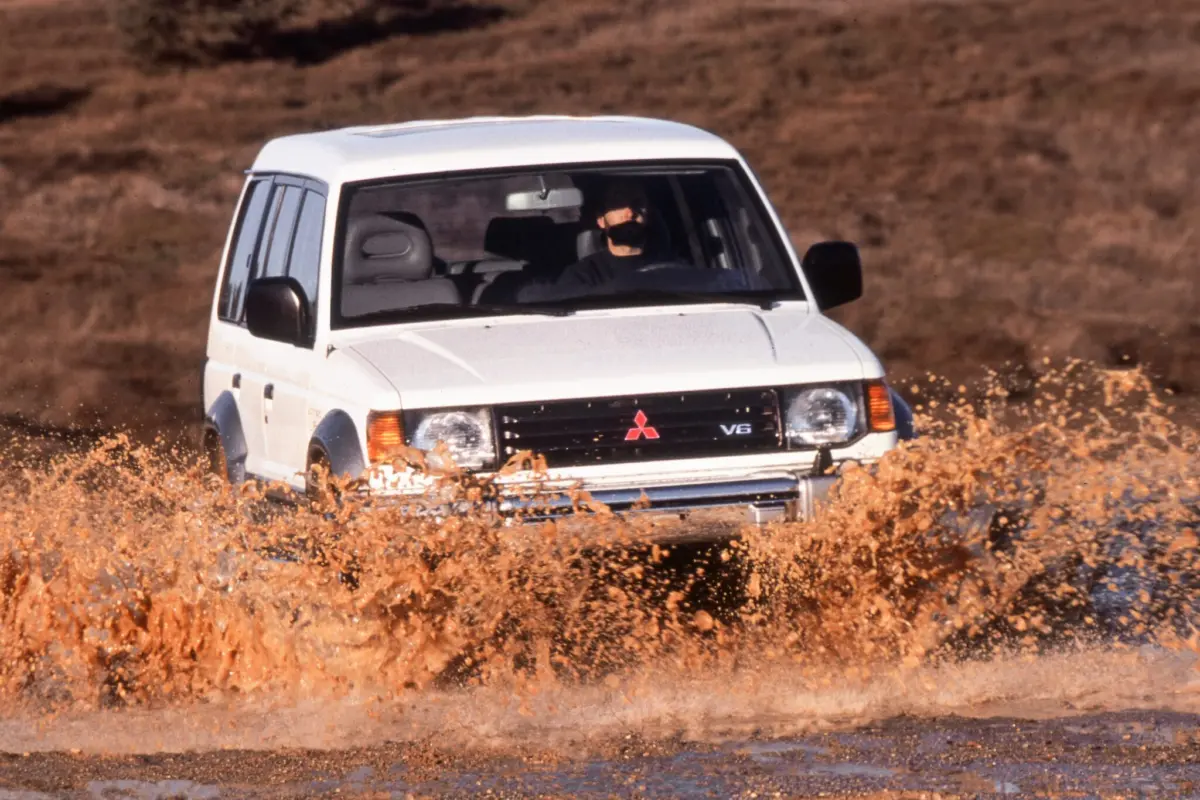
Let’s be honest here: the reason sport-utility vehicles are selling faster than earplugs at a Michael Bolton concert is not because global temperatures are down and average snowfall is up and Americans need four-wheel drive in order to reach the video store for those adult-education tapes hidden behind that veil of beads. It’s because, in contrast to other roomy conveyances like station wagons and minivans, every SUV projects an image.
The Hummer wears a Gold’s Gym body. The Jeep Grand Cherokee is as outdoor-chic as an Orvis flyrod. And the Mitsubishi Montero SR, the object of this comprehensive road test review from the March 1995 issue of Car and Driver, packs all the techno-wizardry of a Sharper Image catalog.
For buyers navigating the mid-1990s automotive landscape, the appeal of utility vehicles had shifted firmly away from purely utilitarian grit toward lifestyle branding and conspicuous consumption. While traditional station wagons languished in suburban driveways, SUVs became rolling statements of personal identity. Mitsubishi positioned the Montero SR squarely at the intersection of rugged capability and cutting-edge gadgetry, aiming straight for consumers who preferred their adventures with a heavy dose of electronic assistance.
Those who enjoy Pentiums, DirecTV, and advanced camera systems will feel immediately at home inside the cabin of the SR. The instrument cluster looks straight off the set of a Cold War thriller, complete with dedicated gauges for everything from the four-wheel-drive engagement mode to oil pressure, voltage levels, and a useful new electronic compass alongside an exterior-temperature display that mercifully replaces the frivolous "lean-angle" inclinometers found in lesser off-roaders.

Indeed, the Mitsubishi Montero SR boasts more switches and buttons than a ceremonial military parade. The stereo system alone—an imposing center-console panel featuring a sharp digital display and an elaborate graphic equalizer—looks fully capable of computing the 1995 United States federal budget or high-profile celebrity divorce settlements. The doors, dashboard, and headliner brim with tactile controls for everything from power locks and side mirrors to a now-standard power sunroof.
An optional equipment package allows the driver to tailor the vehicle’s suspension damping across three distinct settings: soft, medium, or hard. Selecting the softest setting delivers a remarkably cushy ride that dampens rough pavement with ease. If the driver grows bored with adjusting the suspension, they can tinker with another dashboard switch that alters the response profile of the four-speed automatic transmission between "normal" and "power" modes. A dedicated "hold" setting is also included to facilitate second-gear starts when navigating slippery winter conditions.
Beyond its space-age cockpit appointments, the Montero is genuinely spacious, offering enough interior volume to comfortably seat up to seven adults when the rear jump seats are deployed. This is a remarkably tall sport-utility vehicle; the Montero towers a full ten inches higher than a Jeep Grand Cherokee. It is the sort of imposing height that forces drivers to duck instinctively as they pull into a standard home garage. In exchange for this lofty altitude, the driver is rewarded with an exceptional, commanding view of the road ahead, while headroom is remarkably generous across all three rows of seating.
In a market segment dominated by grunting, large-displacement V-8 engines and low-revving inline-sixes, the Montero SR’s powerplant is something of an automotive anomaly. Instead of relying on low-end grunt, Mitsubishi fitted its flagship SUV with a high-revving, twin-cam, 24-valve V-6 engine. This 3.5-liter powerplant generates a respectable 214 horsepower, but it requires 10.5 seconds to pull the substantial 4,714-pound vehicle from a standstill to 60 miles per hour—a performance figure that ranks as slightly below average for this competitive class.

Despite the modest acceleration times, the SR manages to feel lively in everyday driving conditions. The engine supplies ready, accessible torque at anything above 2,000 revolutions per minute and never gives the impression of being mechanically strained. Furthermore, it is an exceptionally smooth six-cylinder engine, willingly spinning up to its lofty 7,000-rpm redline without any unpleasant groans or harshness. True, an engine that makes the bulk of its power high in the rev range—peaking at 5,000 rpm in the SR—is not the ideal configuration for lumbering, low-speed off-road maneuvers over jagged rocks. But on paved public highways, which remain the only place the vast majority of SUVs are ever driven, the SR’s multi-valve engine feels entirely right in step with modern expectations.
The Montero SR is equipped with a sophisticated drivetrain designed to match the rest of its high-tech flash. It utilizes an "Active Trac" system that provides full-time four-wheel drive capability alongside the convenience of shifting on the fly, supplemented by an optional locking rear differential for genuine traction emergencies. A three-channel anti-lock braking system that remains fully operational in every drivetrain mode comes included as standard equipment. Additionally, for the 1995 model year, Mitsubishi increased the Montero’s maximum towing capacity by a significant 1,000 pounds, bringing its total towing ceiling to 5,000 pounds.
Like any complex machine, the Montero SR is not entirely without minor flaws. The steering, for instance, continues to exhibit the same sloppy, vague on-center feel that test drivers have noted in previous iterations. Furthermore, some traditional truck buyers may simply find the Montero SR to be overly gadget-focused. Control freaks, however, will find little to complain about, as no other sport-utility vehicle on the market rewards the driver with such an exhaustive degree of set-it-as-you-want-it dominion over the vehicle’s operational parameters.
Overall, the 1995 Mitsubishi Montero SR emerges as a comfortable, highly capable, and cutting-edge machine that naturally inspires thoughts of loading up with compact discs, a NASA-approved coffee thermos, and a new military-grade portable GPS receiver before setting off on a long cruise toward the horizon.

Buyers can tailor that cross-country cruise to match whatever level of aesthetic style they desire. The base manufacturer’s suggested retail price, which includes nearly all of the essential power features and performance hardware, stands at $35,322. However, layering on premium options such as genuine leather seating surfaces, interior wood trim, a compact disc changer, and—in a curious twist for a dedicated off-roader—chrome wheels pushes the final window sticker price to nearly $40,000. That is an image projection sharp enough to make a buyer wince.









No comments yet. Be the first to join the conversation!