
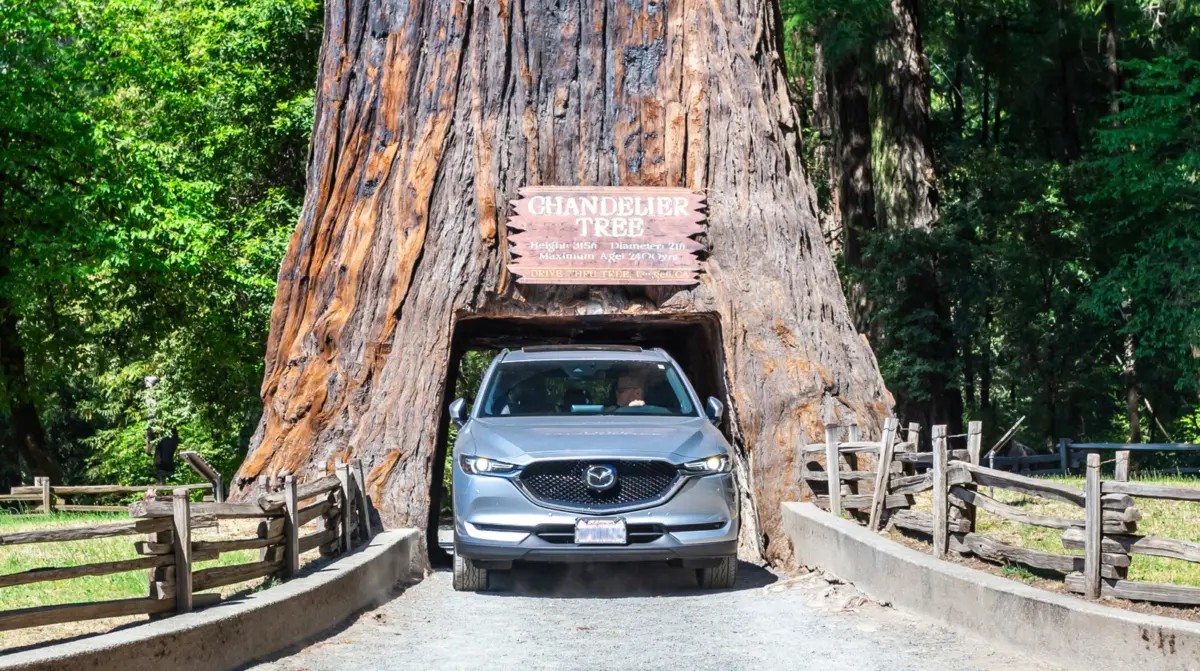
Humanity has long harbored an enduring fascination with conquering nature. Blessed with technical know-how, physical ability, and opposable thumbs, people have spent centuries pulling off feats that push the boundaries of what seems possible. Among the most iconic of these spectacles is the concept of transporting oneself directly through the heart of a massive California redwood, an activity that began long before the first cross-country American road trip and remains a captivating draw for travelers navigating the Pacific Coast.
Back when the logging industry was at its peak and the population of these monumental icons was far more vast than it is today, finding a way to drive, ride, or walk through a living tree was viewed as an engineering marvel. Both giant sequoias and coastal redwoods—proud members of the cypress family—became the canvas for an era of roadside tourism that defined early West Coast travel. While the sheer novelty of these living tunnels might seem unusual or even kitschy to modern observers, the practice offers a fascinating window into how generations past viewed, interacted with, and ultimately learned to value some of the oldest living organisms on Earth.
The historical roots of this automotive and tourism obsession trace back to the late 19th century. In 1878, the first tunnel tree was deliberately created in the Tuolumne Grove, situated in the Sierra Nevada range. The goal was simple yet ambitious: to draw curious travelers deeper into the mountains, capitalizing on a growing public interest in Yosemite and the broader mountainous splendor of California. A massive hole was carved straight through a colossal giant sequoia known as the Dead Giant. Earning its name because it was already a 200-foot-tall snag at the time of the carving, the tree stood as a testament to human ambition until it finally closed to visitors in 1993.
Not long after the Tuolumne Grove experiment captured the public imagination, another engineering feat took shape in 1881. The famous Wawona Tree in Mariposa Grove was carved out, allowing horse-drawn carriages and, eventually, early automobiles to pass directly through its trunk. The Wawona Tree became one of the most photographed and visited natural tourist attractions in the American West, standing tall for nearly a century before a heavy, snowy winter ultimately brought it crashing down in 1969.
Similarly, the Pioneer’s Cabin Tree in Calaveras Big Trees State Park served for generations as both a striking roadside attraction and a tool for educating the public about redwoods. By inviting visitors to drive or walk right through the center of a tree, park operators and conservationists managed to foster a deep, personal connection between everyday people and the towering forests around them. Although the Pioneer’s Cabin Tree ultimately succumbed to a severe winter storm in 2017, its legacy—and the legacy of its sister tunnel trees—remains deeply intertwined with the history of American tourism and the birth of modern forest conservation.
Where to Drive Through a Redwood Today
While many of the earliest tunnel trees have fallen victim to the passage of time, severe weather, or natural decay, drivers who are eager to experience the sensation for themselves still have a few remaining options. Navigating these historic passages requires a bit of care, however, as modern vehicles have grown significantly wider than the automobiles of the early 20th century. Drivers who misjudge the dimensions of their vehicles can easily find themselves in a literal tourist trap, a scenario famously illustrated by modern SUVs getting wedged tightly inside ancient trunks.
Fortunately, travelers touring the northern stretches of California still have a few accessible locations where driving through a tree is possible. Up around Eureka, California, visitors can find the Shrine Tree, located at 13708 Avenue of the Giants in Myers Flat. Interestingly, unlike many of its human-carved counterparts, the expansive portal on the Shrine Tree was initially created naturally by a lightning strike that sparked an interior fire, which was later widened to accommodate vehicles.
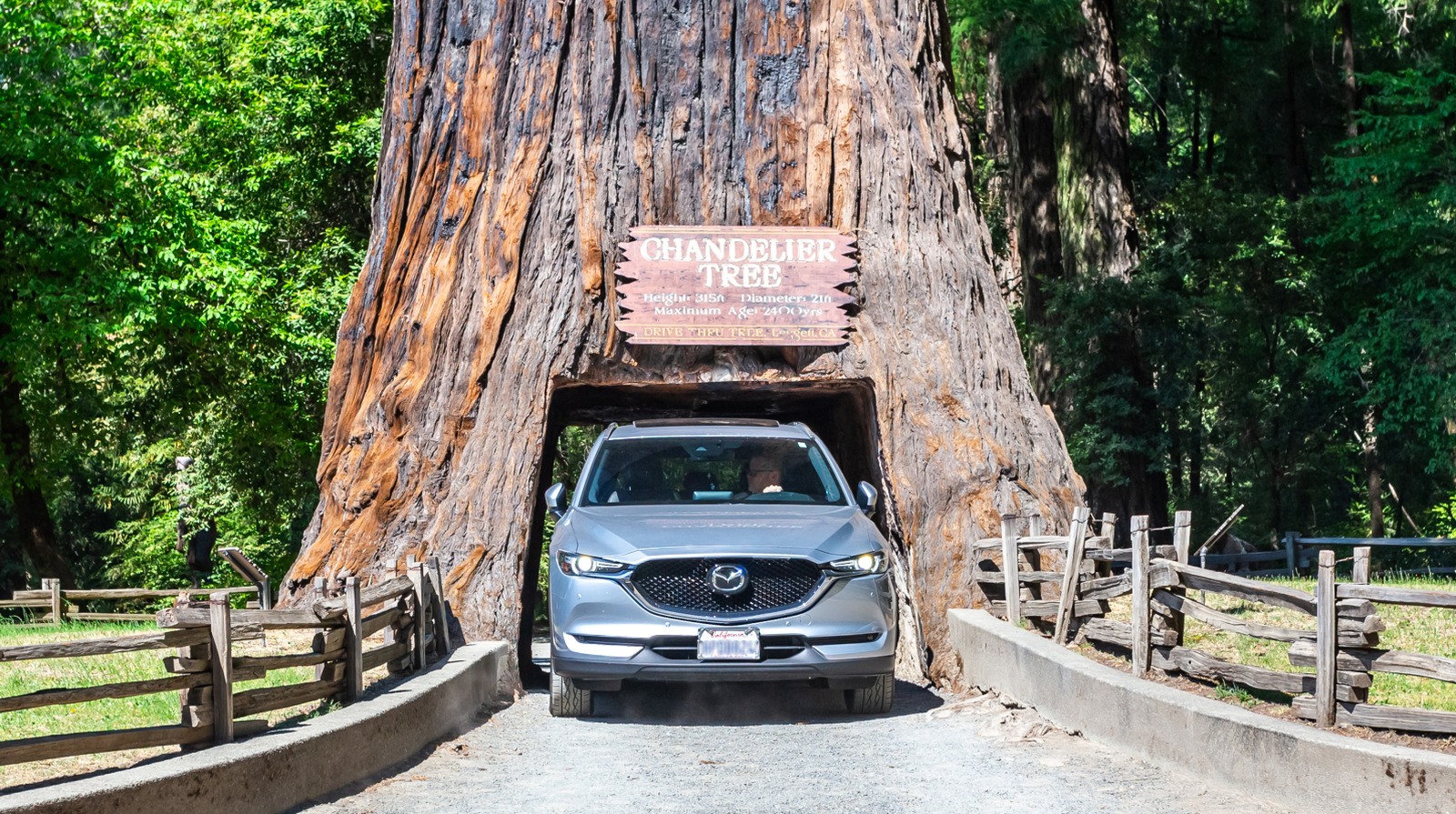
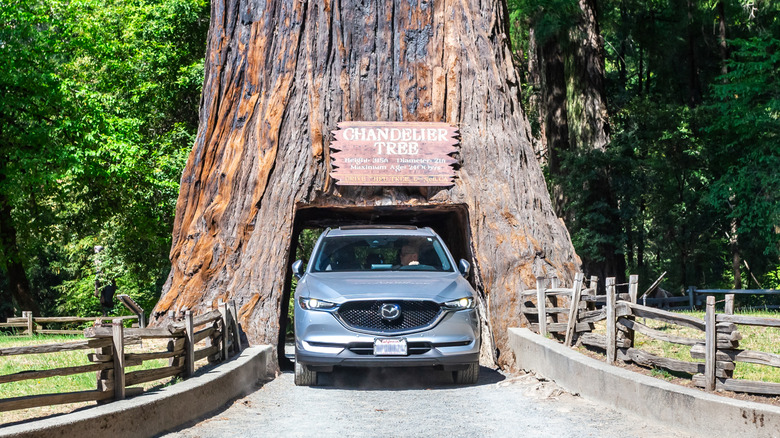
Further north along the Redwood Highway sits the famous Chandelier Tree, located at 67402 Drive Thru Tree Road in the Mendocino County town of Leggett. Aptly named for its distinct, sweeping branches that resemble a chandelier high above the roadway, this tree features a particularly wide opening that accommodates modern passenger vehicles with relative ease.
Another notable stop is the Klamath Tour Thru Tree, situated north of Eureka at 430 CA-169 in Klamath. Carved as recently as 1976, this specific drive-thru attraction was engineered with modern preservation in mind, carefully cut around living portions of wood so that the tree’s health would not be severely compromised or its upward growth stunted.
There is a practical botanical reason why motorists can only drive through coastal redwoods today, as those magnificent specimens are the only types of giant redwoods remaining natively in the lower 48 states. While the practice of carving roads through living trees might strike some contemporary travelers as an outdated roadside gimmick, the broader cultural theme behind the activity continues to hold deep value.
These roadside spectacles serve as powerful magnets, drawing people out of their everyday routines and directly into the breathtaking environments where these ecological wonders thrive. Along the way, the experience educates the public about the rich history of the West Coast, the turbulent past of the early timber industry, and the critical importance of preserving these ancient forests for future generations. Moreover, visiting these unique landmarks allows travelers to directly support the small local municipalities and communities that serve as stewards and neighbors to the world’s tallest trees.








No comments yet. Be the first to join the conversation!