
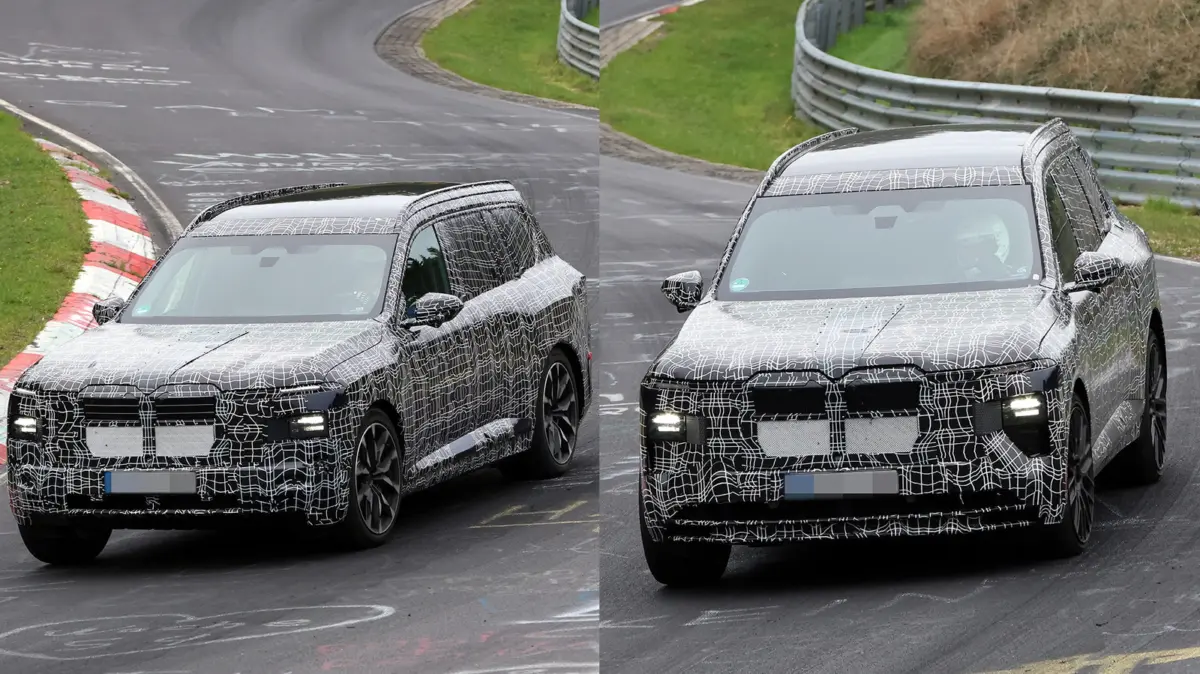
Despite breaking ground early in the luxury crossover segment with the introduction of the first-generation X5 in 1999—followed shortly by the original X3 in 2003—BMW took a remarkably deliberate approach to entering the full-size, three-row SUV market. It wasn’t until early 2019 that the BMW X7 officially made its market debut, immediately establishing itself as a formidable competitor in the elite luxury hauler class. Now, rather than letting its flagship utility vehicle languish in an increasingly competitive landscape, BMW is aggressively pushing forward with development. The highly anticipated second-generation X7 has recently been captured by spy photographers undergoing rigorous testing at Germany’s legendary Nürburgring circuit, appearing in both traditional V8-powered M60 guise and as the fully electric iX7.
BMW’s ongoing product strategy heavily leans into the widespread success of its electrification efforts, particularly as the Munich-based automaker transitions its vehicle lineup into the modern era. Under the current design philosophy, vehicles stemming from the Neue Klasse era share a cohesive visual identity and nomenclature across both internal combustion engine models and their battery-electric counterparts. This unified design approach is clearly evident in the upcoming X7 family. Spy shots reveal that both the gas-powered variant and the pure EV will share nearly identical proportions, with their primary visual differentiators limited to bespoke grille configurations and the presence or absence of traditional exhaust outlets.
The timing of this next-generation rollout could hardly be more strategic for the German manufacturer. Mercedes-Benz has recently introduced a second facelift to keep its aging GLS relevant in the marketplace, while Audi is preparing to launch the Q9, representing the brand’s first serious endeavor in the ultra-luxury large SUV segment. Significantly, neither of BMW’s primary domestic rivals currently offers a dedicated fully electric variant in this specific size class, giving the upcoming iX7 a potential first-mover advantage in the electric flagship three-row utility market.
Split Lights, and Maybe a Split Tailgate
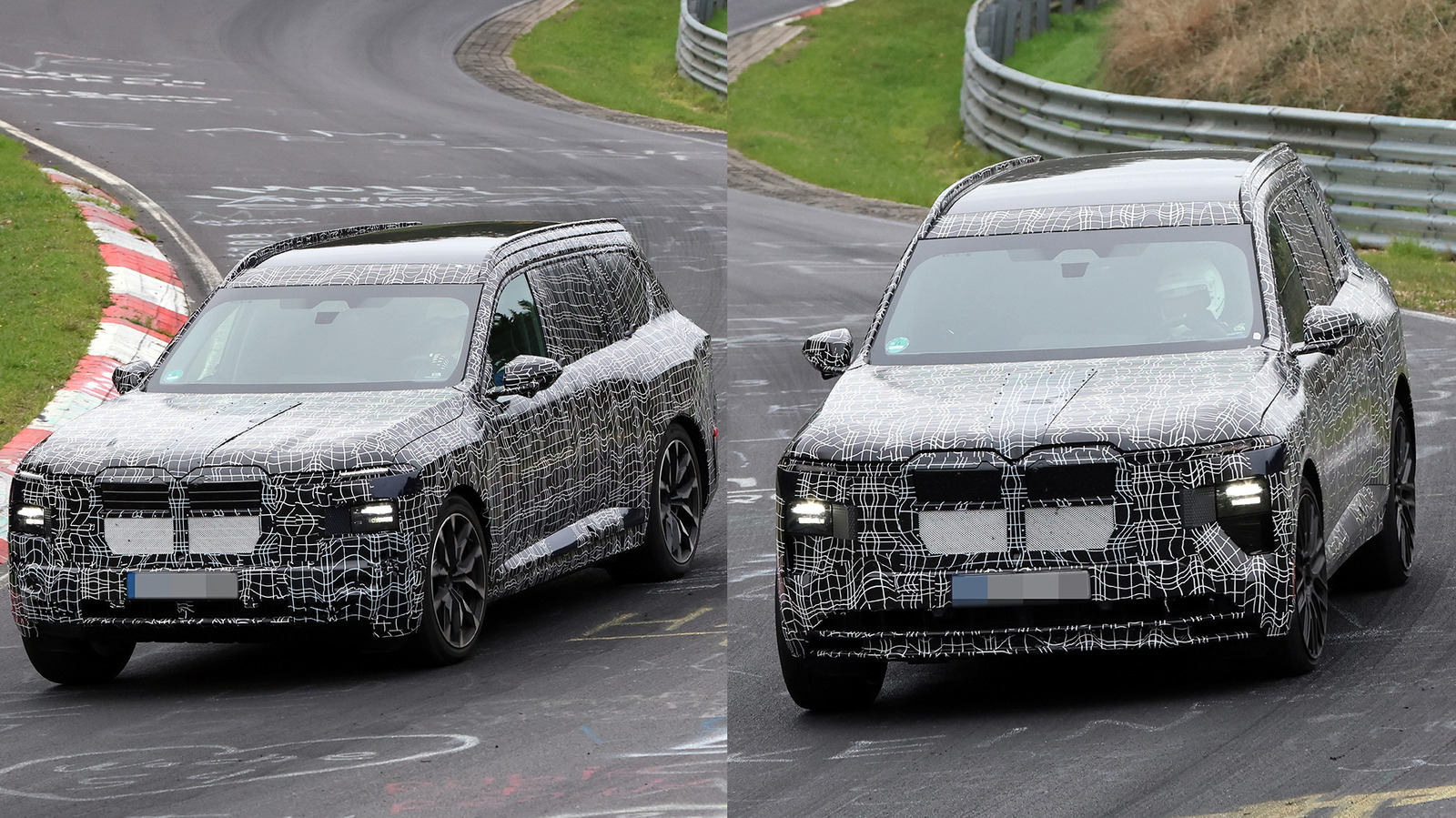
Close inspection of the prototype vehicles testing at the Nürburgring reveals a bold evolutionary step in BMW’s polarizing exterior design language. The iX7 and the X7 M60 exhibit a revised interpretation of the brand’s contemporary split-headlight motif. These lighting elements appear much more refined and resolved than those found on the outgoing first-generation X7, bearing a closer stylistic resemblance to the sophisticated fascia seen on the recent 7 Series facelift. Furthermore, the performance-oriented M60 variant features distinctive yellow running lights, matching styling cues recently observed on other upcoming performance models like the M350 and the iX4 M60.
At the front, both versions sport a pair of tall kidney grilles, though distinguishing details set them apart. The electric iX7 incorporates horizontal vanes within its closed-off grille structure alongside a slim lower front bumper intake, whereas the V8-powered X7 M60 features a much larger, more aggressive lower intake designed to feed cooling air to its forced-induction engine.
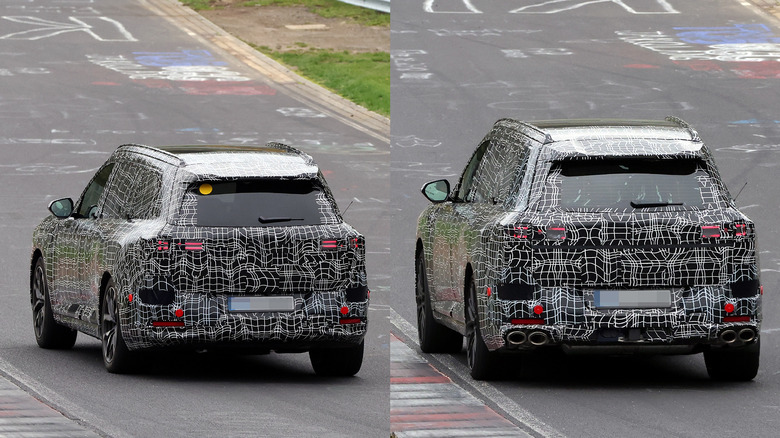
Around the back, the prototypes showcase wide taillight assemblies featuring a pair of thick, illuminated horizontal graphics, with slight pattern variations differentiating the powertrain types. The X7 M60 clearly signals its internal combustion performance credentials through a pair of prominent, round exhaust tips integrated into each corner of the rear bumper, while the iX7 features a completely smooth, unbroken rear fascia.
Questions remain regarding the cargo area functionality of the new generation. It remains difficult to determine whether the upcoming X7 will retain the outgoing model’s signature split tailgate. While this convenient two-piece opening mechanism was famously dropped from the recently redesigned X5 because market research indicated buyers did not prioritize the feature, industry observers suggest that a split tailgate retains significantly higher utility and appeal on a larger, more opulent vehicle like the flagship X7.
The Luxury of Choice
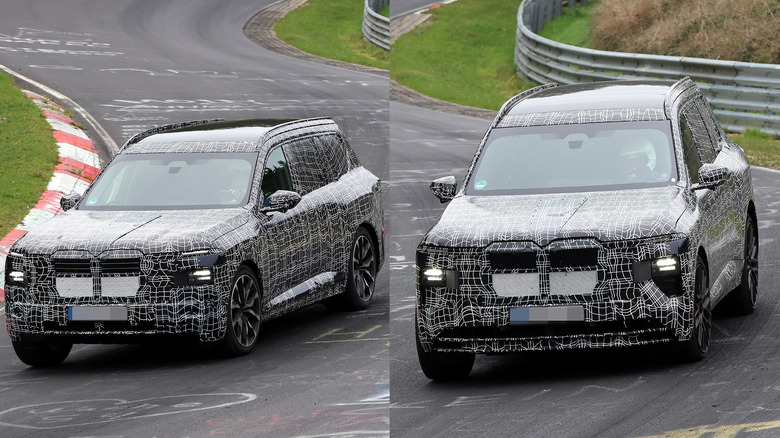
From a profile perspective, the upcoming X7 retains a remarkably blocky, commanding body shape and greenhouse structure that closely mirrors the proportions of the original model. However, closer inspection reveals prominent, muscular fenders sculpted in a manner similar to the iX3 and the X5, alongside the adoption of flush, wing-tip-style door handles first popularized on the X5. While Audi reportedly experimented with similar flush door handle designs during the development phase of its upcoming Q7 and Q9 models before ultimately reverting to traditional pull-style handles due to prevailing preferences among North American consumers, it remains to be seen whether BMW will stick with the flush design throughout the X7’s production lifecycle.
Powertrain options for the internal combustion versions are widely expected to mirror the mechanical hierarchy established by the latest X5 and 7 Series models. A turbocharged inline-six engine equipped with mild-hybrid technology is expected to serve as the baseline powerplant for the standard X7, while the high-performance M60 variant will lean on a potent twin-turbocharged V8 engine. Interestingly, unlike equivalent performance trims available in the X5 and 7 Series families, early indications suggest the X7 M60 will bypass any plug-in hybrid assistance, a decision that underscores BMW’s continued commitment to pure internal combustion power for its heaviest performance haulers, largely driven by strong demand in the American market.
Meanwhile, the electric iX7 lineup is projected to offer multiple variants, all expected to rely on dual-motor setups delivering standard all-wheel drive, with targeted EPA driving ranges anticipated to comfortably surpass the 400-mile threshold. An eventual M Performance derivative of the electric iX7 is also expected to join the portfolio further down the road, though enthusiasts hoping for a dedicated, full-fat X7 M or iX7 M may need to temper their expectations. Nevertheless, the continuation of an ultra-luxurious Alpina variant—likely succeeding the current Alpina XB7—remains a near certainty for buyers seeking the absolute pinnacle of bespoke craftsmanship.
Given the advanced state of testing and the relatively light layers of camouflage visible on these current prototypes, industry analysts expect BMW to officially unveil the second-generation X7 in the coming months, with the electric iX7 and the traditional combustion-powered X7 variants scheduled to launch concurrently.









No comments yet. Be the first to join the conversation!