
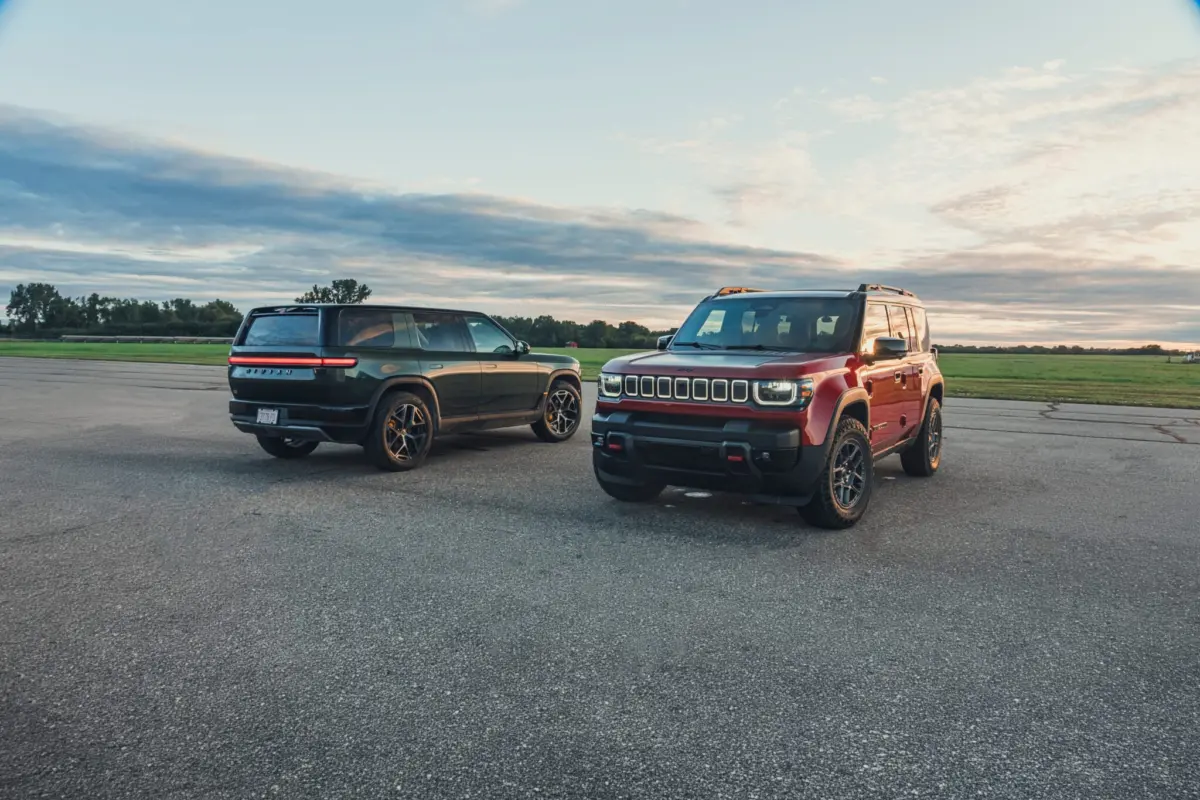
Normally, it is easy to identify an established automotive incumbent. Legacy manufacturing giants and historic nameplates tend to enjoy massive advantages—decades of accumulated engineering experience, deep household name recognition, and virtually limitless financial resources—that are typically scarce for upstart companies trying to break into the market. But when examining the 2027 Rivian R2 and the 2026 Jeep Recon Moab, it becomes remarkably difficult to discern who holds the true mantle of the incumbent and who is merely playing the role of the ambitious challenger.
Jeep has been building rugged, trail-ready sport-utility vehicles since the 1940s—a heritage the company is always happy to constantly remind consumers about—yet it remains a relative newcomer to the world of mass-market battery-electric vehicles. Meanwhile, the very first Rivian vehicles hit public roads just five years ago, making the brand a modern upstart in the broader automotive landscape. However, battery-electric power is the sole focus of Rivian’s engineering efforts, and the R2 represents the company’s third dedicated model. Faced with these contrasting strengths, the question remains: Which type of incumbency provides a more advantageous position in the rapidly shifting electric vehicle market?
The freshly revealed Rivian R2 follows a familiar automotive launch strategy by introducing its most expensive, fully loaded version first. The tested 2027 model is a Performance trim equipped with the Launch package, a configuration that brings an impressive 4,400-pound tow rating and advanced hands-free driving assistance features. Simpler, more affordable variants are slated to arrive soon with prices hovering closer to the $50,000 mark, but the tested vehicle—complete with a $2,000 Launch Green paint job—tallied a final price of $61,485.
Fortunately, one of the R2’s most delightful and practical features comes standard across the lineup: power roll-down hatch glass. For years, traditional sport utilities like the Toyota 4Runner have relied on the lifestyle appeal of a dropped rear window, perfect for sliding a surfboard through or letting a couple of dogs breathe fresh air instead of tailpipe exhaust fumes. Rivian has smartly embraced that exact utility for its electric platform.
The Jeep Recon, by contrast, is currently available exclusively in the high-spec Moab trim. Within the Jeep ecosystem, the Moab moniker signifies elevated off-road capability alongside a correspondingly elevated price tag. Indeed, the Recon’s base sticker price of $68,990 easily exceeds the R2’s as-tested figure. A collection of factory options further inflated the tested vehicle’s price to a substantial $73,345. Major options included a $1,995 Comfort package that adds ventilated front seats and heated second-row seats, as well as a $995 towing package that caps capacity at 3,300 pounds.
Despite the high cost, plenty of serious off-road hardware comes standard on the Jeep, including heavy-duty skid plates, an electronically locking rear differential, and aggressive 33-inch all-terrain tires. Because Jeep is leaning heavily into an electric interpretation of its iconic Wrangler ethos, the Recon’s doors and rear windows can be completely removed without the use of tools. However, tipping the scales at approximately 70 pounds each, removing those hefty doors might require more than just enthusiasm.
Exterior and Interior
Visually, the exterior styling of the Rivian R2 can best be described as a shrunk-down version of the larger R1S. It features a clean, modern aesthetic that employs Rivian’s signature ovoid headlights. There is nothing overly revolutionary about the shape, but that conservative approach works entirely to the brand’s advantage. Rivian wants to sell the R2 in high volumes, and aggressively divisive styling is rarely a smart play when attempting to conquer market share from established internal-combustion rivals—a lesson highlighted by more radical designs like the Tesla Cybertruck.

The R2 benefits visually from having its large wheels pushed out directly to the corners. The tested vehicle wore all-season tires wrapped around 21-inch wheels, representing the mild-mannered "mall-crawler" specification, though Rivian does offer tougher-looking 20-inch wheels paired with true all-terrain tires. Opting for those rugged tires, however, will noticeably reduce the vehicle’s EPA-rated driving range from 330 miles down to 307 miles.
The Recon’s aesthetic, on the other hand, is intentionally anti-electric vehicle, making virtually zero concessions to aerodynamics or rolling resistance. It is square, tall, and features a front bumper that evokes a bulldog’s underbite, combining to create an atmosphere-battling drag coefficient of 0.404. While it does not quite pull off the studied minimalism of a traditional Wrangler, the Recon stands as the most off-road-focused electric vehicle on the market outside of specialized heavyweights like the Hummer EV or the Mercedes-Benz G580e.
The Jeep is also capable of dramatically altering its appearance depending on whether the doors and windows are attached. When fully buttoned up, it presents as a regular SUV with a rugged off-road bent, but removing the doors and opening the full-length canvas roof creates an open-air motoring experience reminiscent of classic dune buggies.
Inside the cabin, the R2 and the Recon accurately reflect their respective manufacturers’ distinct design philosophies. Whether a driver prefers the spare, screen-centric environment of the Rivian or the more conventional layout of the Jeep ultimately comes down to personal priorities and generational preferences, though the Recon is undeniably more user-friendly on a day-to-day basis.
Stellantis may experience occasional shifts in its broader product planning—bouncing between electric vehicles and traditional V8 engines—but its vehicle interiors remain consistently functional, from Jeep and Ram to the Chrysler Pacifica. A tasteful splash of tan leather across the top of the steering wheel matches the seat upholstery, while a bright red panel on the center console immediately draws attention to the physical rocker switch used for selecting terrain modes.
Both the Rivian and the Jeep feature large central touchscreens, but the Recon smartly augments its screen functions with hard physical buttons located on both the dashboard and the steering wheel, alongside traditional rotary knobs for volume and tuning control. Furthermore, the Jeep’s Uconnect 5 infotainment system natively supports wireless Apple CarPlay and Android Auto, whereas the Rivian stubbornly refuses to allow phone mirroring.
Rivian minimizes physical controls inside the R2 by heavily imitating Tesla’s controversial strategy of forcing multi-functional scroll wheels to handle numerous distinct tasks. Drivers wishing to adjust the steering wheel position or the exterior mirrors must navigate through a sub-menu within the central touchscreen and temporarily assign the steering wheel scroll wheels—dubbed "haptic halo wheels" by Rivian—to whatever specific adjustment they wish to make.

While this interface can be annoying, it is likely not an adjustment an owner has to make frequently. At least while wrestling with the digital menus, occupants can admire the lovely birch wood trim that stretches across the width of the dashboard.
Both interiors provide an expansive view of the sky above, with the Rivian utilizing a fixed panoramic glass roof and the Jeep offering a true convertible experience courtesy of its power roll-back soft top. The R2 can drop its side windows and the rear hatch glass with the touch of a button, though the rear quarter windows remain permanently fixed.
The Recon allows owners to completely remove those rear quarter windows and, unlike the cumbersome doors, safely store them inside the vehicle using dedicated storage bags. Both SUVs enthusiastically embrace open-air travel, but the Jeep is far more deeply committed to the concept. The catch is that the driver must be equally committed to dealing with the associated compromises.
Powertrain and Performance
Both the Recon and the R2 showcase the hyperbolic, sports-car-shaming acceleration performance that has quickly become the expected norm for modern electric vehicles. Automobile enthusiasts are now old enough to remember when a sub-four-second run to 60 mph in a Chevrolet Corvette Z06 was considered wickedly fast. Today, everyday family off-roaders can effortlessly torch classic sports cars in a straight-line sprint.
The Rivian R2 utilizes a dual-motor setup that combines to produce 656 horsepower and 609 pound-feet of torque. This immense output translates to a blistering 3.5-second sprint to 60 mph and an 11.4-second quarter-mile run at a terminal speed of 126 mph.
The Jeep Recon is even more powerful, routing its energy through massive Nexen Roadian ATX tires driven by an astonishing 670 horsepower and 620 pound-feet of torque. The Recon easily matches the R2’s 3.5-second time to 60 mph, though it falls slightly behind in the quarter-mile, requiring 11.8 seconds.
The Jeep’s quarter-mile performance is artificially restricted by an electronic 111-mph top speed limiter, which the vehicle reaches more than a full second before crossing the finish line. Even with that governor in place, running an 11-second quarter-mile in a heavy, boxy off-roader is remarkable.

When it comes to efficiency and long-distance driving range, however, the engineering divergences become apparent. The Jeep relies on a 94-kWh battery pack that is physically larger than the Rivian’s 88-kWh unit, but the R2’s superior aerodynamic efficiency and powertrain management allow it to travel significantly further between charging stops.
During rigorous 75-mph highway range testing, the R2 managed an impressive 260 miles of driving range, which is a full 100 miles further than the Recon could manage. The Rivian also charges at a slightly faster rate, replenishing its battery from 10 to 90 percent in 39 minutes, compared to 43 minutes for the Jeep.
When not maintaining high highway speeds, the Recon fares somewhat better—its EPA-estimated mixed range is 222 miles—but that figure still falls well short of the crucial 300-mile threshold that has quickly become a standard expectation for modern electric vehicle buyers.
Neither the Rivian nor the Jeep are designed to be nimble corner carvers, but their handling behavior can easily be predicted by simply looking at their upright proportions. On the skidpad, the Jeep generates 0.74 g of lateral grip, while the Rivian manages a slightly more composed 0.81 g.
The R2 also boasts superior braking performance, hauling itself down from 70 mph in 178 feet, compared to 201 feet for the Jeep. Both vehicles handle much like old-school American muscle cars—hellaciously quick when the road straightens out, but entirely unsuited for keeping pace with a lightweight sports car through tight mountain switchbacks.
The Driving Experience
Although both contenders are calibrated more for everyday on-road comfort than hardcore track performance, the Recon is far more competent and composed on pavement than the traditional gasoline-powered Wrangler it emulates. The inclusion of an independent front suspension and modern rack-and-pinion steering works wonders to civilize the Jeep driving experience.
It is a tall vehicle, but drivers do not get the unsettling sensation of navigating a top-heavy ship, nor does the suspension suffer from the harsh, side-to-side head snap that frequently plagues vehicles with overly aggressive anti-roll bars. The cushy, absorbent ride quality is further aided by the all-terrain tires’ generous 70-profile aspect ratio, meaning owners are unlikely to bend a Recon wheel on a severe pothole or a stray rock out on the trail.

Many drivers feel the R2 offers a superior ride quality compared to its larger sibling, the R1S, despite utilizing a simpler suspension setup featuring conventional anti-roll bars. The R2 clearly benefited from extensive research and development, reflecting its critical importance to Rivian’s long-term business strategy.
Specifically, the spring and damping rates feel remarkably harmonious, providing firm body control while retaining enough vertical compliance to comfortably soak up broken, uneven pavement. There is never any sense of the suspension abruptly running out of travel, whether compressing over deep dips or extending over crests.
Both the Recon and the R2 feature mandatory regenerative braking whenever the driver lifts off the accelerator pedal, but the Jeep’s system is noticeably milder, feeling much more like natural coasting compared to the aggressive deceleration of the Rivian. Rivian firmly insists that owners embrace one-pedal driving, leaving little room for customization.
Drivers who prefer their vehicles to naturally coast down hills—which thermodynamic physics dictates is often more efficient than constantly converting kinetic energy into electricity and back again—might find the R2 a bit too intense in its regen enforcement, even when toggled to its weakest setting.
While prolonged off-road testing was limited during initial evaluations, a direct capability contest between the two might be closer than expected. The Jeep takes its off-road mission seriously, offering 9.1 inches of ground clearance alongside those 33-inch tires, but the Rivian actually boasts slightly more ground clearance at 9.6 inches, and its 32-inch tires are not significantly smaller. Both machines would undoubtedly prove formidable and entertaining in muddy conditions.
And The Winner Is . . .
The Jeep Recon is undeniably quick, charismatic, and packed with personality, but its high price tag and heavily stunted highway driving range suggest that Jeep built this model primarily to establish an electric beachhead rather than to capture serious mass-market volume. In many ways, it proves to be better at being a traditional Jeep than it is at being an efficient electric vehicle.
If buyers are seeking an electric alternative to the classic Wrangler, the Recon is the closest option available today. It can be driven in a rugged, open-air dune-buggy configuration, and strangers will likely continue the Jeep tradition of leaving rubber ducks on the windshield, but the Recon remains a fun concept that desperately awaits the next generation of battery technology to significantly extend its operating range.

When a consumer spends upwards of $70,000 on a modern vehicle, it stings to be thoroughly outperformed in driving range by a much cheaper economy car.
Ultimately, the Rivian R2 wins this comparison because it successfully delivers the striking design and majority of the performance capabilities of the larger R1S at a substantially lower price point. It is relatively straightforward to build a compelling electric vehicle when charging over $120,000, but achieving that same level of appeal in the high-$60,000 range—the true heart of the consumer market—is far more impressive.
Featuring more than 300 miles of EPA-rated driving range paired with instantaneous acceleration, the R2 proves to be the well-rounded electric family SUV worthy of a permanent spot in the driveway.








No comments yet. Be the first to join the conversation!