
Every single installment of the series opened with the same stark reality: the 30-year fixed mortgage rate climbing higher than the week before. It began at 6.66% in late August, pushed past 7% ahead of the HousingWire Mortgage Banking Summit, and hit 7.28% on the morning executives took the stage in Dallas, marking Freddie Mac’s highest weekly average in nearly three years. The rate clock that organized the entire six-part series never stopped ticking. The ultimate question closing out the series was whether mortgage companies across America were organized to survive it.
On October 1, that core question—along with four others—was put directly to the executives in the room through a live survey, with the results projected in real time as the votes rolled in. While the authors expected the room to validate their previous arguments, the gathered leadership did something far more useful. They issued a verdict, and that verdict carries a sense of urgency that transcends anything written in the preceding five articles.
No one is waiting for the Fed
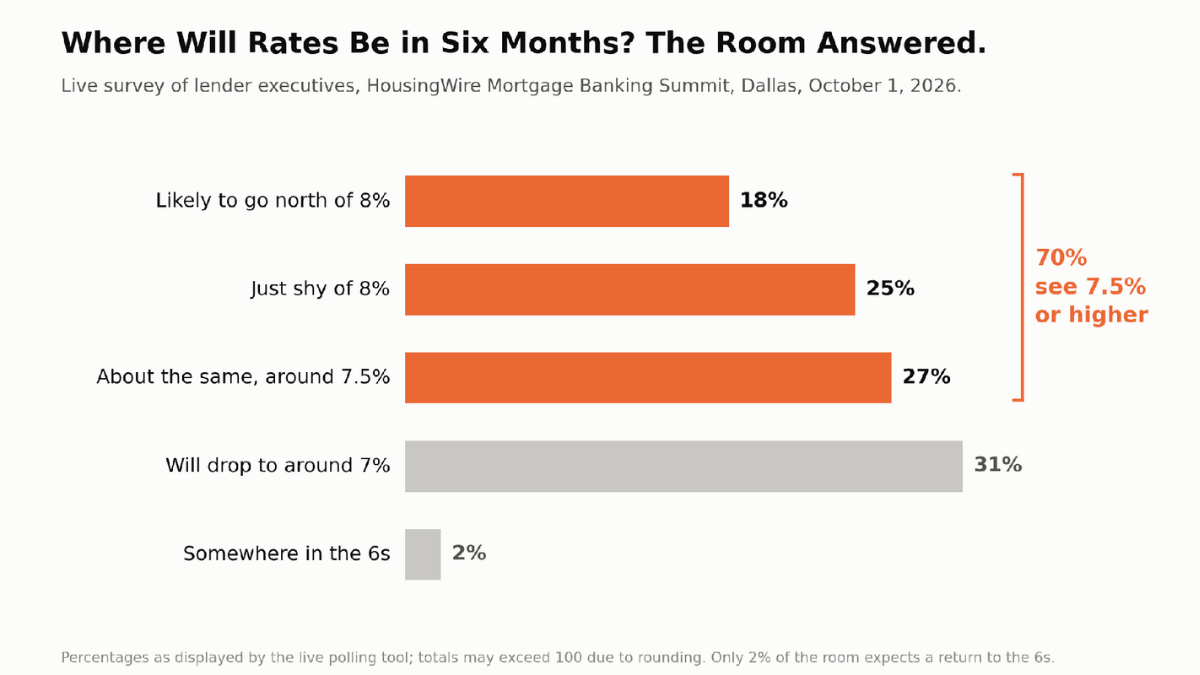
The discussion begins with the data point that should immediately reset every 2027 budget currently in draft across the industry. When asked where mortgage rates will stand six months from now, 27% of the executives in the room predicted they will remain right where they are, hovering around 7.5%. Another 25% projected rates just shy of 8%, while 18% forecasted figures north of 8%. Combined, an overwhelming seven in ten mortgage executives in the United States expect interest rates to anchor at 7.5% or higher well into 2027. Only 31% expect rates to ease down to roughly 7%, and a mere 2%—essentially a statistical rounding error—anticipated a return to the 6% range.
Independent forecasts heavily align with the sentiment in the room. The Mortgage Bankers Association (MBA) projects total originations of $2.12 trillion for 2026 and $2.10 trillion for 2027. This represents a flat market averaging roughly 5.5 million loans a year—fewer total units than the industry closed back in 2009 during the depths of the financial crisis. Meanwhile, single-family housing permits are running 25% below the levels seen in the late 1990s, builder outlooks remain negative through 2027, and between 80% and 90% of all new-home sales now require financial rate buydowns simply to reach the closing table.
Synthesizing these facts paints an unambiguous strategic picture. There is no rate relief on the horizon, and there is no hidden surge of volume waiting to rescue per-loan economics via the market denominator. Whatever it currently costs a firm to originate a loan is the exact cost structure they will carry into 2027, unless they actively dismantle and remove those expenses themselves.
2027–2028: The real truth confronting IMBs as LOs migrate
History offers a single modern parallel for this market environment, though it belongs to a generation ago. The last full year in which the 30-year fixed rate averaged between 7.5% and 8% was 1997. That year, the industry produced roughly $860 billion in volume. Because the average loan size was approximately $115,000, those dollars represented an estimated 7.5 million closed loans.
By contrast, the industry will originate $2.1 trillion in 2026—two and a half times the dollar volume of 1997—yet close only about 5.5 million loans. Adjusting for demographic growth reveals an even sharper contraction. The United States now has roughly a third more households than it did in 1997, meaning the overall transaction rate has plunged from approximately 74 closings per 1,000 households down to roughly 41. The price of money has returned to late-1990s levels, but with half the transactional activity, and current forecasts project this constrained condition extending through 2028.
A second critical divergence from the 1990s strips away the industry’s traditional escape hatch. In 1997, the outstanding mortgage universe carried interest rate coupons from the high-rate eras of the 1980s and early 1990s, meaning every dip in rates sparked a massive refinancing wave. Lenders could consistently refinance their way out of slow purchase markets. That mechanism is effectively gone.
Today, roughly seven in ten outstanding mortgages carry interest rates below 5%, confining the potential refinanceable pool almost entirely to the 2023 through 2026 vintages. Even within that narrow pool, AI-powered digital lenders and automated servicers hold the advantage. They monitor servicing data, payoff requests, and credit inquiries in real time, recapturing loans before traditional retail loan officers even realize an opportunity exists. The refinancing valve is smaller than at any point in modern mortgage history, and what remains of it has largely been claimed by tech-enabled market leaders.
A market characterized by fewer transactions, zero refinance relief, and a rigid industry cost base naturally forces consolidation. Loan officers understand this mathematical reality even if their corporate leadership hesitates, and they are already voting with their feet.
Over the preceding nine months, loan officers updating their National Mortgage Licensing System (NMLS) registrations have driven the broker and wholesale channel to become the only segment in the industry with net positive production growth, capturing more than $8 billion in volume. Independent mortgage banks (IMBs) shed nearly $2 billion in production during this migration, while traditional banks lost more than $5 billion.

These figures do not represent loans lost to a competitor offering a slightly better rate sheet down the street. Instead, originators are abandoning the traditional corporate employment model altogether, migrating to non-delegated and broker platforms where massive wholesale entities provide a manufacturing infrastructure that smaller, independent firms can no longer afford to build on their own.
Yet, when executives in the room were asked which competitors worried them most, only 8% pointed to brokers and non-delegated lenders. Fully 40% cited consumer-direct and digital platforms. Both answers highlight a blind spot. Consumer-direct channels represent the loud, visible threat backed by heavy advertising budgets, whereas the wholesale channel serves as the quiet drain carrying core production out of the building. In essence, industry leadership is watching the front door while inventory slips out through the warehouse.
Seventy-eight percent agree, but zero percent will touch the biggest line
When surveyed about their organizational plans, 78% of the executives in the room offered the exact same answer: reduce operating costs to enable more competitive pricing. It stood as the most lopsided survey result of the day. When asked how they plan to defend against market competition, 45% again pointed to cost reduction, 30% prioritized strategic partnerships with Realtors and builders, and 21% pointed toward a broader product mix. Only 4% stated they intended to pay loan officers more.
Examining the other side of the ledger reveals the paradox. Exactly zero percent of respondents selected paying loan officers less. Zero percent labeled the broker channel a temporary fad, and only 4% indicated plans to sell their companies.
Synthesizing these responses outlines the industry’s operational trajectory for the next three years. There is near-unanimous agreement that overhead costs must come down. Simultaneously, there is a tacit understanding that compensation—the largest single cost line, accounting for 62% to 65% of direct production costs—remains politically untouchable. That leaves executives with one primary lever: everything situated below the loan officer. Fulfillment, production support, and corporate overhead are precisely the areas where artificial intelligence now performs heavy lifting, reading files, clearing underwriting conditions, balancing disclosures, and reviewing entire loan populations for quality control.
Modeling this operational shift demonstrates that the cost per closed loan can drop significantly from roughly $11,900 toward $8,000, cutting the operating stack below the loan officer by more than half.
The 78% consensus represents a clear mandate, but intention and execution are entirely different metrics. The gap between planning to lower operational costs and actually functioning at a lower cost baseline will determine the next cycle’s winners and casualties. Competitors who have already closed that efficiency gap are currently pricing loans at levels others struggle to match.
Evaluating the core tests of modern lending
The broader six-part series rested on four foundational stress tests designed to measure structural health across the industry:
Scale is not determined by sheer size, but by execution. A gap of approximately $6,350 per loan separates top-quintile lenders from bottom-quintile operators. If generating the next billion dollars in production does not demonstrably lower unit costs, a company is simply growing larger rather than stronger.
Regarding the customer base, an archived database of past borrowers does not constitute a franchise. Only permissioned, durable relationships capable of surviving regulatory restrictions like the Homebuyers Privacy Protection Act and the TCPA can generate reliable recapture, cross-sell, and affinity value.
Defensibility requires more than great personnel and localized service. A true competitive moat must be deliberately selected and fully funded, whether that advantage lies in low-cost manufacturing, purchase distribution, servicing recapture, or a specialized product niche.

Finally, technology licenses represent simple overhead expenses unless they produce measurable operating leverage—allowing a firm to handle increased volume without adding proportional headcount.
These four pillars culminate in strategic optionality, defined simply as having attractive choices available before desperation forces a decision. Lenders passing these tests retain the freedom to grow, acquire, partner, raise capital, retain servicing, or remain independent. Those failing them may still have choices, but they are rarely favorable ones.
Navigating the two available doors
With production projected to remain flat or negative over the coming years, interest rates stuck at elevated levels, and industry consensus confirming this outlook, lending institutions face a binary strategic choice. Standing still is no longer an option.
The first path involves dramatic, structural cost reduction. This goes far beyond reactive downsizing after missing volume targets, which is merely basic arithmetic rather than forward-looking strategy. It requires rebuilding the operating model around straight-through processing and exception-based staffing, complete with strict per-loan cost targets and firm timelines. Modern technological tools attack this cost structure from both the sales and operational fronts.
On the sales side, outbound voice artificial intelligence platforms automate prequalification, follow-up, and client acquisition, successfully shrinking the sales and marketing expenses that traditional headcount reductions fail to touch. On the operational side, advanced workflow and digital closing infrastructures generate efficiencies that keep branch operations profitable while elevating quality and throughput for processors and assistants.
Between sales automation and operational streamlining, significant basis points of savings per loan are readily available using technology deployed in the marketplace today. Reductions of 20% to 30% per closed loan over a 24-month horizon represent an engineering challenge rather than an impossible dream. Companies treating the industry cost mandate as an operational target will ultimately dictate market pricing.
The second path entails strategic combination. If a lender’s balance sheet, technology budget, or management bandwidth cannot support a complete operational overhaul, the prudent move is to partner with or merge into a firm offering broader scale, stronger economics, and a resilient balance sheet—executing that transition while the company still commands market value.
Consolidation at this stage is no longer a mere prediction; it is basic math. A 5.5-million-unit market cannot support the industry’s bloated legacy cost base, and the stark efficiency gap between elite and lagging operators serves as the primary mechanism through which strong institutions absorb weaker ones. With only a tiny fraction of executives planning to sell voluntarily, the broader market will eventually force the issue for the rest. The distinction between combining from a position of strength and merging out of financial necessity separates those who choose their partners from those who are chosen by circumstance.
Whether a leadership team intends to sell or remain independent, applying the prospective buyer’s test offers instant clarity. If a sophisticated investor or partner examined the institution tomorrow, would they find profitable production or merely volume waiting for a rate rally? Do they see controlled distribution or loan officers who control the relationships? Does the firm possess a permissioned franchise or a stale database? Does technology represent a wasteful expense or measurable operating leverage?
The mortgage executives gathered in Dallas demonstrated a clear understanding of the macro environment: no rescue is coming from falling interest rates, no surge of volume is waiting around the corner, internal costs must fall, and the channel structure is actively shifting. Understanding these realities is merely the baseline requirement. The decisions finalized over the coming quarters will determine whether institutions navigate toward expanded options or face severe limitations.










No comments yet. Be the first to join the conversation!