
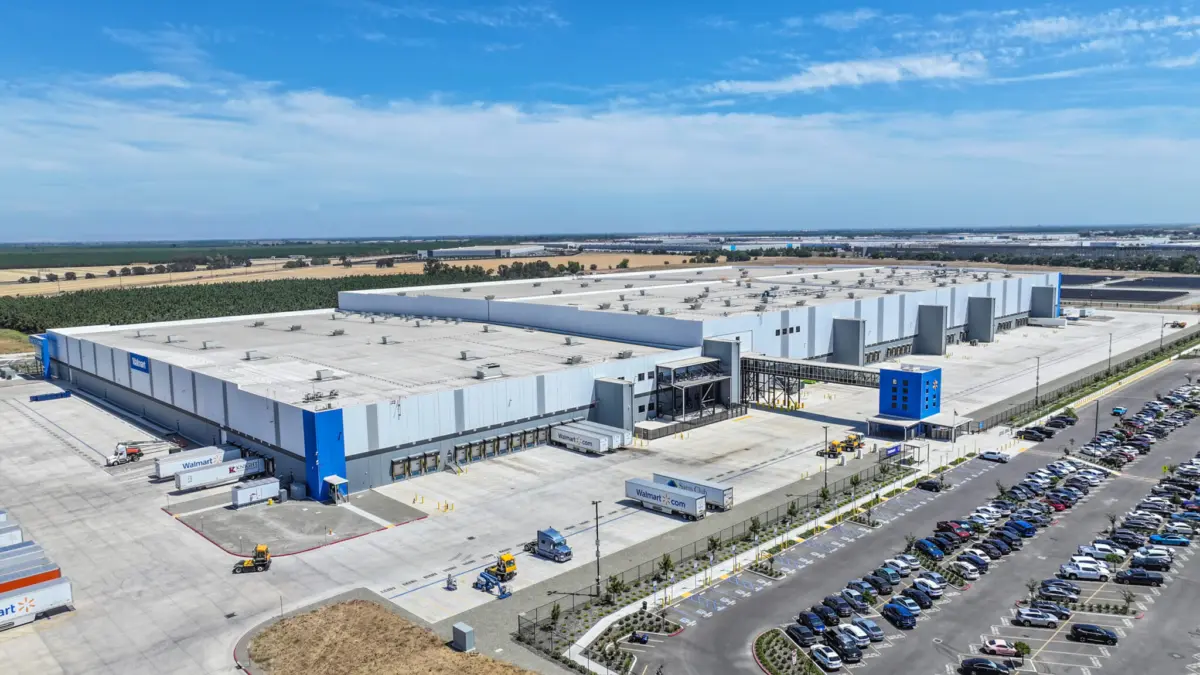
Walmart has officially announced the opening of its fifth next-generation fulfillment center, located in Stockton, California. Spanning an impressive 900,000 square feet, the sprawling new facility is designed to significantly increase Walmart’s storage capacity while enabling the retail giant to fulfill a higher volume of e-commerce orders across California and the broader West Coast.
The launch marks a substantial milestone for the retail corporation, which currently ranks No. 2 in Digital Commerce 360’s Top 1000 Database, a comprehensive industry tracker monitoring North America’s largest online retailers by annual e-commerce sales. Furthermore, Walmart holds the No. 37 position in Digital Commerce 360’s AI Commerce Rankings, a specialized set of metrics featured within the Top 1000 Pro with AI Database. By integrating cutting-edge technology into its physical supply chain network, the company continues to solidify its competitive footing in an increasingly digitized retail landscape.
What Distinguishes Walmart’s New Fulfillment Center in Stockton
At the heart of Walmart’s Stockton fulfillment center is a sophisticated, automated high-density storage and retrieval system. Rather than requiring human workers to travel the expansive facility floor to locate items, the advanced system brings products directly to associates. According to the retailer, this streamlined approach effectively reduces what was traditionally a 12-step fulfillment process down to just five simplified steps. By eliminating unnecessary movement and manual sorting, the technology leaves associates with more time to focus on higher-value tasks within the operation.
The Stockton facility fits into a broader corporate strategy centered on automation. Walmart now processes more than half of its total e-commerce fulfillment volume through automated facilities, a performance metric the company recently shared with investors alongside online sales updates in its fiscal second-quarter earnings results. Beyond these specialized fulfillment hubs, automated freight technology has also been integrated to some capacity across 3,100 of Walmart’s traditional U.S. retail stores.
When combined with Walmart’s broader, nationwide fulfillment network, the deployment of these next-generation centers allows the company to reach an estimated 95% of the U.S. population with next-day or two-day shipping options.
Karisa Sprague, senior vice president of fulfillment operations at Walmart U.S., emphasized the collaborative potential of the new site in a written statement regarding the launch. She noted that the company is successfully bringing together human associates with advanced technology and automation to foster a safer, more efficient operational environment. Sprague added that the Stockton facility can fulfill more orders and get products into the hands of customers much faster, describing the installation as a vital investment in California’s Central Valley and a critical cornerstone for building the next generation of Walmart’s fulfillment network across the West Coast.
Fast Delivery’s Importance for Walmart
Delivery speed has steadily emerged as a central pillar of Walmart’s overarching e-commerce strategy over recent quarters, serving as a primary differentiator in its competition with rival online marketplaces.
During the first fiscal quarter, Walmart U.S. online sales experienced a robust 26% growth rate. Executive leadership has repeatedly pointed to accelerated delivery capabilities as a key catalyst for growth on a global scale. Today, Walmart boasts the capability to reach approximately 60% of the U.S. population through delivery services operating in 30 minutes or less—a rapid fulfillment capability that has successfully been expanded to 38 distinct markets across the country.
At the same time, store-fulfilled delivery metrics have more than doubled over the past two years. Impressively, more than 36% of those store-fulfilled orders are now delivered to consumers in under three hours, demonstrating the tight integration between Walmart’s brick-and-mortar footprint and its digital ordering infrastructure.
Reflecting on these operational efficiencies during an investor call in August, Walmart CEO and president John Furner underscored the strategic value of these investments. Speed matters deeply in modern retail, Furner told investors, emphasizing that the company possesses a significant competitive advantage in its ability to execute rapid fulfillment at scale.
How Walmart Fulfillment Services Will Use the Center
Significantly, the capabilities of the new Stockton facility will extend far beyond Walmart’s traditional first-party e-commerce retail business.
Walmart Fulfillment Services (WFS), the corporation’s end-to-end third-party fulfillment offering designed for independent marketplace merchants, will also utilize the massive space. The center will process and fulfill online orders for the diverse array of third-party merchants, brands, and distributors selling goods through Walmart.com. Consequently, the opening carries direct operational relevance for the rapidly expanding base of sellers participating in the Walmart Marketplace, who rely on the retailer’s logistics network to scale their businesses.
The integration of third-party sellers into Walmart’s advanced logistics network has already yielded explosive growth. According to John David Rainey, chief financial officer at Walmart, the volume of units shipped either the same day or the next day through Walmart Fulfillment Services grew by nearly 150% during the first fiscal quarter alone, highlighting the strong demand among marketplace merchants for reliable, high-speed fulfillment solutions. As the Stockton facility ramps up operations, it is expected to provide essential capacity to support this ongoing commercial momentum across the West Coast and beyond.










No comments yet. Be the first to join the conversation!