
Piled high on eroding river banks, wedged deeply inside uprooted trees, deeply embedded in riverbed sediment, and tightly jammed beneath heavy logs, the remnants of a catastrophic natural disaster continue to haunt western North Carolina. Two years after Hurricane Helene tore through the region—leveling dense forests, crushing houses, and choking local waterways with an apocalyptic mix of displaced automobiles, household refrigerators, and infrastructure—the arduous, exhausting work of environmental remediation grinds forward.
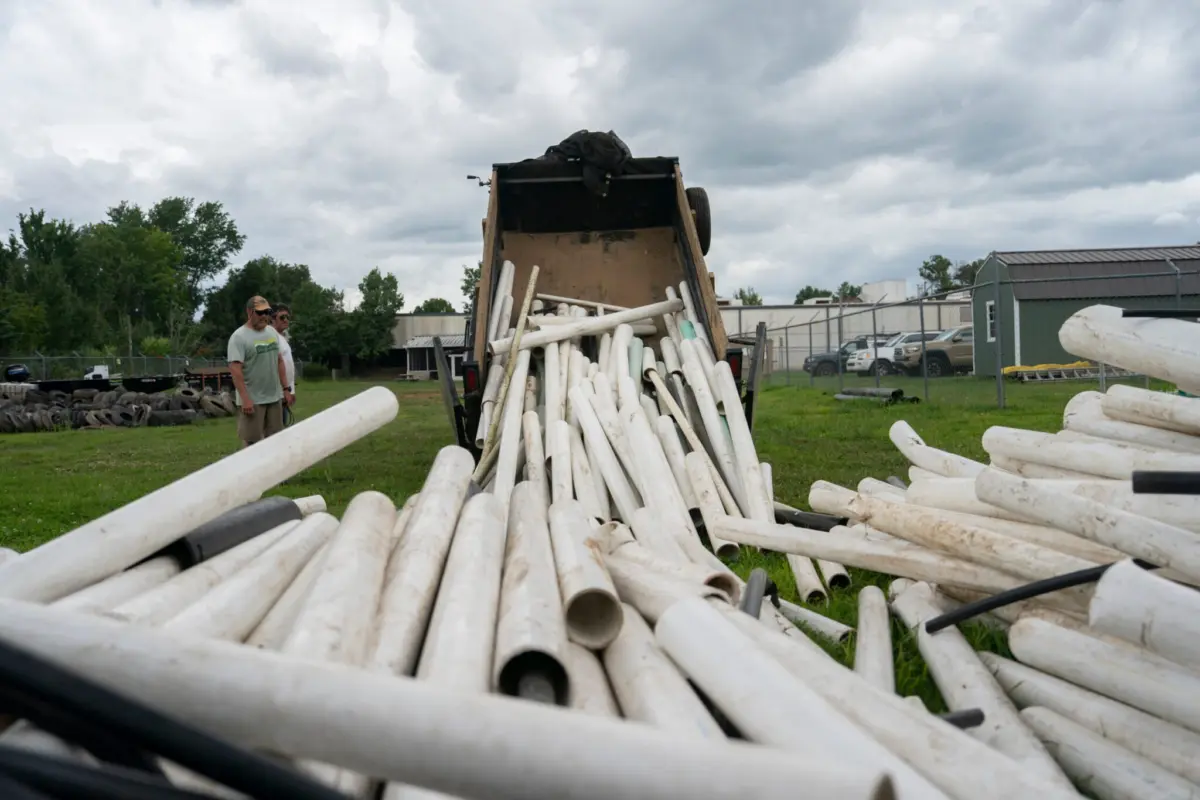
Along the iconic French Broad River, famed for its roaring whitewater rapids and deep historical roots in the region’s outdoor recreation economy, one persistent item visually dominates the landscape and frustrates cleanup crews: massive, seemingly endless quantities of PVC pipes. These industrial materials washed away from a major manufacturing facility located north of Asheville when the storm struck. Now, as the Atlantic hurricane season intensifies, the lingering presence of these pipes serves as a stark, physical reminder that the devastating ecological and economic damage of extreme weather events can disrupt human lives and natural habitats for years after the storm clouds clear.
“Just the amount of time and energy that we put into removing all this pipe is exhausting,” said Jon Stamper, operations director at MountainTrue, the prominent regional nonprofit environmental organization spearheading cleanup efforts across several western North Carolina rivers heavily impacted by Helene. “We still have stretches of river that haven’t been touched.”
MountainTrue estimates that its specialized field crews have pulled hundreds of thousands of individual pipes from the river system, the vast majority of which have been hauled away to local landfills. Yet, an untold number of pipes continue to litter the riverbanks and channel for a staggering 70-mile stretch, winding all the way down to a large lake situated near the Tennessee border.
The Canada-based manufacturing firm IPEX has declined to disclose the exact quantity of PVC pipes that were stored outdoors at its Woodfin, North Carolina, site prior to the storm, nor will the company share the results of a company-funded assessment evaluating how much debris remains scattered throughout the river. Corporate representatives cited that information as “commercially sensitive.” However, company officials previously reported that roughly 60 percent of the pipes stored outdoors at the facility—which is tightly sandwiched between active railroad tracks and the rushing waters of the French Broad River—were swept away during the historic 2024 flood, though a large portion was recovered relatively quickly in the immediate aftermath.
Acknowledging that the remaining volume of environmental debris is still deeply significant, IPEX has agreed to provide MountainTrue with $500,000 in funding to support ongoing cleanup operations along the French Broad River, a financial commitment that will allow the nonprofit organization to extend its labor-intensive fieldwork into the coming year.
Meanwhile, a $10 million state grant originally awarded to MountainTrue in 2025 to clear massive accumulations of debris from multiple western North Carolina rivers—funding that was initially scheduled to expire in December—has been officially extended through February. Even with this critical financial extension, organizational leaders emphasize that there is still a tremendously long way to go. MountainTrue estimates it has already expended more than 50,000 grueling work-hours and over $1.5 million exclusively on pipe removal along the French Broad River alone.
In certain sections of the river, environmental assessments indicate that PVC pipe comprises up to 80 percent of the total debris field. This overwhelming concentration poses severe physical risks to whitewater rafters, tubers, and kayakers, while simultaneously altering natural water flow dynamics, disrupting aquatic habitats, and fundamentally modifying the local river ecosystem.
“We understand the ongoing challenge,” said IPEX CEO Colleen Pritchett, addressing the protracted recovery timeline and the sheer scale of the environmental impact. “We recognize that recovery efforts are complex, they’re resource-intensive, and it’s constantly shaped by the river conditions.”
The Epic Flood Took Everyone by Surprise
When Hurricane Helene roared through western North Carolina in late September 2024, it unleashed an unprecedented deluge, dumping more than 30 inches of rain in isolated mountain zones within a matter of hours. The torrential downpour triggered catastrophic landslides, toppled millions of mature trees, pushed sturdy commercial and residential buildings completely off their structural foundations, and choked vital waterways with an overwhelming volume of debris.
At the IPEX manufacturing facility, a substantial earthen berm stood as the primary structural barrier separating towering stacks of industrial PVC pipes from the rushing currents of the French Broad River. Company leadership stated that facility engineers had carefully planned for what is traditionally designated as a 100-year flood—a severe high-water event carrying a statistically calculated 1% probability of occurring in any given year—and had actively moved vulnerable pipe inventories out of that designated high-risk flood zone ahead of the storm.
However, the meteorological reality of Hurricane Helene far exceeded historical precedent, producing flooding conditions roughly ten times worse than a standard 100-year event.
“আমরা secured the site as best we could, and we sent people home a day before the flooding was expected,” said Johnny Drummond, vice president of manufacturing for the company. He noted that corporate planners simply did not anticipate a catastrophic 1,000-year flood, an extreme meteorological phenomenon defined as having a 1-in-1,000 chance of occurring in any single year.
The disaster forced IPEX to close its manufacturing plant for several months following the disaster, generating financial losses described by Pritchett as “well over $100 million.” In the time since the disaster, the company has reinvested more than $100 million to structurally repair, rebuild, and fortify its physical facilities against future hydrological events. Furthermore, the firm is actively studying engineering solutions to securely contain its pipe inventory during potential future floods—a preventative measure that MountainTrue had publicly advocated for months.
Although the riverways still contain a wide variety of other hurricane-related wreckage, the PVC pipes are so ubiquitous that they have come to define the entire cleanup initiative.
“There are places where you go that it makes up almost everything that we remove,” said Stamper, who previously worked as a professional whitewater river outfitter before taking on his current role overseeing ten dedicated cleanup crews comprising roughly 100 workers. Many of these field workers are former river rafting guides or commercial fishing guides who tragically lost their primary livelihoods when the hurricane devastated the region’s thriving outdoor recreation industry.
Extracting the industrial pipe from the natural environment is exceptionally vexing because the rigid materials frequently intertwine with dense masses of organic debris, eventually becoming deeply embedded in the shifting gravel and silt of the river bottom. Over time, local fish and various aquatic creatures have begun taking up residence inside the hollow tubes. Beyond the immediate physical clutter, Stamper voiced deep concerns regarding the long-term environmental and public health consequences of leaving the plastic in the water. Over extended periods of exposure, PVC material degrades, becomes brittle, and fragments into hazardous microplastics that permanently infiltrate the river system.
“We want to avoid that stuff sitting there forever and just slowly deteriorating and breaking into smaller and smaller pieces,” Stamper explained. “Some of the pipe that’s been sitting out since Hurricane Helene that has been exposed to the sun all the time is getting to the point where you could crack it when you grab it.”
Removing Pipes Is Tedious, Sometimes Dangerous
The physical nature of the extraction work is as treacherous as it is tedious. Many of the pipes—ranging from straight, rigid industrial conduits to massive, flexible coils that have completely unraveled—are trapped deep beneath enormous piles of tangled logs and mixed storm debris, often forming towering mounds up to 20 feet high.
Cleanup field crews frequently visualize these massive, unstable structures as hazardous jungle gyms that workers must skillfully climb, navigate, and balance upon while utilizing heavy tools to safely dismantle the piles, according to Jemima Filiss-Cook, who leads cleanup operations in Madison County, where the vast majority of the industrial pipe debris remains heavily concentrated.
Filiss-Cook noted that many of the dedicated crew members had already begun independently cleaning up the riverbanks long before MountainTrue officially hired them, finding a sense of community and mutual support through what she described as a process of “trauma bonding” over the shared tragedy of the disaster.
The specialized teams naturally attract avid outdoor enthusiasts, including experienced rock climbers, because the physical cleanup demands a high level of technical proficiency, meticulous patience, and absolute comfort with hazardous outdoor conditions, said Anna Alsobrook, MountainTrue’s dedicated French Broad Riverkeeper.
During field operations, cleanup crews utilize specialized saws to cut longer, unwieldy sections of pipe into manageable chunks before loading them manually onto flat-bottomed workboats. These boats are then navigated carefully down the river to designated landing points, where the heavy loads are transferred onto commercial trucks for final disposal. Virtually all of the recovered plastic is hauled away to regional landfills, though a small fraction of pipes found in pristine, undamaged condition has been gifted directly to local community members for personal use, given the current lack of viable large-scale recycling infrastructure for the material, according to MountainTrue.
“I truly don’t think anybody else could do this work except for our debris team members,” Alsobrook said, emphasizing that workers must possess the rare technical ability to safely navigate unpredictable whitewater rapids while piloting heavily laden watercraft filled with commercial-grade pipes and cutting equipment.
The initial operational priority for the teams focused heavily on removing submerged or floating pipes that presented an immediate physical danger, severe safety hazard, or dangerous entrapment risk to recreational tubers, swimmers, and kayakers. Today, much of the remaining labor focuses on extracting stranded debris scattered across expansive floodplains and tangled along dense riverbanks, particularly around sharp riverbends and corners where materials remain highly vulnerable to being swept back into the current during the next major high-water event.
As water levels naturally fluctuate throughout the seasons, Stamper noted that the river continuously reveals hidden deposits of industrial pipe that were previously buried beneath layers of sediment.
To maintain momentum after current state and corporate funding streams are exhausted, MountainTrue is actively applying for additional grant funding to extend its specialized river remediation program. Because of the vast scale of the disaster, Stamper cautioned that it could ultimately take many years to clear all of the industrial debris from the watershed.
“We’re going to do our best as long as the funding allows,” he concluded. “लेकिन there’s going to be pipe out there that we can’t get ever.”











No comments yet. Be the first to join the conversation!