
For more than four decades, hot hatchbacks have served as the cornerstone of automotive enthusiasm in the United States. These vehicles have long provided burgeoning drivers with a reliable recipe: affordable pricing, everyday practicality, and genuine fun-to-be-behind-the-wheel dynamics. From the early days of lightweight European imports to the modern era of turbocharged dominance, the hot hatch has remained a beloved segment for enthusiasts who demand versatility without sacrificing entertainment. However, the modern automotive marketplace has shifted dramatically. Today’s consumers and manufacturers overwhelmingly favor hatchbacks-on-stilts—otherwise known as crossovers—leaving traditional hot hatch buyers with a dwindling selection of choices.
For those shopping on a strict budget, the pickings are relatively slim. The market features the excellent and ubiquitous, if slightly subdued, Volkswagen GTI, alongside the Mini Cooper S, which has arguably traded some of its hardcore driver-focused edge over successive generations. Upping the financial stakes brings a few more serious contenders into the ring, such as the razor-sharp Toyota GR Corolla and the track-capable Honda Civic Type R. Yet, even these formidable modern machines can sometimes feel a bit clinical. They check every box for performance and capability, but they often lack a certain touch of eccentricity—a distinct personality that sets true collector cars apart from standard production models.
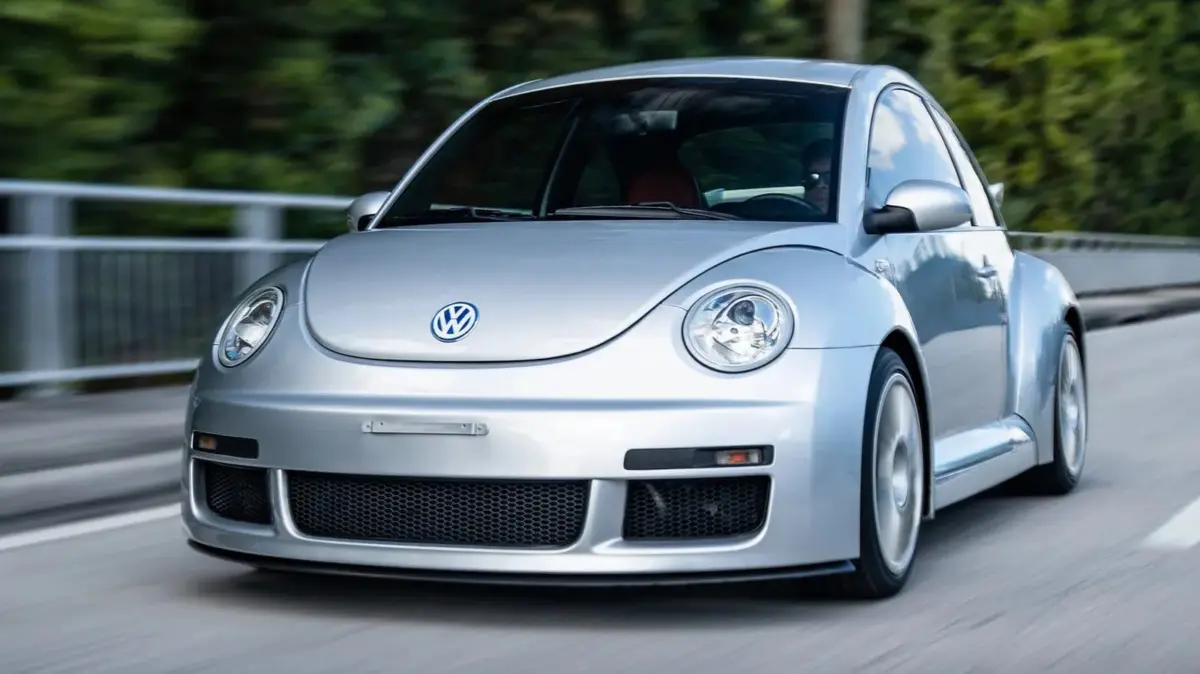
For automotive purists searching for maximum character paired with genuine performance pedigree, few vehicles match the sheer audacity of a 2001 Volkswagen Beetle RSi currently listed for auction on Bring A Trailer.
If your automotive aspirations are constrained by a modest budget, the Beetle RSi is bound to break your heart. With a production run capped at just 250 units globally, this bullish, widened Beetle is neither cheap nor accessible for the average buyer. Yet, measured by pure enthusiast metrics, it is immeasurably cooler than almost any modern hot hatchback on the market. At the heart of the RSi lies a naturally aspirated 3.2-liter VR6 engine. This powerplant churns out a stout 221 horsepower and 236 lb-ft of torque, routing its output through a traditional six-speed manual gearbox and distributing it to all four wheels via Volkswagen’s 4Motion system. Without a doubt, the Beetle RSi stands as the ultimate production Beetle ever assembled, far eclipsing the standard iterations that populated suburban driveways at the turn of the century.
How can you put a price on something this special?
To understand the genesis of the Beetle RSi, one must look at it not merely as a standalone novelty, but as a crucial engineering testbed. The RSi effectively served as the development laboratory for the legendary Golf R32, a car that successfully packaged the same intoxicating VR6 powertrain and all-wheel-drive system into the more conventional Golf hatchback architecture. Yet, while the Golf R32 went on to become a beloved performance icon, the limited-run Beetle RSi received an entirely different level of bespoke, no-holds-barred treatment that set it apart from its stablemates.
On the outside, the Beetle RSi wears an aggressive aerodynamic bodykit directly inspired by the New Beetle Cup race cars that competed in specialized support series during the early 2000s. This aggressive exterior widening stretches the car’s geometry, accommodating a front track that is 1.8 inches wider and a rear track that is 2.32 inches wider than a standard New Beetle. The comprehensive restyling package continues with a square-jawed front bumper designed to funnel air efficiently, a striking twin-spoiler rear setup that generates genuine high-speed downforce, and a functional rear diffuser cradling a Remus twin-pipe exhaust system. Filling out those bulbous, widened arches are a set of iconic 18-inch OZ Superturismo wheels wrapped in 235/40ZR performance tires, all kept in check by a track-tuned, four-wheel independent suspension setup.
Unlike many limited-edition variants of pedestrian automobiles where the modifications end with exterior stickers and minor suspension tweaks, the Beetle RSi’s transformation runs deep into the cabin. The interior of the RSi is clad in materials that represented the absolute cutting edge of automotive lightweighting at the turn of the millennium. Carbon fiber panels and genuine billet aluminum trim pieces adorn the cockpit, replacing standard plastic components. Front-seat occupants are held firmly in place by heated, hard-back carbon-fiber Recaro racing bucket seats finished in a striking, contrasting Tropical Orange leather that immediately signals the car’s uncompromising performance intentions.
In a move that highlighted the vehicle’s serious track-oriented focus, the conversion process required a few sacrifices. Most notably, in its quest to become a stripped-down, driver-focused performance machine, the Beetle RSi lost one of the standard New Beetle’s most recognizable and charming interior quirks: the dashboard-mounted "bud vase" flower pot.
The specific example currently crossing the auction block represents a remarkably well-preserved slice of Volkswagen history. Bearing chassis number 176 of the 250 units produced, this particular RSi was initially registered in Japan before making its way to the United States, where it currently carries a clean Florida title. Showing just 18,000 kilometers on its digital odometer—equating to roughly 11,000 original miles—it is undoubtedly one of the lowest-mileage and cleanest surviving examples in existence.
When it was brand new in 2001, the Beetle RSi commanded a staggering price tag of around £50,000 in the United Kingdom. Adjusted for inflation, that initial cost translates to well over $131,000 in today’s currency, cementing the fact that the RSi was never intended to be a mass-market, value-focused automobile. Because of their extreme rarity and limited geographic distribution, public sales of the Beetle RSi are exceptionally scarce, making it difficult to establish a traditional market value through historical comps.
Nevertheless, the collector market has spoken clearly. With bidding having already climbed past $86,000 with a full week remaining on the auction clock, it is evident that enthusiasts and collectors recognize the irreplaceable nature of this machine. Buyers are once again willing to pay top dollar for the rare privilege of owning the ultimate performance-focused Beetle. As the auction ticks down toward its conclusion, the winning bidder will secure not just a piece of early-2000s automotive history, but a wildly eccentric, VR6-powered reminder of an era when manufacturers were willing to take daring, mechanical risks.









No comments yet. Be the first to join the conversation!