
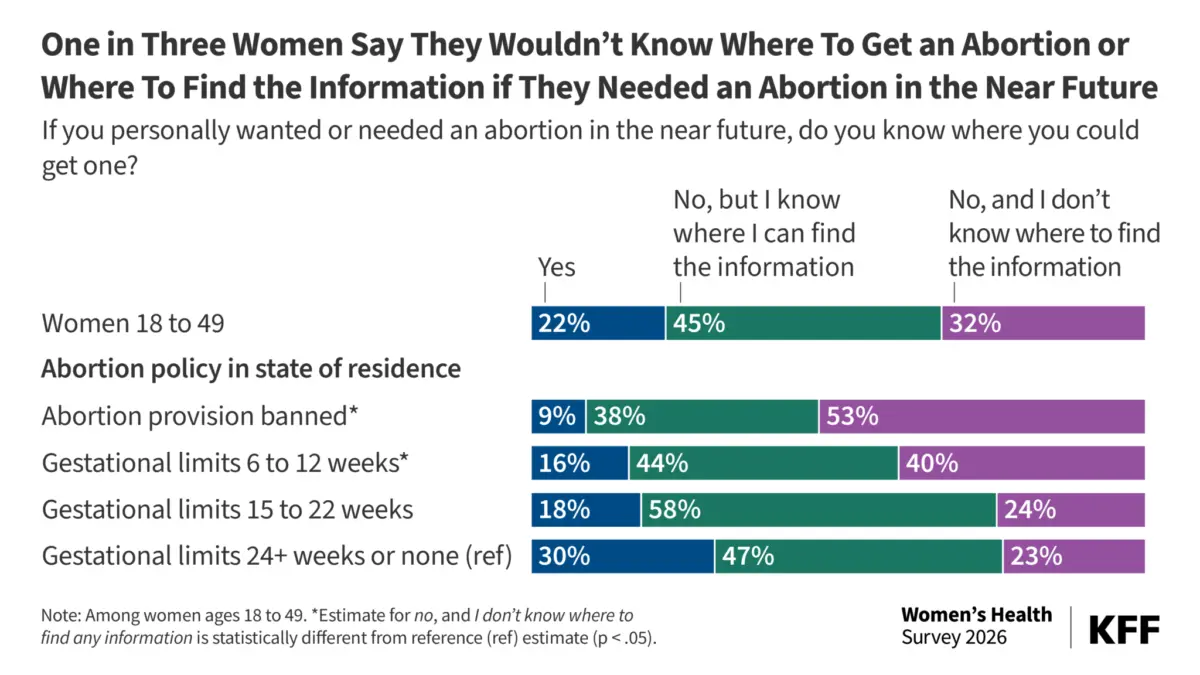
Four years after the landmark Supreme Court decision that dismantled the constitutional right to abortion, a significant and growing share of women of reproductive age find themselves navigating a fragmented and increasingly confusing healthcare landscape. According to a comprehensive new survey released by KFF, more than half of reproductive-age women living in states with total abortion-provision bans now report that they would not know where to go or where to find reliable information if they or someone they knew needed to obtain an abortion.
This pervasive lack of clarity has intensified notably over the past two years. The new data shows that 53% of women living under strict state-level bans are entirely in the dark about how to access care, a substantial increase from the 43% who reported the same uncertainty in 2024. The confusion is not isolated strictly to states with outright bans; it ripples outward into regions with varying degrees of legal restriction. Among women living in states that have enacted gestational limits restricting abortion between six and 12 weeks of pregnancy, 40% state they would not know where to seek services or information. Nationally, about one in three reproductive-age women, or 32%, report a total lack of knowledge regarding where to find abortion care, up from one in four, or 26%, in the 2024 survey.
The findings from the 2026 KFF Women’s Health Survey—fielded between March 11 and April 14 among a nationally representative sample of 3,538 women ages 18 to 49—illustrate the complex realities confronting patients in a post-Roe v. Wade America. As the legal terrain shifts from state to state, the mechanisms for delivering care have also evolved dramatically, creating a profound disconnect between the availability of modern medical options and public awareness of those options.
The wider availability of medication abortion via telehealth has fundamentally transformed the ways in which many women secure abortion care, including individuals residing in states where the procedure is heavily restricted or outright banned. Medication abortion, typically involving a regimen of pills, has become a central battleground and a primary vehicle for reproductive healthcare access in restricted jurisdictions. Yet, the survey reveals a stark awareness gap regarding how these options actually function within the current legal framework.
While two-thirds of reproductive-age women—roughly 68%—have heard of medication abortion pills, a mere 18% actually know that people residing in their specific state can legally or practically obtain them online. That fraction shrinks dramatically when looking strictly at hostile territory; among women living in states with active abortion-provision bans, only 8% are aware that online access to the pills is an avenue that exists.
Instead, the prevailing state of public knowledge is dominated by uncertainty or misconceptions. A large majority, sitting at 71%, report that they are entirely unsure how they would go about acquiring medication abortion pills or indicate that they have never even heard of medication abortion as a concept. Meanwhile, 11% of respondents hold the mistaken belief that people within their state cannot secure the pills online under any circumstances, highlighting a profound information vacuum that leaves vulnerable populations guessing about their healthcare options.
The cumulative weight of these restrictions and information voids is increasingly felt on a personal level across the country. As the country moves further away from the legal precedents of the past, the human cost of navigating a patchwork of state laws is becoming more visible. The survey highlights that one in eight reproductive-age women, or 12%, say they personally know someone—a category that includes themselves—who has encountered direct difficulties in trying to obtain an abortion because of the strict limitations imposed by their state of residence. This figure represents a notable rise from the 8% who reported personal or secondary hurdles in the 2024 survey data.
When respondents detail the specific hurdles they or their acquaintances have faced, several primary logistical and financial barriers consistently emerge at the forefront. Traveling long distances out of state to reach a jurisdiction where the procedure remains legal ranks among the most common and taxing difficulties. This is compounded by the compounding distress of simply not knowing where to go for care, as well as the substantial financial burdens involved. Not having enough money to cover the soaring costs associated with travel, lodging, time away from work, and the medical procedure itself serves as a major impediment for patients trying to exercise bodily autonomy.
Beyond the immediate hurdles of securing an abortion, the legal climate is also casting a broader shadow over general maternal health and reproductive wellness. A strong majority of reproductive-age women, reaching 59%, express deep concern that sweeping abortion-provision bans and related legal penalties might negatively affect the safety and quality of a future pregnancy for themselves or for someone close to them. This anxiety is widespread, resonating across majorities in almost every demographic group surveyed, with notable exceptions primarily concentrated among Republican and rural women, who tend to view the regulations through a different political and cultural lens.
These compounding factors underscore the ongoing evolution of the national debate surrounding reproductive rights. As legal battles continue to play out in state legislatures and courtrooms across the nation, the everyday realities for women trying to navigate healthcare decisions are characterized by mounting uncertainty, geographical barriers, and a critical lack of clear, accessible information. The findings from the 2026 KFF Women’s Health Survey provide a detailed snapshot of a populace grappling with a transformed healthcare system, where knowing where to turn for basic reproductive care has become an increasingly difficult challenge.







No comments yet. Be the first to join the conversation!