
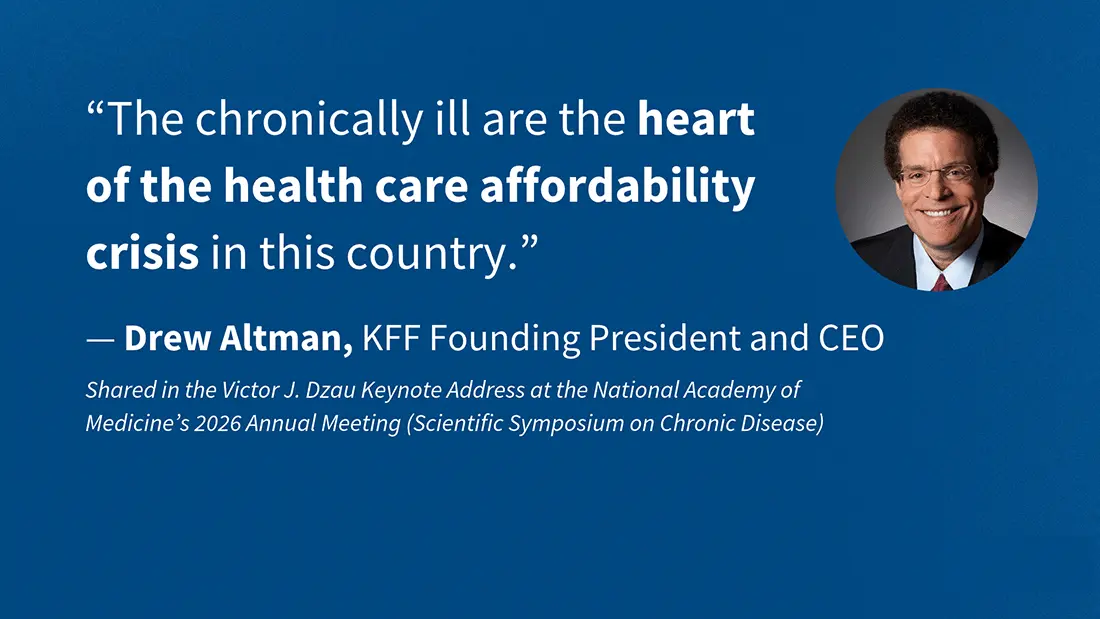
As health policy debates cycle back to the forefront of American politics, driven by voter anxieties over the cost of living and healthcare expenses, the nation faces a convergence of massive structural challenges. Speaking at the annual meeting of the National Academy of Medicine (NAM), KFF founder Drew Altman delivered a comprehensive keynote address dissecting the intersection of federal policy, mounting fiscal pressures, and the often-overlooked plight of patients managing chronic conditions.
Altman, marking a major professional transition after 37 years at the helm of KFF, addressed a packed audience during a conversation moderated by Dr. Brendan Lee, professor and chairman of the Department of Molecular and Human Genetics at Baylor College of Medicine. The event centered on chronic disease, providing a backdrop for Altman to examine how chronic illness is intricately tied to the broader political and economic landscape of American healthcare.
Recalling his early days in government and academia—including earning his PhD in political science at MIT and later running a federal health agency—Altman highlighted how the country’s health policy architecture is approaching critical junctions. KFF, which Altman founded in the early 1990s, was built on the premise that the United States needed an independent, trusted source for health policy information, combining rigorous policy analysis, public opinion polling, and a dedicated health newsroom. Operating as an endowed public charity based in San Francisco, the organization remains intentionally neutral, avoiding policy recommendations while providing data that frequently challenges stakeholders across the political spectrum.
Altman outlined three major systemic problems currently confronting American health policy, noting that these challenges constantly compete for legislative space and federal funding. No president, administration official, or newly seated Congress can tackle them all simultaneously in a comprehensive manner. Furthermore, Altman emphasized the existence of an "invisible crisis" of costs and affordability affecting the chronically ill and individuals grappling with major diseases—a crisis that underscores the necessity of placing chronic illness at the center of health policy discussions.
The first major challenge stems from sweeping legislative and budgetary shifts at the federal level. Altman pointed to the impacts of major fiscal legislation, such as the One Big Beautiful Bill (OBBB), which incorporated nearly a trillion dollars in federal health spending cuts over a ten-year period. Compounding these reductions was the failure to extend enhanced Affordable Care Act (ACA) premium tax credits. According to KFF’s widely cited research, the expiration of these credits effectively doubled premiums for roughly 24 million enrollees, forcing millions to drop coverage entirely or transition into high-deductible plans averaging around $7,000 annually.
For lower-income workers—such as ride-share drivers, salon workers, and agricultural laborers earning modest wages—such high deductibles render insurance functionally useless. Notably, KFF data shows that roughly one-third of American farmers and ranchers rely on the ACA Marketplaces for their health coverage. Altogether, analysts project that these cumulative federal cuts will result in approximately 14 million additional uninsured individuals over the decade, pushing the total uninsured population back toward the 40-million mark and reversing years of coverage gains.
At the state level, these federal reductions create severe fiscal dilemmas. As a former state human services secretary, Altman noted that while certain states—particularly blue states—will attempt to backfill some of the lost federal funding, they cannot replace it all. Consequently, other vital state budget items will inevitably face contraction, ranging from K-12 and higher education to environmental protection and corrections, while few states are positioned to raise taxes to cover the shortfall. Among these cuts, the single largest reduction stems from newly instituted Medicaid work requirements, totaling $330 billion over a decade—a policy that remains politically popular yet heavily scrutinized by health policy experts.
The second major challenge involves the health and stability of federal health agencies. Reflecting on his own career trajectory in public service, Altman raised pressing questions about the future of government institutions. He questioned how the nation can revitalize rather than demonize public service at a time when a staggering majority of graduates from premier public policy programs gravitate toward private consulting firms rather than government agencies.
Federal agencies have recently endured severe staffing reductions, the dismantling or marginalizing of key research bodies such as the Agency for Healthcare Research and Quality (AHRQ), and the warping of scientific missions. Recent reports from research arms of the Department of Health and Human Services (HHS), for instance, have asserted that enrollees dropping coverage did so solely due to fraud—claims that have sparked widespread concern and prompted countless inquiries from career public servants displaced by the administrative upheaval. Interestingly, the Centers for Medicare & Medicaid Services (CMS), bolstered by its massive budget and shielded by high-profile leadership, has largely remained insulated from the cultural and scientific battles impacting other federal divisions. Rebuilding these foundational agencies remains an uphill battle, as political candidates rarely campaign on restoring the administrative state, despite its absolute necessity for public health infrastructure.
The third major hurdle centers on the national obsession with reigning in healthcare costs, a concept that suffers from profound conceptual ambiguity. Altman pointed out that policymakers, industry leaders, and researchers frequently talk past one another because they are addressing entirely different financial metrics. Stakeholders operate within distinct, overlapping frameworks that often conflict.
While federal lawmakers focus on curbing federal health spending, their cuts often shift financial burdens onto state governments. Meanwhile, employers remain laser-focused on annual premium increases. KFF’s annual employer health benefits survey reveals that the average cost of a family policy now approaches $28,000 annually—roughly the equivalent of purchasing a new economy car every year. Furthermore, the catch-all term "value" is frequently invoked to describe both forward-looking delivery reforms and defensive industry lobbying designed to block government regulation or genuine market competition.
Beneath these competing definitions lie two distinct cost crises. The first is national health care spending as a share of Gross Domestic Product (GDP) or per capita spending. Despite decades of predictions that U.S. health spending would rapidly surpass 20 percent of GDP, spending has remained relatively stable at approximately 18 percent. While significantly higher than that of other wealthy nations, this stability masks underlying cost drivers—principally, high unit prices—that policymakers rarely confront directly, choosing instead to focus incrementally on utilization and volume.
The second, far more politically volatile cost crisis is affordability—the direct financial burden of healthcare on everyday people. This specific dimension is what has transformed healthcare into a dominant voting issue. Altman emphasized that these six distinct cost problems—national spending, personal healthcare costs, federal spending, state spending, employer premiums, and systemic "value"—frequently clash. For instance, reducing federal spending invariably drives up state-level expenditures. Meaningful reform requires tackling underlying prices, yet there is little evidence that the political landscape possesses the appetite for such reforms, nor is there bipartisan consensus on how to achieve them beyond incremental measures. With the pharmaceutical and hospital industries strongly opposed to aggressive regulation, the near-term legislative outlook points toward modest, incremental policy tweaks rather than sweeping structural overhauls.
Crucially, Altman argued that chronic illness sits squarely at the center of both the affordability crisis and the systemic complexity of American healthcare. While skeptics might argue that individuals with chronic conditions naturally utilize more care and therefore face higher hurdles, the fundamental obligation of any healthcare system is to effectively care for its sickest populations—an obligation the U.S. system is currently failing to meet adequately. The chronically ill represent the epicenter of the nation’s affordability crisis, facing compounded administrative complexities, coverage gaps, and rising out-of-pocket expenses. When combined with the ranks of the uninsured, chronically ill patients bear the heaviest burden of a fragmented delivery system—a population whose ranks are only projected to expand following recent federal coverage cuts.
Addressing these foundational challenges, Altman concluded, requires confronting the pervasive decline in public trust across government agencies, the news media, medicine, and science. Rebuilding a shared foundation of reliable information and scientific consensus is essential to proving that government policies and healthcare access can meaningfully improve people’s lives.
Drawing on extensive public opinion polling conducted by KFF, Altman offered a note of cautious optimism. The data indicates that the American public is not entirely consumed by pervasive misinformation or radicalized skepticism on social media. Instead, a vast segment of the population remains independent and open-minded, with social media echo chambers largely serving to reinforce pre-existing beliefs rather than swaying the broader electorate.
Crucially, the public continues to place the highest levels of trust in frontline medical professionals—physicians, nurses, and pharmacists. Mobilizing these trusted messengers to bridge knowledge gaps and center human needs in policy and clinical work offers a viable path forward for restoring stability and equity to the nation’s healthcare system.








No comments yet. Be the first to join the conversation!