
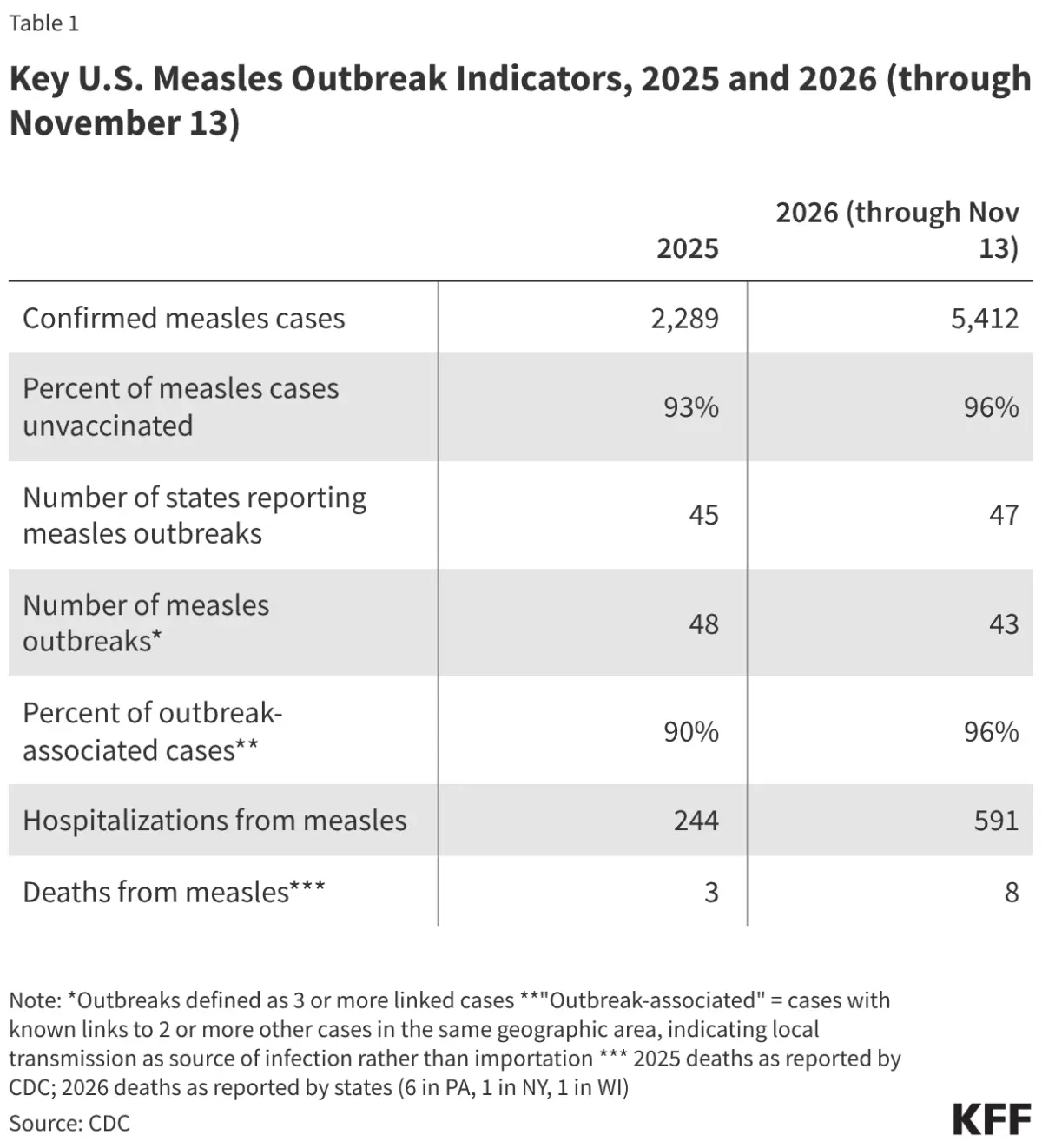
Originally published in July 2025 and updated to reflect mounting developments through November 2026, a critical policy watch has cast a sharp spotlight on the future of infectious disease control in the United States. While the U.S. had proudly maintained official "elimination" status for measles since 2000—meaning the nation had avoided widespread, uncontrolled domestic transmission for over twelve months—that hard-won milestone is now facing its most severe threat in decades. Between January 2025 and November 13, 2026, public health agencies nationwide have recorded a staggering 5,412 measles cases, exposing deep vulnerabilities in the country’s public health infrastructure, vaccination coverage, and official communication strategies.
The resurgence of the highly contagious virus is driven by a convergence of systemic challenges. Federal, state, and local public health departments have suffered significant funding and staffing reductions, severely hampering prevention and localized outbreak responses. At the same time, public trust in health authorities has eroded, accompanied by growing skepticism regarding vaccine safety. Complicating matters further, mixed messaging from federal health leadership, including Department of Health and Human Services (HHS) Secretary Robert F. Kennedy, Jr., has downplayed risks and fostered confusion about proper medical responses. As international travel continues to reintroduce the virus into domestic populations, experts are left questioning whether the United States can preserve its coveted measles elimination status.
Understanding Measles, Transmission, and Health Risks
To grasp the magnitude of the current crisis, public health officials emphasize just how transmissible measles truly is. Among the most contagious viruses known to affect humans, a single case of measles in a completely non-immune population can spark between 12 and 18 secondary infections on average, a metric epidemiologists refer to as the basic reproduction number. While many individuals recover without long-term complications, severe health issues occur in roughly 30 percent of cases. Approximately one in every one thousand infections proves fatal, with the highest risk of severe outcomes concentrated among young children and immunocompromised individuals.
During the initial wave of the recent resurgence in 2025, public health authorities confirmed 2,288 cases, resulting in 243 hospitalizations and three deaths. Beyond immediate acute illness, medical researchers have documented how measles inflicts long-lasting damage on the immune system, particularly in young children, leaving survivors uniquely vulnerable to secondary infections from other pathogens. Those who successfully recover do typically develop robust, long-term immunity against future measles infections, but the path to recovery can carry steep physical and societal tolls.
Safe and effective vaccines have been available in the United States since 1963, most commonly administered today as the combination measles, mumps, and rubella (MMR) vaccine. Medical literature confirms that receiving the recommended two doses of an MMR vaccine is approximately 97 percent effective in preventing infection and subsequent transmission. Federal guidelines recommend that children receive their initial dose between 12 and 15 months of age, followed by a second booster dose between ages 4 and 6 before entering school.
Epidemiologists calculate that achieving "herd immunity" requires at least 95 percent of a population to possess immunity through prior infection or full vaccination, effectively halting transmission chains and preventing large-scale outbreaks. This 95 percent coverage goal forms the bedrock of immunization campaigns, aligning with the federal Healthy People 2030 target. However, national data reveals that estimated two-dose MMR coverage for kindergartners fell to 92.4 percent for the 2025-2026 school year, continuing a slow decline from 94.7 percent in 2011. Furthermore, vaccination coverage varies drastically by state, ranging from a low of 75.2 percent in Idaho to a high of 98.9 percent in West Virginia, with only 10 states meeting or exceeding the 95 percent threshold during the 2025-2026 period.
National, Regional, and Global Measles Elimination Goals and Prior Certifications
Efforts to eradicate domestic measles transmission stretch back decades. The first national objective was announced in 1966, closely followed by formal elimination goals established by the Centers for Disease Control and Prevention (CDC) in 1978 and 1993. On a broader regional scale, member states of the Pan American Health Organization—the Americas regional office of the World Health Organization, which includes the United States—committed in 1994 to interrupting endemic transmission across the hemisphere by the year 2000. In 2012, WHO member states endorsed a Global Vaccine Action Plan aiming for measles elimination across all six WHO regions by 2020.
Despite these ambitions, official elimination status was not verified in the U.S. until March 2000, following rigorous internal CDC reviews and evaluations by external panels of epidemiological experts. A decade later, a formal re-verification process launched by the CDC in 2011 affirmed that the nation had successfully sustained its elimination status. The Pan American Health Organization’s Measles and Rubella Elimination Regional Monitoring and Re-Verification Commission (MRE-RVC) has historically monitored and designated the U.S. as having sustained elimination. However, at its annual meeting in November 2025, the MRE-RVC shifted the designation of the United States to "sustained with major concerns" in light of persistent, widespread transmission.
Defining Elimination and Historical Precedents
Under established guidelines, measles elimination is formally defined as the interruption of endemic virus transmission for a period of 12 months or longer, maintained under conditions of high-quality public health surveillance. If continuous transmission persists across a 12-month window, the disease is reclassified as endemic.
Prior to the 2025-2026 outbreaks, the largest test of U.S. elimination status occurred during the 2018-2019 outbreaks, which were largely centered in tight-knit, low-vaccination communities in New York City and surrounding counties. State and local leaders responded swiftly by declaring public health emergencies, mandating vaccinations under threat of fines, closing schools, barring unvaccinated children from classrooms, and launching extensive public outreach campaigns. Federal agencies provided critical technical assistance, while high-ranking officials from both parties underscored the importance of vaccination. President Trump publicly urged parents to vaccinate their children, and then-CDC Director Robert Redfield condemned organizations spreading misinformation about vaccines. These aggressive, coordinated measures successfully interrupted transmission chains, containing the outbreak within 12 months and preserving the nation’s elimination status by August 2019.
Evaluating the Threat to Current Elimination Status
The landscape shifted dramatically in 2025, a year that saw more reported measles cases, active outbreaks, affected states, and fatalities than any single year since 1992. These trends persisted unabated into 2026. A defining characteristic of the recent crisis has been the high proportion of cases driven by domestic, local transmission rather than international importation, pointing to sustained, unbroken chains of spread within American communities.
When compared to the baseline elimination period between 2001 and 2011—during which only 64 total outbreaks occurred over a decade—the recent numbers are alarming. In 2025 alone, the U.S. recorded 48 distinct outbreaks, followed by an additional 43 new outbreaks through November 13, 2026. While imported cases accounted for roughly 40 percent of infections during the early 2000s, imported sources dropped to just 10 percent in 2025 and 4 percent in 2026, demonstrating that the virus is actively circulating within domestic populations. Fatalities have similarly climbed, with state reports indicating three deaths in 2025 and eight in 2026, surpassing the single death recorded across the entire 10-year elimination baseline period.
State and local health departments bear primary responsibility for responding to outbreaks, yet many have struggled against severe resource constraints. Federal funding cuts have left numerous local health departments—which historically rely on federal grants for over half their operational budgets—struggling to maintain robust surveillance and contact-tracing capabilities. Furthermore, unlike the aggressive containment policies enacted in New York in 2019, several states heavily impacted by the recent outbreaks, such as Texas, New Mexico, and South Carolina, did not implement comparable school restrictions, mandates, or financial penalties.
Federal leadership has also presented a fractured response. While federal agencies supplied technical assistance and funding to hard-hit regions, HHS Secretary Robert F. Kennedy, Jr. faced widespread criticism for downplaying the severity of measles and promoting alternative treatments over vaccination. In January 2026, then-Deputy CDC Director Ralph Abraham publicly characterized the outbreaks as "just the cost of doing business," attributing the spread to personal freedom in unvaccinated communities. Conversely, later in the year, current CDC Director Dr. Erica Schwartz firmly endorsed the MMR vaccine as completely safe and the premier defense against infection. In October 2026, the CDC attempted to bolster local response efforts by allocating an additional $100 million in grants to state and local health departments.
Public polling underscores the deep-seated communication hurdles facing health authorities. Surveys conducted by KFF reveal that nearly 20 percent of American adults believe the demonstrably false claim that receiving the measles vaccine is more dangerous than contracting the virus itself. With vaccination rates in three-quarters of states sitting below the critical 95 percent herd immunity threshold, epidemiologists warn that the country is inching closer to losing its official elimination status.
Regional and Global Context
The United States is not alone in grappling with surging measles transmission. Neighboring countries have faced similar epidemiological pressures, with Mexico reporting 6,213 cases and Canada reporting 5,463 cases in 2025. The situation prompted PAHO to officially strip Canada of its measles elimination status in November 2025 following a year of continuous domestic transmission. Across the Americas, 13 countries reported nearly 15,000 cases in 2025, overwhelmingly concentrated in North America. Globally, the World Health Organization reported more than 344,000 measles cases worldwide by late 2026, driven by massive outbreaks in the European and Eastern Mediterranean regions, alongside heavy burdens in nations such as Bangladesh, Guatemala, and Yemen. This high level of global virus circulation maintains a constant threat of international importation for U.S. travelers, triggering new domestic sparks upon their return.
Looking Ahead
Federal epidemiologists and external international review boards continue to analyze genomic sequencing data to determine whether current transmission chains stem directly from the West Texas outbreak that began in January 2025 or represent entirely independent importation events. If ongoing cases across multiple states are genetically linked to continuous transmission lines exceeding 12 months, the formal criteria for measles elimination will have been broken.
The MRE-RVC, PAHO’s expert review committee, evaluated the U.S. elimination status during its scheduled annual meeting in November 2026. Losing official elimination status would mark a profound regression for American public health, signaling that sustained investments in prevention and community trust can no longer be taken for granted. Public health experts warn that a return to endemic measles would mean enduring cycles of preventable hospitalizations, avoidable deaths, and disruptive school and daycare closures, placing an unsustainable burden on an already strained public health infrastructure.








No comments yet. Be the first to join the conversation!