
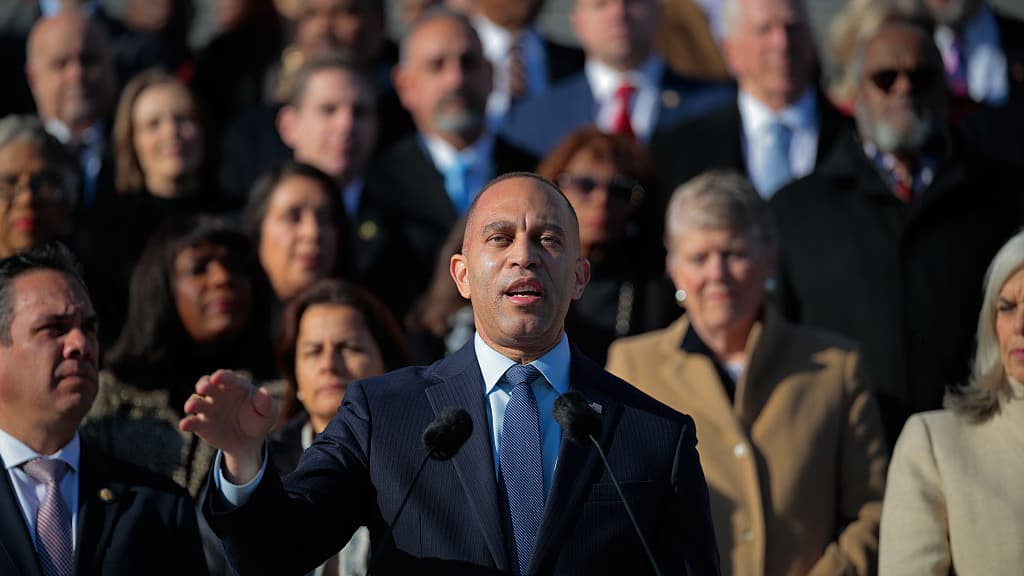
More than a century and a half after Joseph Rainey of South Carolina made history in 1870 as the first Black person to serve in the United States House of Representatives, Capitol Hill is on the brink of another monumental breakthrough. This week, current and newly elected House Democrats are scheduled to meet to select Representative Hakeem Jeffries of New York as the chamber’s next Speaker, positioning him to become the first Black leader of the institution and placing him second in the presidential line of succession.
For Jeffries and the broader Black community, the moment is laden with profound symbolic significance, alongside distinct political hurdles, according to numerous Black leaders. As Democrats prepare to command their largest majority since the early years of President Barack Obama’s administration, the leadership transition carries distinct echoes of 2008. That landmark year shattered a profound racial ceiling in American politics, while simultaneously igniting intense expectations that the party would swiftly deliver tangible economic relief and lasting systemic change.
Today, Jeffries steps into a role of immense national influence. As Speaker, he will dictate the legislative priorities of the House, wield central authority in high-stakes negotiations over federal spending and policy, and quarterback his party’s legislative opposition. In doing so, he will directly counter a Trump administration that has spent much of the past two years systematically dismantling institutional safeguards designed to protect civil liberties. This friction is amplified by a political climate that has frequently exposed deep cultural divides, including controversies earlier this year when President Trump shared a social media video depicting Barack and Michelle Obama through racist tropes.
Reflecting on the historical weight of the moment, Reverend Frederick Haynes—a prominent Black megachurch pastor who was recently elected to a U.S. House seat in Dallas to succeed Jasmine Crockett—notes the deep philosophical roots connecting Jeffries to the legacy of the civil rights movement.
"When Martin Luther King Jr. said, ‘I have a dream,’ he’s saying it’s deeply rooted in the American dream, and that’s the tradition that Congressman Jeffries taps into," Haynes says.
Haynes recalls meeting Jeffries years ago at Cornerstone Baptist Church in Brooklyn, a vital organizing hub during the Civil Rights Movement with deep historical ties to Dr. Martin Luther King Jr. Jeffries grew up attending the church while coming of age in the borough’s Crown Heights neighborhood.
"There are some people when you meet them and they’re young, you know they have the ‘it’ factor," Haynes observes. "You know that they are hungry for knowledge. They are determined to make a difference."
Haynes is part of a broader wave of religious leaders entering the halls of Congress, a group that includes incoming Senators Adam Hamilton of Kansas, a megachurch lead pastor, and James Talarico of Texas, a seminarian. Haynes views Jeffries’ ascendance as a natural extension of this moral tradition, offering an opportunity to bring the ethical framework of the Black church community front and center in national governance.
"Congressman Jeffries will have an opportunity to bring the moral tradition of the Black community that has believed in democracy, even when we’ve been victimized by a practice of democracy that was more fascist than democratic," Haynes says. "You cannot appreciate what it means to be Black in this country without knowing that our community has always believed in democracy."
Navigating Party Factions and Expectations
Jeffries has been steadily positioned for this apex leadership role since late 2022. Following the midterm elections that year, House Democrats—then operating in the minority—unanimously selected him to succeed the legendary Nancy Pelosi as their next caucus leader. Long before the recent midterm elections concluded, Jeffries had already successfully consolidated support across the ideological spectrum of his party, securing the backing of the Congressional Black Caucus as well as influential progressive members like Representative Alexandria Ocasio-Cortez and Congressional Progressive Caucus Chair Greg Casar.
Yet, despite this broad coalition, Jeffries continues to face pockets of internal skepticism. In the wake of Election Day, several incoming progressive members publicly withheld their immediate commitments to back his speakership bid, while select liberal advocacy organizations began agitating for alternative leadership.
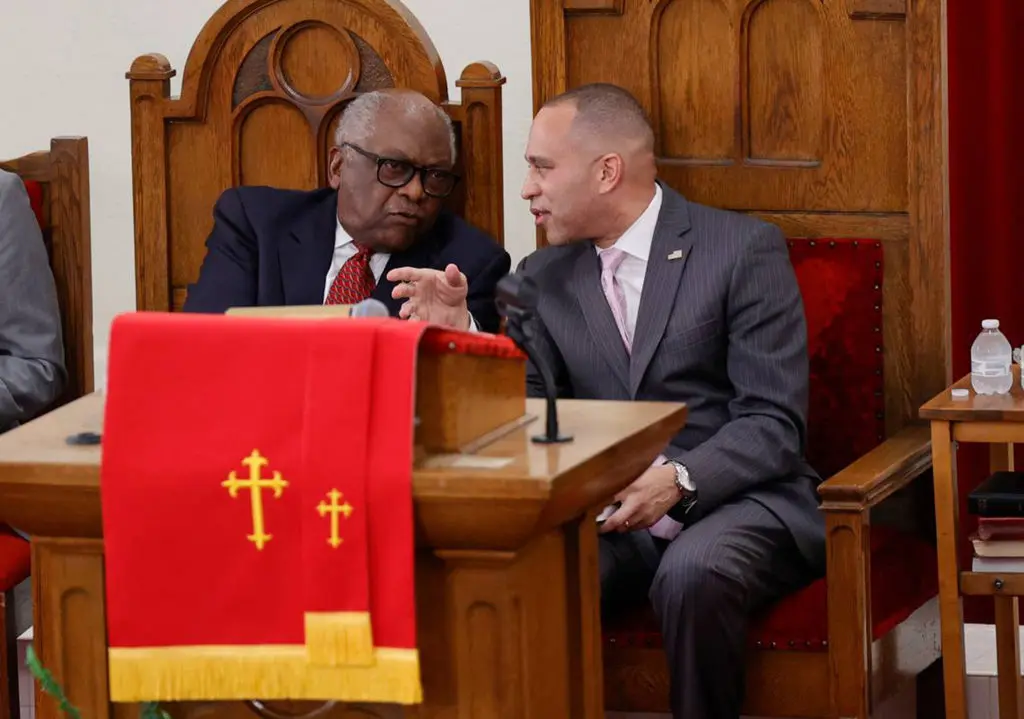
Managing these delicate internal dynamics is an inherent challenge of the office, one that is acutely understood by veteran lawmakers like Representative Jim Clyburn of South Carolina, one of the most influential Black politicians in modern American history. Clyburn, who has served as a trusted mentor to Jeffries for years, suggests that the speakership is a notoriously thankless job defined by the exhausting daily labor of balancing competing party factions and colossal egos without causing permanent fractures.
"You’re operating behind a glass door," Clyburn says, describing the intense public scrutiny facing modern legislative leaders. "Everybody thereby can see through."
When asked about the specific guidance he has offered his protégé, Clyburn keeps the details of their private conversations close to the vest, though he distills the core of his advice into a single, resonant admonition: "Conduct yourself in such a way that you’ll ensure that you won’t be the last."
In an open letter distributed to his House colleagues earlier this month following historic midterm victories, Jeffries signaled an inclusive approach, writing that he intends to draw upon "the insights and perspectives of every single part of the Caucus in the days and weeks ahead." At the same time, he explicitly acknowledged that the party’s mandate extends far beyond symbolic messaging or partisan theater. "House Democrats must deliver dramatic change," he wrote.
Turning Representation Into Results
For Carl Heastie, the Speaker of the New York State Assembly and the first Black leader in that chamber’s history, Jeffries’ impending promotion represents the intersection of formidable legislative skill and personal integrity. Heastie has known Jeffries for decades, having worked alongside him when Jeffries served as a member of the New York State Assembly from 2007 to 2012.
Heastie notes that the speakership requires a delicate synthesis of leadership and pure lawmaking ability—demanding a capacity to listen intently to both grassroots constituents and nervous colleagues while keeping a diverse caucus unified. It also requires the confidence to let lived experience inform policy decisions when appropriate.
As an example, Heastie points to Jeffries’ pivotal work helping secure a landmark 2010 state law that reformed how New York counted incarcerated individuals for state and local redistricting purposes. The practice of counting prisoners where they were incarcerated—often referred to as prison gerrymandering—disproportionately drained political representation from urban communities of color and funneled population weight into rural districts housing correctional facilities. Jeffries led a fierce legislative battle on the Assembly floor to ensure incarcerated individuals were counted in their true home communities instead.
"Hakeem to me was always one of the finer debaters on the floor," Heastie recalls. "When he debated or spoke on the bill, everybody would stop what they were doing to make sure that you listened to him."
For Heastie, watching his former colleague step into the national spotlight is a deeply personal point of pride, serving as proof that despite challenging political winds and polarization, the core promise of the American experiment endures.
"That a Black person from Brooklyn can become the first Black Speaker in the history of this nation," Heastie reflects. "I’m just so proud of him, and I can’t wait."






No comments yet. Be the first to join the conversation!