
By its very definition, the sports utility vehicle is meant to be a master of utility. Traditionally, this implies space, versatility, and the capacity to haul passengers, gear, and cargo across challenging terrain. Yet, throughout automotive history, a few daring manufacturers have dared to upend this formula entirely by lopping off the rear doors, ditching the rear bench, and introducing a vehicle classification that sounds almost like an oxymoron: the two-seat SUV.
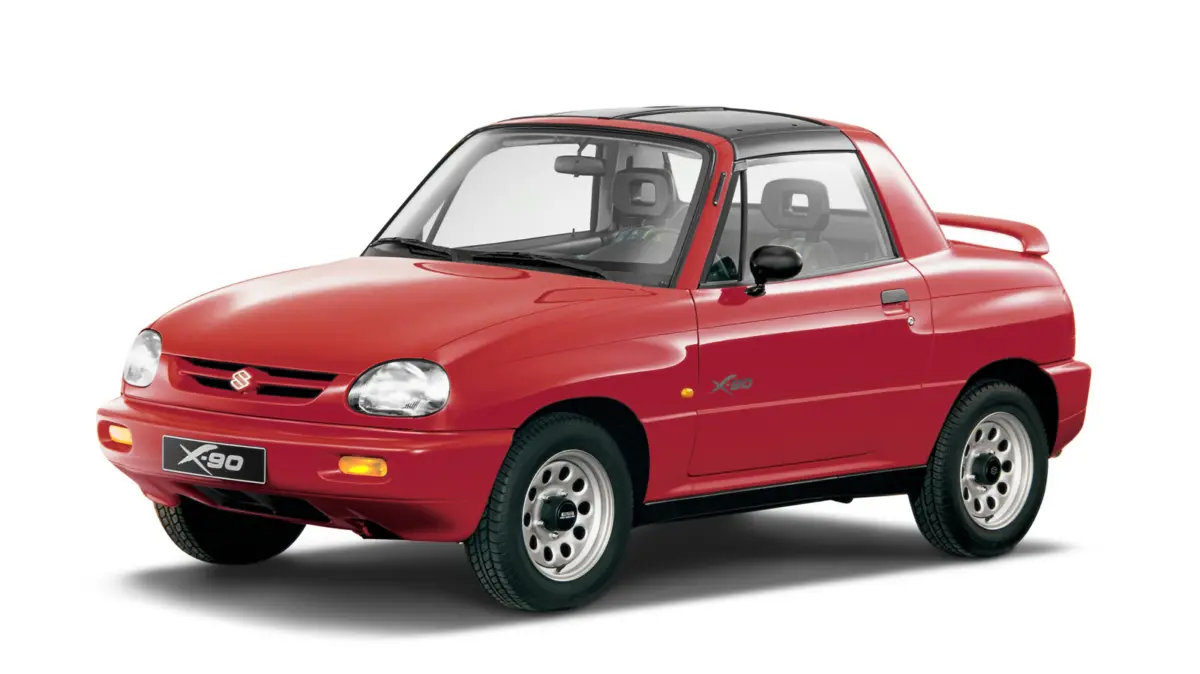
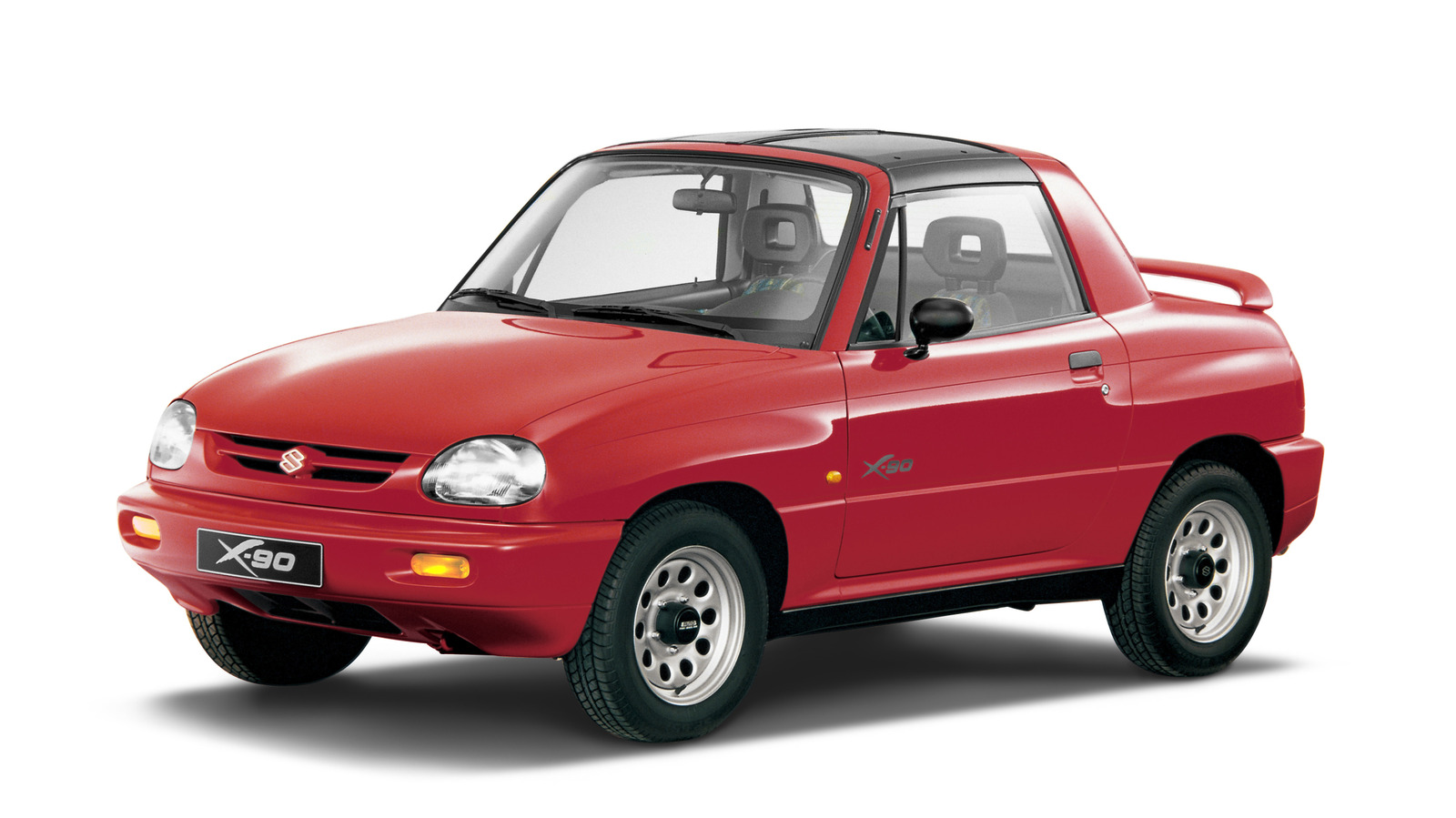
To understand just how strange this automotive niche is, one only needs to look back at the Suzuki X-90. Released in the mid-1990s, the X-90 stands out as arguably the only mass-market, globally distributed two-seat SUV ever attempted. By exploring its legacy, automotive historians and enthusiasts are left wondering whether other vehicles of its kind exist, or if the two-seat SUV is truly as rare as it first appears. When looking strictly at the criteria, conventional two-door SUVs—such as the Jeep Wrangler, including variations like the Scrambler SRT Concept—typically incorporate a rear row of seats, disqualifying them from the pure two-seat club. Similarly, most single-cab pickup trucks are excluded, even though an argument can be made that they serve a related utilitarian function.
This brings the focus back to Suzuki’s diminutive experiment from the 1990s. Single-handedly attempting to pioneer an entirely new market segment and ultimately falling short, the X-90 barely fits the traditional physical dimensions or performance metrics of a full-blown SUV. Measuring a mere 146 inches in length and powered by a modest 1.6-liter engine generating just 95 horsepower, its statistical footprint is remarkably light.
However, beneath its eccentric exterior, the X-90 utilized traditional body-on-frame construction akin to proper, heavy-duty 4x4s. It came equipped with genuine four-wheel drive and a live rear axle. Suzuki’s smaller off-road vehicles have long maintained an enviable reputation within the automotive community for punching above their weight class, venturing deep into the wilderness where larger vehicles fear to tread. Consequently, the X-90’s trail capabilities should not be lightly discounted.
Despite its mechanical credentials, the market simply did not embrace the X-90. Its strongest market was the United States, where a modest 7,205 units were sold over a three-year period beginning in 1996. Given the peculiar nature of the small Suzuki, automotive observers are naturally led to wonder: are there any other vehicles cut from the same cloth? Are there any other two-seat SUVs operating anywhere in the wild?
Those Zany Europeans Have Us Covered
True to form, when the automotive world produces bizarre design experiments, European coachbuilders and low-volume manufacturers are frequently at the forefront. Swiss firm Sbarro, for instance, has built a legendary reputation for creating motoring oddities that defy conventional classification. Among its extensive and eccentric back catalog are a Volkswagen Golf-sized hatchback powered by a Ferrari V8—though distinct from the engine Ducati once utilized for a Lancia sedan—and an open-topped variation of the Renault Espace minivan.
Beyond those curiosities, Sbarro also delivered one of the most mechanically surreal two-seat SUVs the world has ever seen: the Monster G, unveiled in 1987. The vehicle featured specifications unlike any other SUV in history, most notably utilizing wheels sourced directly from a Boeing 727 commercial airliner.
Other extraordinary details of the Monster G included a heavily modified chassis borrowed from a Range Rover, paired with a potent Mercedes 6.3-liter V8 engine under the hood that pumped out an impressive 350 horsepower. As if those specifications were not enough, the vehicle’s trunk housed a folding motorcycle and a portable generator. Because the Sbarro Monster G was constructed as a strict one-off commission tailored for a wealthy German enthusiast, it remains virtually unknown to the general public.
In a similarly unorthodox vein, French manufacturer Aixam introduced another striking interpretation of the two-seat SUV formula through the Mega Track. Functioning essentially as a lifted, V12-powered supercar utilizing the engine from the W140 Mercedes S-Class, the Mega Track serves more as a spiritual precursor to modern high-riding performance machines like the Lamborghini Huracan Sterrato and Porsche 911 Dakar than it does to a traditional utility vehicle.
The Mega Track was an imposing machine. It measured an immense 196.85 inches in length and 98.4 inches in width, while tipping the scales at more than 4,400 pounds. Naturally, it joins the exclusive roster of rare two-seat SUVs, complete with four-wheel drive capability and an adjustable suspension system that allowed the driver to increase ground clearance at the push of a button. By comparison to Sbarro’s custom creation, the Mega Track was almost mainstream, with approximately five to six units ultimately produced. Even so, by any conceivable metric, it stands as an exceptionally scarce example of an already rare automotive genre.
What Else Might Qualify as a Two-Seat SUV?
Expanding the search across a broader historical and global landscape reveals other candidates that might tenuously qualify as two-seat SUVs. Following the widespread military utilization of the Willys Jeep during World War II, transitioning the platform into a civilian vehicle was a logical next step for the manufacturer. Initial derivatives, designated as the CJ-1 and CJ-2, were engineered primarily as rugged agricultural workhorses designed to operate directly in fields. By 1945, the refined CJ-2A entered production. Manufactured continuously until 1949, more than 214,000 units were ultimately built.
In its most Spartan specification, the early CJ-2A technically featured only a driver’s seat, though optional extras allowed buyers to add a passenger seat or a rear bench, keeping it in contention for this unique list. Furthermore, owners could easily remove the rear bench in an original Willys Jeep, effectively converting it into a dedicated two-seater. Whether modern enthusiasts genuinely classify the historic Willys Jeep as an SUV, however, remains open to debate.
While an eighty-year-old Jeep continues to command respect for its off-road pedigree, a distinct breed of modern commercial SUVs has emerged across international markets in recent decades. Though rarely offered to North American consumers, these vehicles frequently utilize a two-seat layout to maximize cargo capacity for commercial applications.
One prominent example is Toyota’s long-serving Land Cruiser, a nameplate that traces its roots directly back to 1951. In various global regions, current iterations of the Land Cruiser are marketed specifically as commercial vehicles. While maintaining the outward appearance of a standard civilian station wagon, the cabin is configured with just two front seats, separated from a dedicated rear load area by a heavy-duty security mesh.
Similarly, international markets receive versions of the current Land Rover Defender 90 configured expressly for commercial use, marketed under the Hard Top moniker. These variants feature a streamlined cabin housing only two seats up front. For those seeking a blend of classic aesthetics and modern performance, Land Rover Classic offers a restoration and "remastering" service for vintage Defenders, dropping a formidable 405-horsepower V8 engine under the bonnet. Among the body styles made available through this bespoke program is the 90 Hard Top, featuring a dedicated two-seat interior layout. Beyond that specialized cabin configuration and the numerical designation in its name, however, the modern Defender shares virtually nothing else with the quirky, misunderstood Suzuki X-90 that started the conversation.








No comments yet. Be the first to join the conversation!