
Factory performance has reached unprecedented heights, offering consumers everything from track-ready supercars to lightning-fast electric vehicles straight off the showroom floor. Yet, for true automotive enthusiasts, achieving a genuinely unique driving experience often requires stepping outside the boundaries of conventional manufacturing. Enter the obscure engine swap—a meticulous and frequently maddening pursuit of mechanical eccentricity. While automotive culture is no stranger to ambitious conversions, a specific subset of these projects stands apart: those that completely transform a vehicle’s character by introducing an exhaust note and performance profile that defies all logic and expectation.
Automotive builders have long gravitated toward projects that maintain a deceptive, sleeper-style appearance from the outside. The visual allure often relies on subtlety, ensuring that the finished vehicle gives away none of its hidden mechanical secrets through protruding superchargers or ostentatious body modifications. Instead, the true shock value is reserved for the ignition sequence and the subsequent rush of acceleration. From exotic Italian powerplants shoehorned into stainless-steel time machines to heavy-duty diesel engines resting inside lightweight urban hatchbacks, these conversions challenge traditional engineering norms and force bystanders to do a double-take.
Ferrari-Powered DeLorean
Almost everything about the factory-original DeLorean is awe-inspiring, from its brushed stainless steel bodywork and rakish lines to its immortalized silver-screen connection as Doc Brown’s time machine in the Back to the Future franchise. However, its factory-installed 130-horsepower, 2.8-liter V6 has consistently disappointed enthusiasts who feel the iconic wedge-shaped design deserved a powertrain capable of matching its futuristic aesthetics.
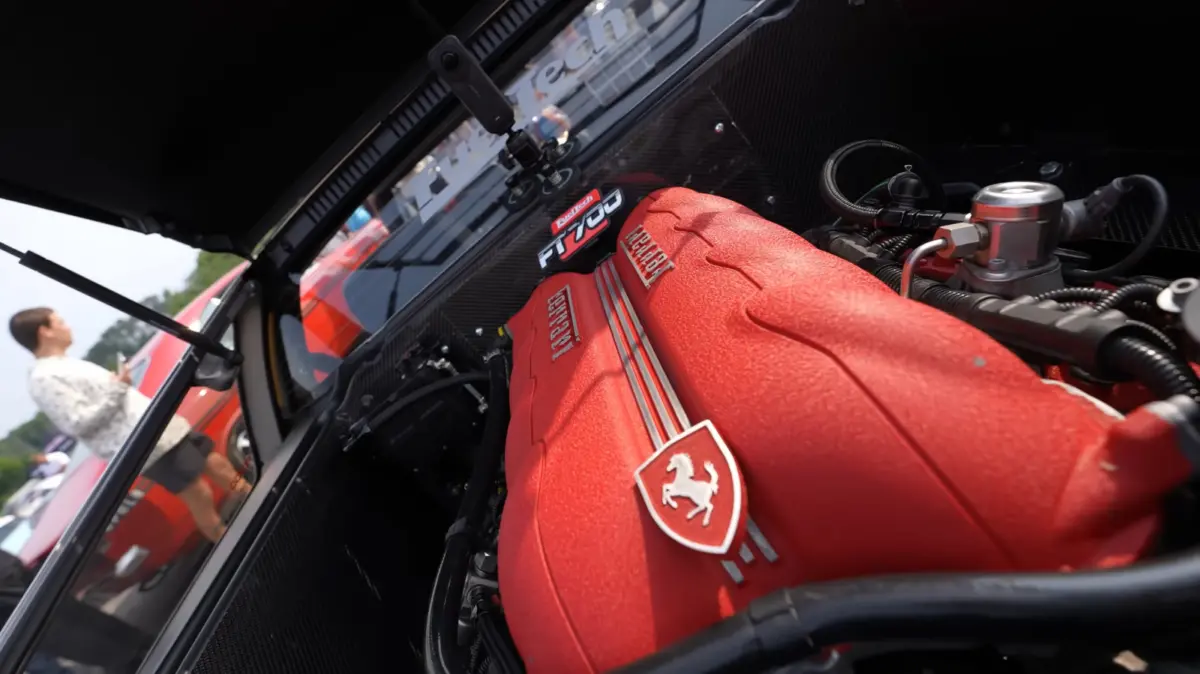
An engineering firm named FuelTech set out to rectify this performance deficit. When they acquired the vehicle, it was devoid of an engine, lacking even the original Peugeot-Renault-Volvo PRV unit. Rather than sourcing a replacement factory-spec motor, the team opted for an exotic 4.3-liter V8 pulled directly from a Ferrari California. This Italian powerplant generates an impressive 453 horsepower and 358 pound-feet of torque, completely transforming the acoustic and dynamic profile of the rear-engine coupe.
To manage the substantial increase in power, FuelTech integrated a six-speed Tiptronic transmission harvested from a Porsche 911. Comprehensive handling and safety upgrades were also essential, leading to the installation of a KW suspension kit and a significantly larger braking system. While purists typically prefer to keep DeLoreans entirely stock or convert them into exact time machine replicas, this particular project rescued a severely neglected shell, resulting in a bespoke creation that bridges Italian engineering and cinematic history.
Cummins-Swapped Prius
Few automotive transformations are as inherently jarring as dropping a heavy-duty industrial diesel engine into a hybrid hatchback designed for maximum fuel efficiency. This particular project features a Toyota Prius that originally rolled off the assembly line with a 1.5-liter inline-four hybrid system. Owner Ben Schulz systematically stripped out the entire hybrid drivetrain, interior components, and a substantial amount of internal metalwork to accommodate a vastly different mechanical heart.
In place of the factory setup, Schulz installed a turbocharged 3.9-liter inline-four Cummins diesel engine, a powerplant more commonly found in commercial and construction applications. On the dyno, the modified setup delivered a staggering 360 horsepower and 550 pound-feet of torque. While a Volkswagen TDI engine and front-wheel-drive configuration were briefly considered, the rear-wheel-drive Cummins conversion ultimately proved too compelling to ignore.
The visual juxtaposition of the finished car remains its most remarkable attribute. The exterior retains a remarkably standard appearance, with the original rear wheels widened rather than replaced to preserve the subtle factory aesthetic. Hearing the deep, thunderous rumble of a heavy-capacity turbo diesel four-cylinder echoing down the road—only for a classic Prius to emerge through a thick cloud of diesel smoke—creates one of the most remarkable double-take scenarios in modern car culture. Future plans for the build involve restoring the original interior to further enhance its ultimate sleeper status.
K24-Swapped C6 Corvette
The Chevrolet Corvette has a rich history of pushing performance boundaries, but its lineage has always been defined by multi-cylinder configurations, stretching from early inline-six powerplants to legendary small-block V8s. A factory four-cylinder Corvette has never existed. Undeterred by tradition, engineers at Unruly Motorsports decided to engineer that exact anomaly by removing a C6 Corvette’s stock 6.0-liter LS2 V8 and replacing it with a turbocharged Honda K24 four-cylinder engine.
While a stock C6 Corvette reliably produces 400 horsepower, the builders behind this project targeted a vastly higher performance threshold. Before installation, the heavily modified K24 produced an astonishing 828 horsepower on 20 pounds of boost, aided by forged internal components, a closed-deck block, and a 67-millimeter ceramic ball-bearing turbocharger. Paired with a built two-speed Powerglide transmission, the engine ultimately peaked at 917 horsepower and 563 pound-feet of torque on the dyno.
The motivation behind the swap extended far beyond simply provoking traditionalists. The car was constructed to perform on the drag strip, where it consistently registers quarter-mile elapsed times in the low 11-second range. Amidst its immense straight-line speed, the car continues to draw curious stares at local meets, primarily due to the unmistakable, high-revving soundtrack of a Japanese four-cylinder emanating from beneath the classic American sports car hood.
Volvo 5-Cylinder-Powered Miata
Engine-swapped Mazda Miatas have become a staple of the tuning community, ranging from high-revving, naturally aspirated K24 builds exceeding 800 horsepower to exotic motorcycle-engine conversions capable of screaming past 10,000 RPM. However, a particular first-generation Miata powered by a Volvo five-cylinder engine offers a uniquely compelling mechanical narrative that prioritizes resourcefulness over vast financial expenditure.
Aside from subtle exterior graphics, the roadster easily passes for an ordinary, inexpensive project car parked in a residential driveway. Beneath the factory bonnet, however, lies a turbocharged B2544T engine originating from Volvo’s acclaimed T5 family. Displacing 2.4 liters across five cylinders, the powerplant is tuned to deliver between 300 and 400 horsepower within the lightweight chassis.
Although initial plans involved attempting to fit a larger Volvo T6 inline-six, the slightly more compact T5 proved to be a practical packaging solution that delivered a similarly distinctive acoustic signature. The engine is mated to a robust six-speed manual transmission sourced from a BMW 1 Series, chosen specifically for its ability to handle high torque loads. The conversion serves as a testament to grassroots automotive creativity, proving that combining an affordable chassis with a junkyard engine and European transmission can yield results as compelling as any high-dollar custom build.
Rich Rebuilds’ V8-Swapped Tesla
Automotive YouTuber Rich Rebuilds captured widespread attention when he successfully transformed a flood-damaged Tesla Model S into an internal combustion vehicle by integrating a 6.2-liter LS3 V8 engine from a Chevrolet Camaro. The project involved mating the electric vehicle’s original body with the American V8 while making a concerted effort to maintain a relatively unassuming exterior appearance. The car was finished in a distinctive, utilitarian brownish vinyl wrap that nods to its playful "ICE-T" moniker, combining internal combustion engine terminology with the Tesla brand identifier.
The conversion required positioning the LS3 within the Tesla’s front trunk area and coupling it with a sequential six-speed manual transmission routed through a custom-fabricated transmission tunnel. The resulting setup generated approximately 440 horsepower. While the project initially drew considerable skepticism and online criticism for altering an electric vehicle, the car ultimately saved a flood-damaged shell from permanent disposal in a salvage yard. After years of changing hands among digital creators and receiving subsequent updates—including a Magnuson supercharger—the V8-swapped Tesla remains a definitive conversation starter whenever its side-exit exhaust system unleashes a traditional V8 roar.
Turbo VR6-Powered Porsche 996 Turbo
The Porsche 911 996 Turbo is recognized as an exceptionally capable sports car, utilizing a 3.6-liter twin-turbocharged flat-six Mezger engine that produces 415 horsepower and 413 pound-feet of torque in standard form. Because the original platform is remarkably responsive to aftermarket tuning, specialized firms routinely extract output figures approaching or exceeding 1,000 horsepower using factory architecture.
Pushing the envelope even further, Speed Density Motorsports developed a conversion capable of delivering up to 1,500 horsepower by abandoning the traditional flat-six entirely. In its place, the team installed a heavily modified 3.2-liter Volkswagen VR6 engine—a power plant with a continuous production history spanning more than three decades. Upgraded with billet aluminum components, forged internals, and a Precision 8565 ball-bearing turbocharger running on methanol, the modified setup represents a union of German sports car engineering and Volkswagen’s iconic narrow-angle layout.
Demonstrated through high-powered development vehicles running on E85 fuel, the single-turbo VR6 setup produces an aggressive, highly distinctive exhaust note that completely redefines the acoustic personality of the 996 generation. While the chassis has hosted various non-stock powertrains over the years, the unique harmonic resonance of a built VR6 provides a truly singular driving and auditory experience.
V6-Swapped Daewoo Matiz
Few automotive platforms inspire enthusiastic tuning initiatives quite like the Daewoo Matiz, a diminutive four-door city hatchback produced primarily for economical urban commuting. Originally powered by a modest 0.8-liter inline-three generating just 52 horsepower, the Matiz was engineered strictly for affordability rather than performance dynamics. Seeking a radically disproportionate challenge, a builder decided to install the largest possible engine into one of the smallest production chassis available.
The chosen powerplant was a naturally aspirated 3.2-liter V6 sourced from a Vauxhall Vectra, producing 208 horsepower and 221 pound-feet of torque. Because a standard Matiz weighs a mere 1,711 pounds, the resulting power-to-weight ratio proved exceptionally potent. Accommodating the large V6 beneath the tiny hood required custom engine mounts and a modified intake manifold, though the builder managed to retain the factory airbox layout.
To ensure the chassis could manage the performance upgrade, the builder installed a custom front big brake kit utilizing Ford Focus RS rotors and Mitsubishi Lancer Evolution VI calipers, positioned behind 18-inch Porsche alloy wheels. A lightened flywheel and a limited-slip differential help harness the V6 output, while the interior remains largely stock aside from a modified Vauxhall gear shifter. The completed hatchback stands as an exercise in mechanical audacity, proving that boundary-pushing engineering can originate from the most unassuming foundations.









No comments yet. Be the first to join the conversation!