
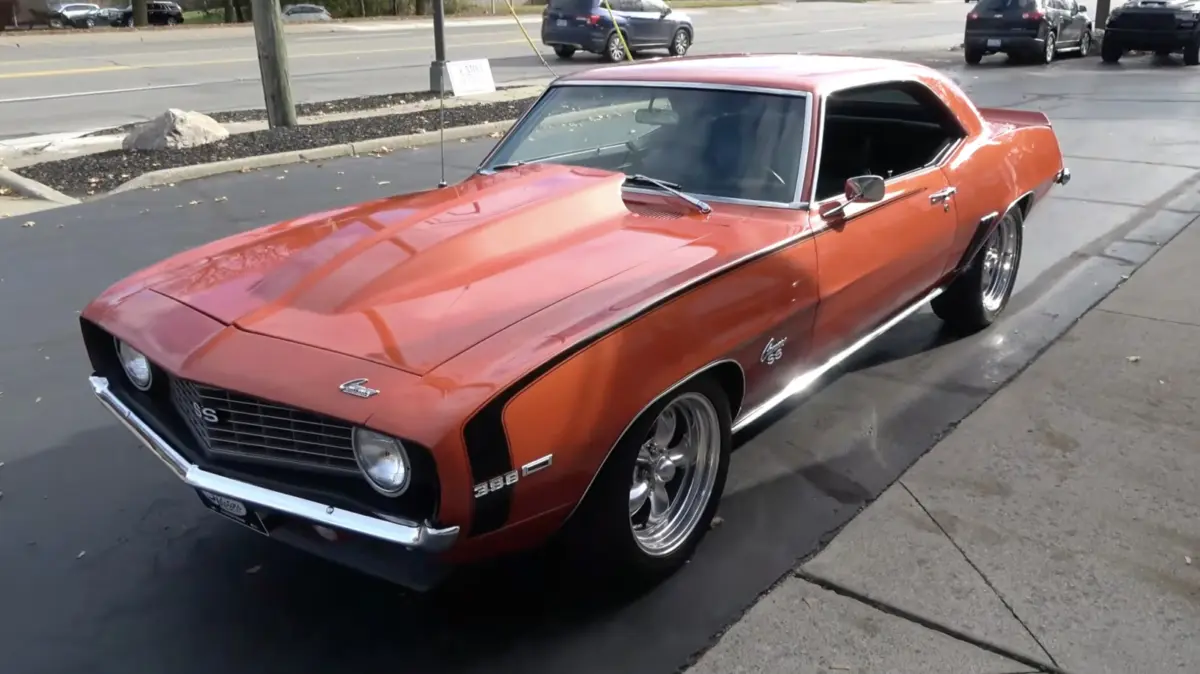
While automotive enthusiasts continue to yearn for another generation of the legendary Chevrolet Camaro and speculate endlessly about whether General Motors will ever bring the iconic nameplate back, the best bet for gearheads is often to look back at its golden era. A pristine example of that golden era has recently surfaced in the classifieds, offering a masterclass in classic muscle car restoration blended with tasteful, modern upgrades.
Listed by a dealer in Clarkston, Michigan, and currently advertised on Hemmings with an asking price of $58,900, this Ontario Orange 1969 Chevrolet Camaro SS is a true head-turner. Showing just 10,000 miles on the odometer following a comprehensive body-up restoration, the vintage muscle car bridges the gap between classic styling and modern drivability. Underneath its cowl hood lies a formidable 396-cubic-inch big-block V8 engine that immediately raises a fascinating historical question for muscle car purists: Just how did that legendary powerplant really stack up against its fierce rivals back in the high-stakes era of 1969?
Neither the Hemmings listing nor the dealer’s detailed YouTube walkaround video provides exact dynamometer-tested horsepower or torque figures for this specific build, but a visual inspection makes it abundantly clear that this is far from a factory-stock motor. The 396 cubic-inch engine bay has been enhanced with quality aftermarket components designed to wake up the big-block. It wears an Edelbrock Performer aluminum intake manifold, ceramic-coated headers that improve exhaust scavenging, a mild camshaft for a lumpy idle and stronger mid-range pull, and a Flame Thrower high-energy-ignition distributor to ensure a hot, reliable spark. Chrome valve covers and a matching chrome open-element air cleaner add a brilliant shine under the hood, ensuring the engine compartment looks just as impressive as the exterior paint.
Putting that power to the pavement is a robust Turbo-Hydramatic 400 three-speed automatic transmission, which reliably funnels torque back to a 10-bolt rear axle equipped with 3.23 gears. It is a classic drivetrain combination built to handle cruising duties with ease while still offering plenty of straight-line authority when the secondary throttle opens up.
For historical context, Chevrolet offered three distinct versions of the 396 big-block engine in the 1969 Super Sport lineup. These factory powerplants were officially rated at 325, 350, and a staggering 375 horsepower, with factory torque ratings sitting comfortably between 410 and 415 pound-feet. Sitting firmly at the pinnacle of the factory lineup was the mighty L78 engine, which squeezed its peak 375 horsepower out at 5,600 rpm. Without putting this particular restomod on a dyno, there is no definitive way to know precisely where its modified 396 lands among those historical factory specifications, but the upgraded intake, exhaust, and ignition components certainly suggest it breathes a bit easier than it did rolling off the assembly line more than five decades ago.
How the 396 stacked up
To understand the cultural impact of this car, it helps to look at how Chevrolet’s big-block performance compared to its contemporaries during the golden age of American muscle. On paper, the top-tier L78 engine completely outgunned most of its direct competition in the pony car wars. Its factory-claimed 375 horsepower easily eclipsed the 345 horsepower claimed by Pontiac for the Ram Air IV Firebird. It also outmuscled the 335 horsepower rated for the Ford Mustang Mach 1 when equipped with its legendary 428 Cobra Jet engine—widely remembered as one of the most powerful and capable powertrains the Mach 1 ever came with. Even the entry-level 325-horsepower version of the SS 396 sat within a mere 10 horsepower of the mighty Ford Cobra Jet on paper.
However, real-world track testing painted a somewhat different and more nuanced picture. Period performance figures published by Car Life magazine, as chronicled by Curbside Classic, were recorded using vehicles evaluated in showroom-stock trim. According to those vintage evaluations, a factory-stock Camaro SS 396 L78 could reach 60 miles per hour from a standstill in 6.8 seconds and cover the classic quarter-mile distance in 14.77 seconds at a trap speed of 98.7 miles per hour.
In comparison, the Mach 1 equipped with the 428 Cobra Jet managed to sprint to 60 miles per hour in a much quicker 5.5 seconds and conquered the quarter-mile in 13.9 seconds at 103.3 miles per hour. Two other factory-rated 375-horsepower rivals also managed to run quicker quarter-mile times than the Chevrolet during period testing: the Plymouth ‘Cuda 440 clocked a 14.01-second run, and the legendary Boss 429 Mustang managed a 14.09-second pass, despite recording a slightly slower 7.1-second acceleration run to 60 miles per hour.
In almost every case, traction was the ultimate limiting factor rather than raw engine output. The skinny, bias-ply tires of the era simply struggled desperately to put the immense low-end torque of big-block engines down onto the asphalt effectively. Because of these tire limitations at the drag strip, factory gross horsepower ratings alone could never completely settle the fierce pony car arguments that raged among enthusiasts in the late 1960s.
Today, restomods like this Ontario Orange Camaro bypass many of those original vintage limitations by incorporating modern chassis and tire technology. The exterior of this particular 1969 model features brilliant Ontario Orange metallic paint accented by a classic black hockey stick stripe along the side profile. Aerodynamic and cosmetic enhancements include front and rear spoilers, a aggressive cowl induction hood, and dual chrome exterior mirrors.
The stance has also been thoroughly updated. The car rolls on modern 17-inch American Racing Torque Thrust wheels, which are wrapped in sticky Dunlop rubber—measuring wider 255/45ZR17 tires in the back to help plant power to the ground, and 235/40R17s up front for crisp steering response. Beneath the sheet metal, the chassis has been improved with tubular upper and lower control arms that vastly modernize the front suspension geometry. Cooling duties are handled by an upgraded aluminum radiator, while driver comfort and safety are greatly enhanced by the addition of power steering and power front disc brakes featuring modern slotted and drilled rotors.
Inside the cabin, the black vinyl interior retains its authentic vintage charm while offering choice creature comforts. It features factory front bucket seats, a traditional center console housing the shifter, a classic sport steering wheel, and a modern Retrosound radio that blends seamlessly into the dash while providing updated audio capabilities.
As automotive enthusiasts continue to speculate on whether Chevrolet will ever bring back the Camaro nameplate in a future generation, looking back to the past might just be the best way to satisfy that muscle car craving. For anyone looking to experience the timeless appeal of a classic first-generation pony car with modern reliability and road manners, this low-mileage Ontario Orange time capsule offers a compelling ticket straight back to 1969.







No comments yet. Be the first to join the conversation!