

In the months leading up to the release of The Social Reckoning—a long-anticipated sequel to David Fincher’s acclaimed 2010 film The Social Network, which meticulously charted the meteoric rise of Mark Zuckerberg and Facebook—industry insiders and film enthusiasts spent a fair amount of time grumbling about a significant creative shift. The core grievance among critics was simple: Aaron Sorkin, the writer-director taking the helm for this chapter, is no David Fincher.
That assessment is, of course, demonstrably true. Sorkin wrote the razor-sharp script for The Social Network and rightfully earned an Academy Award for his efforts. Fincher was notably in talks for a time to direct The Social Reckoning, but when those negotiations fell through, the gig ultimately landed with Sorkin, setting off a wave of pre-release skepticism. Sorkin has built a legendary career specializing in crackling, fast-paced dialogue and heartfelt, if frequently self-righteous, liberal political viewpoints. Yet, the feature films he has directed himself, such as The Trial of the Chicago 7 and Being the Ricardos, have rarely been considered particularly dynamic from a purely cinematic standpoint. His signature excessive earnestness can often cut both ways: while it is genuinely refreshing that an artist cares deeply about his subject matter, an overwhelming surplus of earnestness can occasionally grow exhausting for an audience.
Which is precisely why it comes as something of a pleasant surprise that The Social Reckoning moves along as briskly and compellingly as it does. This cinematic account focuses on how Wall Street Journal investigative reporter Jeff Horwitz—played here by Jeremy Allen White—managed to crack the monumental story of how, in the volatile period leading up to the 2020 United States presidential election, Facebook founder and CEO Mark Zuckerberg essentially encouraged the systematic amplification of extremist views. As the film illustrates, this algorithmic choice fed directly into the violent and unprecedented January 6 attack on the United States Capitol.
Horwitz, however, cannot uncover a corporate conspiracy of this magnitude entirely on his own. He enlists the clandestine help of a loyal, highly skilled Facebook engineer who works as part of the organization’s dedicated civic integrity team, but who has grown increasingly skeptical of the company’s internal policies and broader societal impact. Frances Haugen, brought to life by Mikey Madison, at first offers only minimal, guarded information during their initial interactions; she genuinely loves her demanding job and is terrified of losing her livelihood. But the deeper she digs into Facebook’s sinister, quantified practices of promoting high-engagement rage bait at the expense of social cohesion, the more deeply disenchanted she becomes with the corporate machinery she serves.
At its core, The Social Reckoning functions as an old-school, shoe-leather journalism thriller in the grand tradition of classic cinema. Sorkin’s overarching point seems to be that even in the hyper-accelerated digital age, there are not really any fundamentally new ways to practice thorough, ethical journalism—all the traditional rules, relentless fact-checking, and human sacrifices still apply. His script is remarkably dense with complex information, and the narrative—which opens in 2019 with Horwitz joining the paper’s San Francisco bureau and more or less wraps up with the publication of his Pulitzer Prize-winning, multi-part 2021 expose known as the Facebook Files—frequently leapfrogs backward and forward through time.
To help viewers navigate these structural temporal shifts, the film helpfully indicates the changing years via a sliding timeline appearing at the bottom of the screen. Sorkin’s approach to telling this dense, procedural story is somewhat professorial, relying heavily on a style of storytelling that leans more toward telling than showing. Fortunately, cinematographer Jeff Cronenweth—a frequent Fincher collaborator who also shot The Social Network—endows the picture with a handsomely polished, atmospheric look. Somehow, despite the heavy exposition, the runtime slips by far faster than audiences might have initially expected.
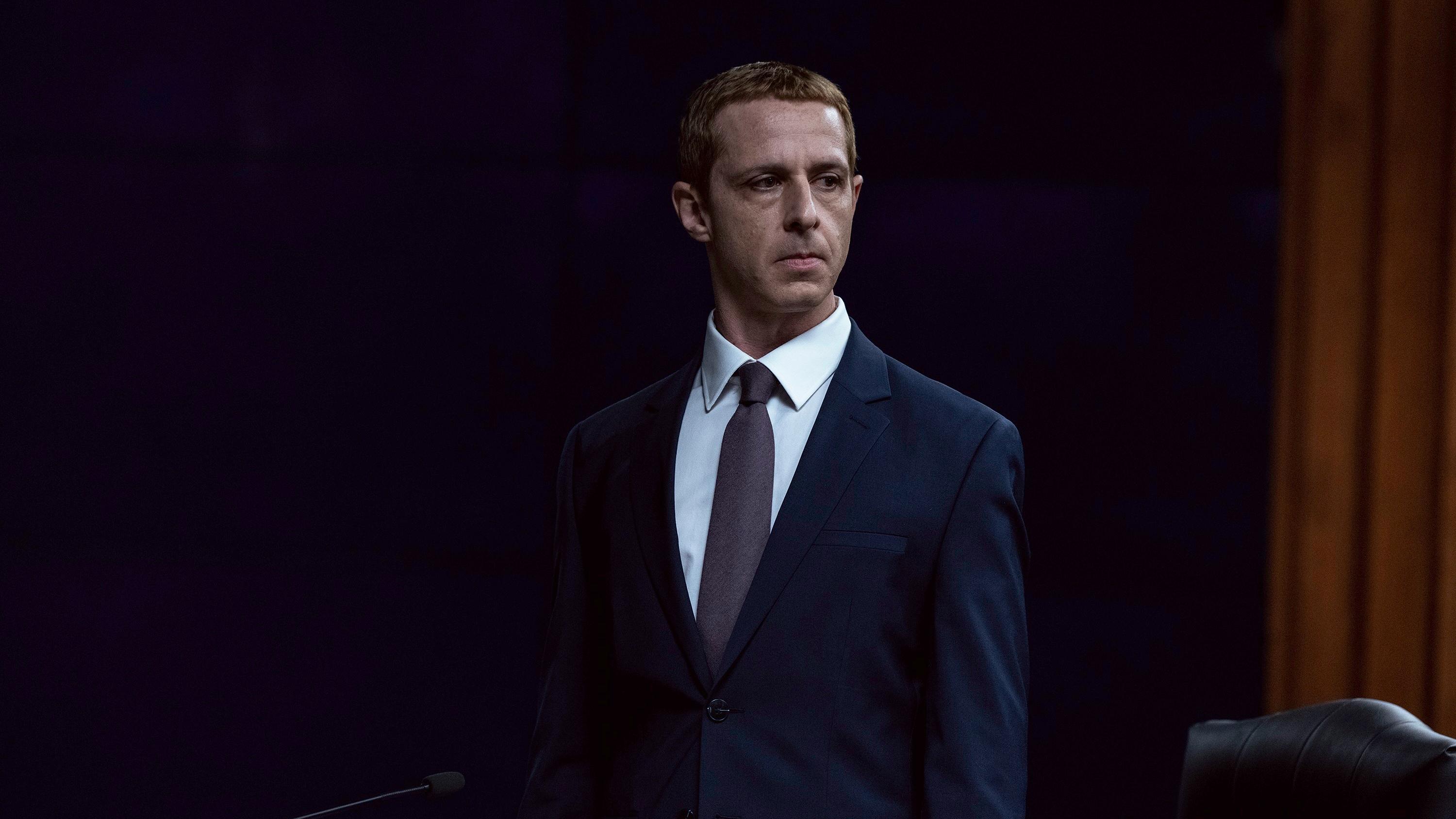
That steady narrative momentum is thanks, at least in part, to Sorkin’s astute casting choices. Mark Zuckerberg is portrayed by chameleon actor Jeremy Strong, who radiates a palpable, robotic clamminess throughout the film. In many of his key scenes, Zuckerberg is ensconced within a mock Congressional hearing setup, overseen by a take-no-prisoners crisis communications specialist played with fierce authority by Wunmi Mosaku. This specialist has been hired expressly to make the tech mogul appear more human and likable—a Sisyphean task if ever there were one in modern public relations. He sits, straight-backed and deeply tense, clad in a dark suit, working terrifically hard at the exhausting task of mimicking human warmth. At one critical juncture in the film, when he is relentlessly grilled under hot lights about his company’s institutional role in promoting the views of hate groups, he snaps back defensively, “We’re a corkboard. We don’t control what people pin to it.”
Strong has built a career being attracted to playing unlikable, deeply flawed people, and he is undeniably exceptional at it. Yet, unlike his recent portrayal of fixer extraordinaire Roy Cohn in The Apprentice, where he offered a subtle dash of tempered sympathy to remind viewers that even monsters are human, Strong takes a different path here. He focuses almost solely on the tech oligarch’s calculating, evasive, and emotionally detached nature. It is a disciplined and ultimately correct choice for the material.
As Jeff Horwitz, Jeremy Allen White serves up a classic, remarkably muted portrayal of a reporter so intensely dedicated to his craft that he appears seriously fun-deprived. Oddly enough, it takes a smart, ultra-serious tech engineer to finally loosen him up, and his scenes with Mikey Madison—in which their characters spar, debate, and exchange sharp banter—represent the movie’s strongest dramatic highlights. At one point in their developing rapport, Horwitz refers to Frances as a modern-day Cassandra, citing the classic mythological story of the cursed Trojan princess who was blessed with the true gift of predicting the future, yet cursed so that absolutely no one would believe her warnings.
Only, as Frances quickly points out, he has slightly mangled and misapplied the literary myth. She promptly sets him straight, while also filling him in on the correct metaphorical meanings and historical origins of Chicken Little and the Boy Who Cried Wolf for good measure. It is Madison who ultimately anchors the emotional core of the movie. Frances wears studious schoolgirl glasses and suffers quietly from severe neuropathy; living and working in the chilly, unforgiving microclimate of San Francisco, she needs to bundle up in chunky leg warmers and knitted wristlets just to keep physical numbness at bay—wardrobe choices that give her a distinct, waifish air.
At one revealing moment, she describes herself with self-deprecating clarity as “the girl in class with her hand raised that nobody wants the teacher to call on.” That description is a mouthful of classic Sorkinese dialogue if ever there were one, but as she spins the words out naturally, Madison is so plaintive and sincere that she makes you immediately see that vulnerable girl sitting in the classroom. Frances Haugen serves as the moral conscience and the true hero of The Social Reckoning, and Sorkin clearly knows it. He practically hands the emotional momentum of the movie over to Madison, and even within a film heavily populated by rapid-fire talking—and frequently by men talking over one another—it is her stalwart yet unassuming presence that ultimately makes the entire project sing.








No comments yet. Be the first to join the conversation!