
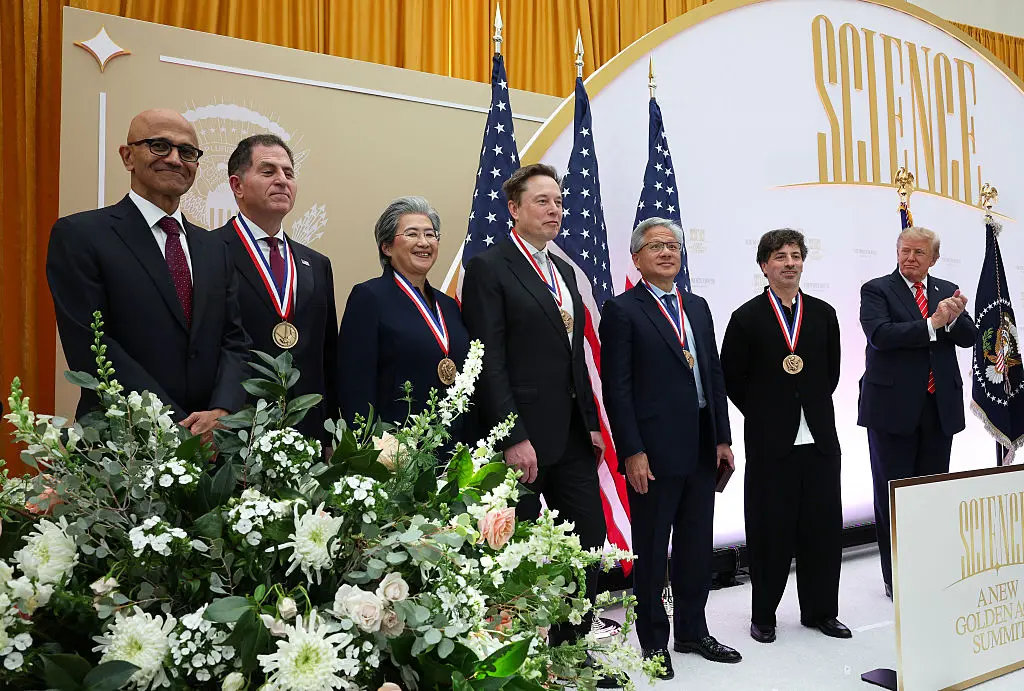
WASHINGTON — In a high-profile ceremony at the White House on Thursday, President Trump hosted the Golden Age of American Innovation Summit, an event designed to celebrate the nation’s preeminence in science, technology, and engineering. During the gathering, the administration bestowed the country’s most prestigious civilian honors upon several of the most influential figures in the global technology sector.
Among the honorees were Tesla and SpaceX chief Elon Musk, Nvidia CEO Jensen Huang, Alphabet co-founder Sergey Brin, and AMD CEO Lisa Su, all of whom were awarded the National Medal of Science. Widely recognized as the nation’s highest scientific distinction, the medal is traditionally presented by the president to individuals who have made extraordinary contributions to the advancement of knowledge in the biological, behavioral, physical, chemical, or engineering sciences.
In addition to the science medals, the ceremony also highlighted major figures in computing and enterprise technology. Dell Technologies founder and CEO Michael Dell, alongside Microsoft CEO Satya Nadella, received the National Medal of Technology and Innovation. This award honors individuals and teams who have made lasting contributions to America’s economic, environmental, and technological well-being through the promotion of technological innovation, the commercialization of new products and processes, and the development of the nation’s technological workforce.
The event drew immense interest from both the technology industry and political observers, not only because of the monumental corporate footprints of the recipients, but also due to the intersecting relationships between Silicon Valley leadership and the federal government. According to reports from various journalistic investigations, the collective group of awardees and their associated corporate entities have contributed nearly $6 billion to efforts and initiatives tied to President Trump and his administration.

Financial disclosures and public records highlight the scale of these contributions across multiple avenues. Alphabet and Microsoft, for example, previously directed corporate donations toward the president’s official inauguration fund as well as the renovation and funding of the White House ballroom. Meanwhile, leadership and entities associated with AMD provided substantial financial backing to a prominent pro-Trump Super PAC. Furthermore, Michael and Susan Dell made headlines by pledging a monumental $6.25 billion to help fund Trump Accounts, the administration’s newly established savings program designed to build long-term financial security for American children.
During his address at the summit, President Trump praised the assembled executives for their transformative impact on the modern economy and national security. He asserted that the honorees had played an instrumental role in helping to pioneer an incredible future for America. Emphasizing the geopolitical stakes of technological leadership in the twenty-first century, the president told the audience that because of the innovation and dedication of these leaders, the United States would always remain on top, adding that no other nation could effectively compete with American ingenuity.
The ceremony also unfolded against a backdrop of complex and sometimes tense policy intersections between major technology firms and federal regulators. Notably, Microsoft CEO Satya Nadella received his National Medal of Technology and Innovation under unique circumstances, coming immediately after the administration announced an indefinite suspension of Microsoft from the H-1B visa program. The federal program has long served as a crucial mechanism for U.S. technology companies to recruit and retain highly skilled foreign workers, particularly in software engineering, artificial intelligence, and advanced research fields. The sudden suspension has introduced a layer of regulatory friction between the government and the technology sector, even as top executives were being fêted at the White House for their contributions to American progress.
The juxtaposition of high-level recognition and regulatory friction underscores the multifaceted nature of the relationship between modern tech giants and Washington. As artificial intelligence, semiconductor manufacturing, and advanced computing continue to dominate global strategic competition, the intersection of political fundraising, national policy, and corporate leadership remains a defining characteristic of the contemporary American landscape. The Golden Age of American Innovation Summit served as a vivid demonstration of these converging forces, bringing together the nation’s foremost architects of technological change inside the halls of government.









No comments yet. Be the first to join the conversation!