
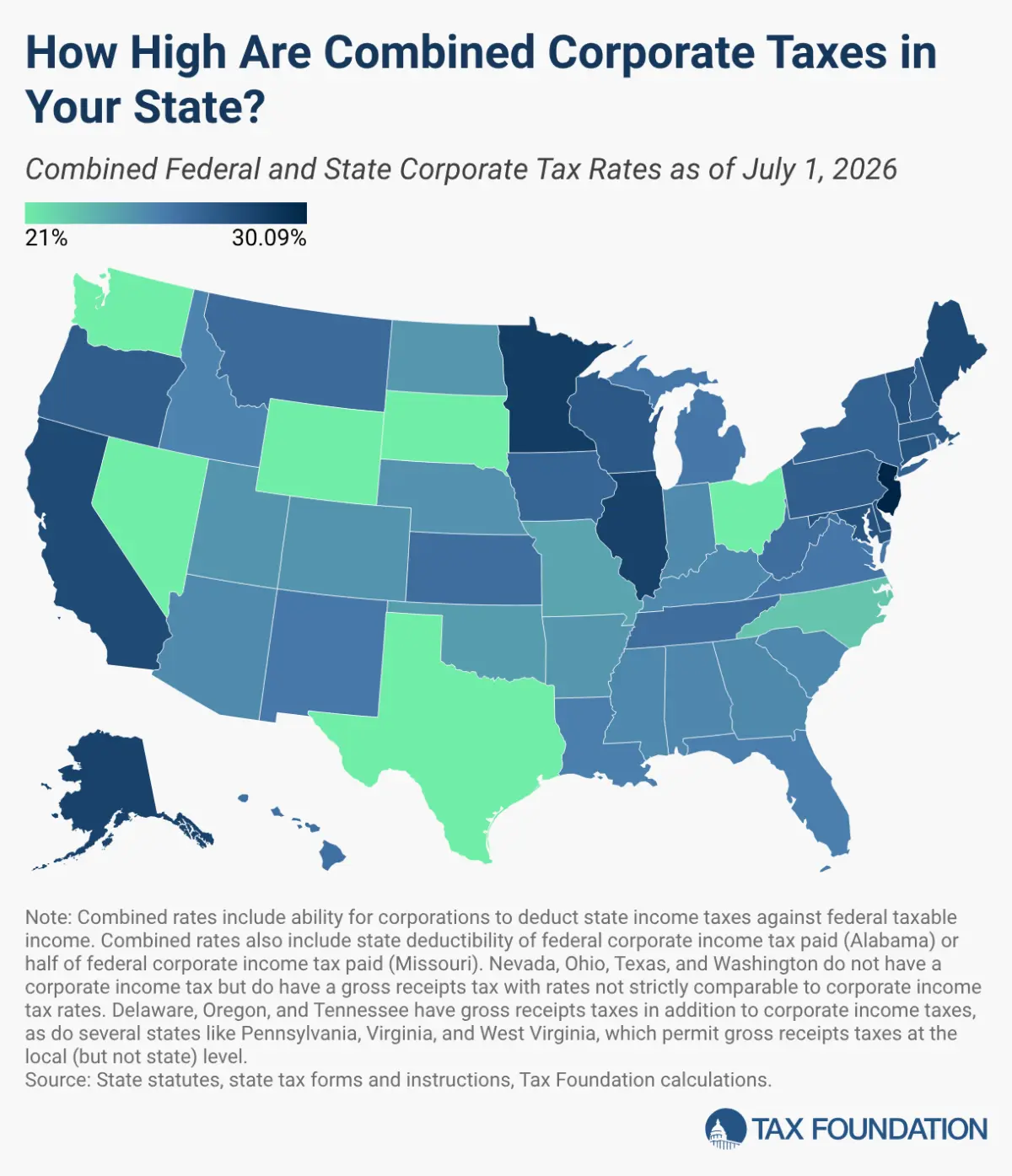
Corporations operating within the United States face a multi-layered tax environment characterized by a combination of federal mandates and a diverse array of state-level policies. At the core of the federal system is a corporate income tax levied at a flat rate of 21 percent. However, the total tax liability for any given business is frequently shaped by state-level policies, which vary dramatically across the country in structure, rate, and application.
Beyond the federal baseline, 44 states and the District of Columbia impose their own taxes on corporate income. These state systems introduce a wide spectrum of top marginal rates, stretching from a modest 2.0 percent in North Carolina to a notable 11.5 percent in New Jersey. The structural design of these state taxes also varies significantly: 13 states utilize graduated corporate income tax structures with multiple brackets, while 31 states and the District of Columbia opt for flat tax rates on corporate earnings.
The corporate income tax, broadly defined, is a levy imposed by federal and state governments on business profits. It is worth noting that a large number of companies are not directly subject to the corporate income tax because they are structured as pass-through businesses. In these cases, business income is reported and taxed under the individual income tax code rather than the corporate framework. For traditional C corporations, however, navigating both federal and state rules is a central component of financial planning and compliance.
The diversity of state tax codes extends well beyond traditional income taxes. In a handful of states, the approach to business taxation takes an entirely different form. In Nevada, Ohio, Texas, and Washington, corporations are subject to gross receipts taxes rather than traditional corporate income taxes. Meanwhile, Delaware, Oregon, and Tennessee take a hybrid approach, imposing both a corporate income tax and a separate levy on gross receipts.
Adding another layer of complexity, some state and local governments target business revenue through localized policies. Pennsylvania, Virginia, and West Virginia levy gross receipts taxes at the local level, even though they do not impose them statewide. On the other end of the spectrum, two states—South Dakota and Wyoming—stand out for having neither a corporate income tax nor a gross receipts tax, leaving businesses in those jurisdictions exempt from state-level revenue levies of this type.
Gross receipts taxes operate fundamentally differently from corporate income or standard sales taxes. They are applied directly to a company’s total gross sales without allowing deductions for standard business expenses, such as employee compensation, the cost of goods sold, and overhead costs. Furthermore, unlike a retail sales tax that is collected at the final point of purchase, a gross receipts tax is assessed on businesses and applies to transactions at every stage of the production process. This compounding effect throughout the supply chain is known as tax pyramiding, which can significantly alter the economic burden on firms depending on their industry and supply chain length.
When combining federal and state obligations, the overall tax burden on corporations can climb substantially. The state with the highest combined corporate income tax rate in the nation is New Jersey, where the total burden reaches 30.1 percent when factoring in federal interactions. Several other states also push combined rates near or above the 28 percent threshold, including Alaska, Illinois, Maine, and Minnesota. Conversely, the six states that levy no state corporate income tax—Ohio, Nevada, South Dakota, Texas, Washington, and Wyoming—face only the baseline federal tax rate of 21 percent, though four of these states offset the absence of an income tax by imposing statewide gross receipts taxes.
Calculating the true tax liability for a corporation often involves navigating complex federal and state interactions, particularly regarding deductions. Under the existing tax code, corporations are generally permitted to deduct state corporate income tax payments against their federal taxable income. Taxable income represents the amount of corporate earnings subject to tax after accounting for allowable deductions and exemptions, making it distinct from and lower than gross income.
This deductibility lowers the effective federal corporate income tax rate for businesses operating in states with income levies. For example, a corporation subject to Rhode Island’s 7 percent flat corporate income tax may deduct those state tax payments against the 21 percent federal corporate income tax. This deduction reduces the effective federal rate to 19.53 percent, resulting in a combined overall rate of 26.53 percent.
In a further twist, a small number of states permit corporations to deduct federal corporate income tax liability against a portion of their state corporate income tax. Alabama stands out by allowing full deductibility of federal corporate income tax liability against state tax liability, while Missouri permits a 50 percent deduction of federal corporate income tax liability. These provisions effectively lower the corporate income tax rates faced by businesses operating within those state borders.
When averaging the tax burdens across all jurisdictions, including the states that impose no corporate income taxes at all, the average combined state and federal corporate tax rate in the United States stands at 25.5 percent. This figure underscores the reality that for most American corporations, state taxes play a meaningful role in shaping overall profitability and operational costs.
Analyzing the broader economic implications of these policies reveals why business taxation remains a central topic of debate among policymakers and economists. Economic research frequently suggests that corporate income and gross receipts taxes are among the most economically damaging ways for governments to raise revenue. Because these levies directly impact capital investment, business expansion, and labor productivity, tax reform in this area is often viewed as a promising mechanism for states seeking to increase their economic competitiveness. Lowering or streamlining corporate tax burdens can foster a more welcoming environment for business growth, ultimately generating positive spillover effects for both companies and the workforce they employ.









No comments yet. Be the first to join the conversation!