
By Staff Reporters
Originally published on July 29, 2026, and updated to reflect newer guidance from the Centers for Medicare & Medicaid Services (CMS), a critical policy analysis reveals that upcoming Medicaid work requirements could jeopardize health insurance coverage for over 100,000 individuals with significant disabilities. As states prepare to implement new community engagement rules under the 2025 reconciliation law, vulnerable adults awaiting federal disability determinations face complex bureaucratic hurdles that threaten to create dangerous gaps in medical coverage.
Starting January 1, 2027—or sooner at individual state option—44 states must condition Medicaid eligibility for adults in the Affordable Care Act (ACA) Medicaid expansion group and certain waiver programs on meeting strict work or community engagement requirements. While federal law mandates exclusions for individuals deemed "medically frail," the framework specified in the June 2026 interim final rule could introduce substantial barriers, making it exceedingly difficult for some low-income adults with severe health needs to successfully claim this exemption.
The ACA Medicaid expansion currently provides essential health care coverage to millions of low-income adults with significant medical needs, including individuals with profound disabilities who are in the midst of applying for the Supplemental Security Income (SSI) program. Because the path to securing federal disability benefits is notoriously lengthy, spanning many months or even years, these applicants rely heavily on Medicaid to stay insured while they remain unable to work.
The Vital Bridge of Medicaid During the SSI Application Process
Supplemental Security Income is a means-tested federal assistance program administered by the Social Security Administration. It provides monthly cash payments to individuals with limited income and resources who cannot work due to a disability, or to adults aged 65 and older. Approval for SSI generally qualifies an individual to receive health coverage through Medicaid, and once approved, these beneficiaries are exempt from work requirements.
However, navigating the application process is notoriously difficult. Demonstrating eligibility requires proving limited income—defined as no more than $2,073 per month in 2026—and limited resources capped at $2,000 for an individual or $3,000 for a couple. For applicants under age 65, proving a qualifying disability is often the most complicated hurdle, requiring a complex five-step process that starts with verifying that current earnings fall below the threshold of substantial gainful activity, which stands at $1,690 per month in 2026.
Subsequent steps assess the severity of physical or mental impairments against strict medical criteria across numerous body systems, ranging from musculoskeletal and neurological disorders to cardiovascular, digestive, and immune system conditions. While some applicants qualify quickly through programs like the compassionate allowance framework—which has approved over one million people for combined disability benefits since 2008—others must undergo exhaustive reviews of their residual functional capacity, age, education, and work history.
This evaluation requires analyzing past jobs using detailed personal histories and medical records, often supplemented by consultative examinations. Compounding the challenge, the Social Security Administration has historically relied on outdated occupational information from the Department of Labor’s Dictionary of Occupational Titles, which was last updated in 1991. Although the agency has spent hundreds of millions of dollars since fiscal year 2021 partnering with the Department of Labor to develop an updated occupational survey system, the new framework has not yet been fully implemented.
Consequently, the disability determination process is exceptionally slow. As of May 2026, initial processing times averaged 184 days—more than six months—with roughly 862,000 people waiting for initial determinations. Many applicants receive unfavorable decisions and must endure lengthy appeals, though legal representation can significantly improve approval odds and accelerate final decisions.
Disparities in Coverage Across Expansion and Non-Expansion States
Because applicants are barred from engaging in substantial gainful work while their cases are pending, they face high risks of uninsurance. Medicaid serves as a vital safety net during this waiting period, particularly in states that adopted the ACA Medicaid expansion.
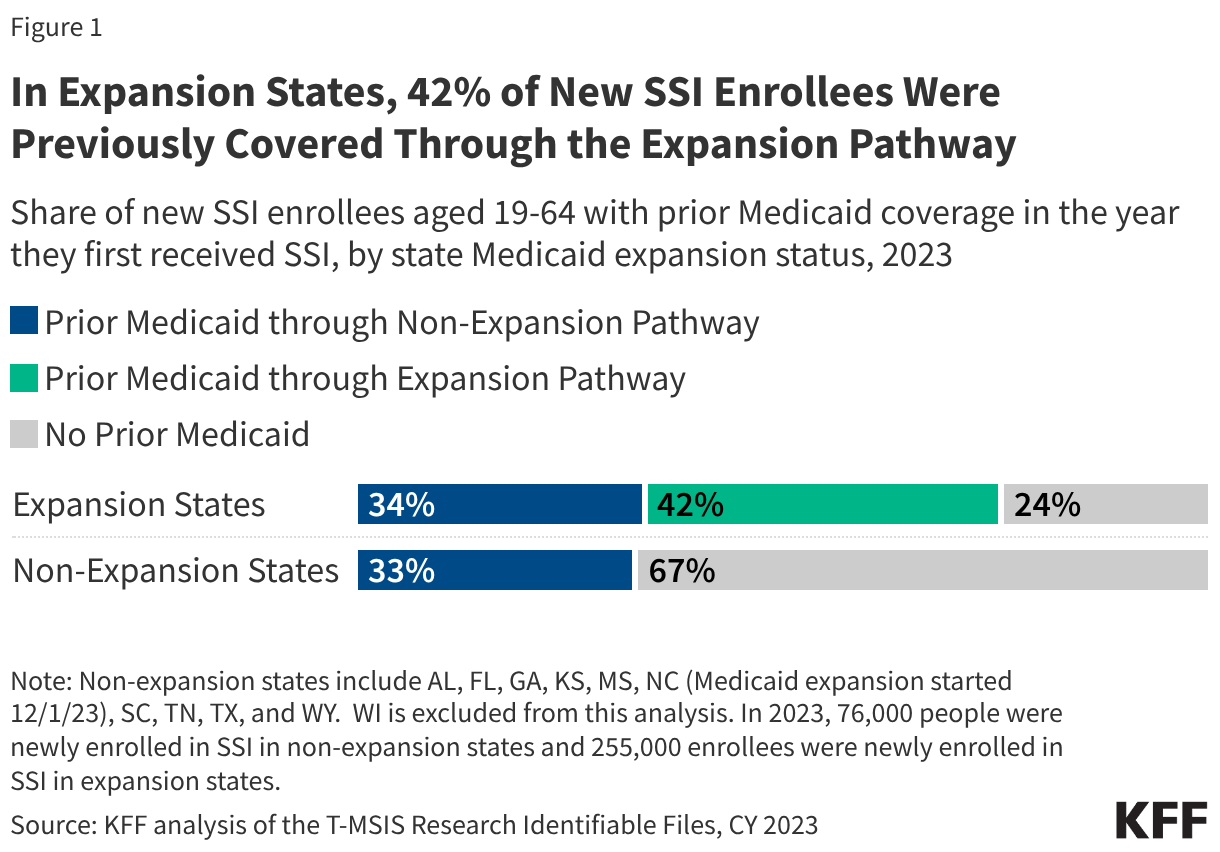
Recent data analysis highlights the profound reliance on expansion coverage among disability applicants. In calendar year 2023, out of 337,000 individuals who became newly eligible for SSI, over 200,000 had prior Medicaid coverage through alternative pathways, with approximately half of those enrollees receiving coverage directly through the ACA expansion. Overall, 223,000 SSI applicants aged 19 through 64 maintained Medicaid while waiting for a determination, including over 106,000 covered via the expansion pathway.
The structural differences between expansion and non-expansion states are striking. In ACA expansion states, 76% of new SSI enrollees aged 19 through 64 had prior Medicaid coverage through a different pathway, including 42% covered specifically through the expansion. In contrast, only 33% of new SSI enrollees in non-expansion states had prior Medicaid coverage. While roughly one in three new SSI enrollees in both types of states maintained non-expansion Medicaid—such as coverage for parents and caretakers—the expansion pathway provided an additional lifeline to more than 100,000 vulnerable individuals in 2023 alone. Those without prior coverage were likely uninsured due to their low incomes and complete inability to work.
How Work Requirements Threaten Coverage During Disability Reviews
The intersection of upcoming work mandates and ongoing disability applications creates severe administrative risks. Under the upcoming rules, non-exempt adults in the ACA expansion group must work, perform community engagement activities for at least 80 hours per month, or attend school half-time.
Because SSI applicants must maintain earnings below substantial gainful activity levels, they cannot meet these hourly thresholds through employment. Furthermore, their physical or mental impairments often preclude them from fulfilling requirements via education or volunteering. To maintain their health coverage, these individuals must successfully secure a medical frailty exclusion.
However, the interim final rule issued in June 2026 establishes a restrictive definition of medical frailty, requiring individuals to demonstrate a physical or mental health condition that directly impairs their ability to meet community engagement standards. This two-part test forces applicants to navigate a rigorous verification process while simultaneously waiting for a federal disability determination.
Consequently, SSI applicants enrolled through the Medicaid expansion may face two concurrent, high-stakes assessments of their ability to work administered under entirely different timelines and criteria. States must process income-based Medicaid applications within 45 days, and starting in January 2027, they must conduct eligibility renewals for expansion enrollees every six months instead of annually. This rapid churn means many applicants will face a medical frailty review long before the Social Security Administration concludes its disability evaluation.
These overlapping administrative burdens threaten to strip health insurance away from people experiencing severe health crises.
CMS Guidance and Mitigation Efforts
To mitigate these risks, recent guidance from the Centers for Medicare & Medicaid Services instructs states to verify medical frailty on an ex parte basis whenever possible, utilizing reliable data already available to the state without requiring additional documentation from the individual.
CMS has also outlined a tiered medical frailty framework that states may adopt voluntarily. Under this framework, states can identify eligible individuals using claims data alone in the first tier, combine claims and encounter data in the second tier, or deploy an individualized manual process requiring additional documentation in the third tier where existing data is insufficient.
While self-attestation will be permitted in 2027, restrictions taking effect in 2028 will limit self-attestation to once per continuous enrollment period, forcing states to collect formal documentation during renewals. Policy experts warn that even with advanced data-sharing strategies, stringent documentation requirements may cause vulnerable individuals with disabilities to lose Medicaid coverage or face wrongful enrollment denials while awaiting final decisions from the Social Security Administration.










No comments yet. Be the first to join the conversation!