
Editorial Note
Originally published on July 29, 2026, this brief has been updated to reflect newer guidance on the medical frailty exclusion from the Centers for Medicare & Medicaid Services (CMS).
A sweeping reconciliation law enacted in 2025 is set to introduce significant changes to the nation’s healthcare landscape, introducing new hurdles for some of the country’s most vulnerable populations. Under the legislation, 44 states will soon be required to condition Medicaid eligibility for adults in the Affordable Care Act (ACA) Medicaid expansion group, as well as enrollees in certain waiver programs, on meeting strict work and community engagement requirements. These mandates are scheduled to take effect starting January 1, 2027, or earlier at the option of individual states.
While the statutory framework specifies mandatory exclusions—most notably for individuals classified as "medically frail"—the practical approach to determining medical frailty outlined in a June 2026 interim final rule from the federal government could create formidable barriers. For many individuals with significant healthcare needs, including those with disabilities currently navigating the lengthy process of applying for the Supplemental Security Income (SSI) program, this could put their vital healthcare coverage at severe risk.
The intersection of these new Medicaid work rules and federal disability programs highlights a critical vulnerability in the healthcare safety net. Medicaid expansion has historically provided essential health coverage to millions of low-income adults, including individuals living with severe disabilities who are waiting months or even years for an official disability determination from the Social Security Administration (SSA). Because these applicants are frequently unable to work due to their medical conditions, they rely heavily on Medicaid to bridge the gap while their SSI applications are processed. However, the impending work requirements threaten to disrupt this vital lifeline.
How Medicaid Provides Coverage During the SSI Application Process
Medicaid serves as a crucial safety net for individuals with disabilities, including those who are in the midst of seeking federal assistance. National data indicates that approximately one in five Medicaid enrollees live with a disability, a figure that jumps to 43 percent among adults aged 50 to 64. Interestingly, only about one-third of these individuals receive SSI income and qualify for Medicaid on that basis alone. The remaining two-thirds rely on alternative Medicaid eligibility pathways, such as the ACA Medicaid expansion.
Obtaining an SSI determination is notoriously complex and time-consuming. Because applicants are, by definition, unable to engage in substantial gainful work while awaiting a decision, maintaining continuous health insurance is essential to managing their medical conditions. Without Medicaid, many would face prolonged periods of uninsurance.
Recent data analysis underscores the magnitude of this population. In 2023, approximately 223,000 SSI applicants aged 19 through 64 maintained Medicaid coverage while waiting for their determinations to be finalized. This total included more than 106,000 individuals who received their coverage specifically through the ACA expansion pathway.
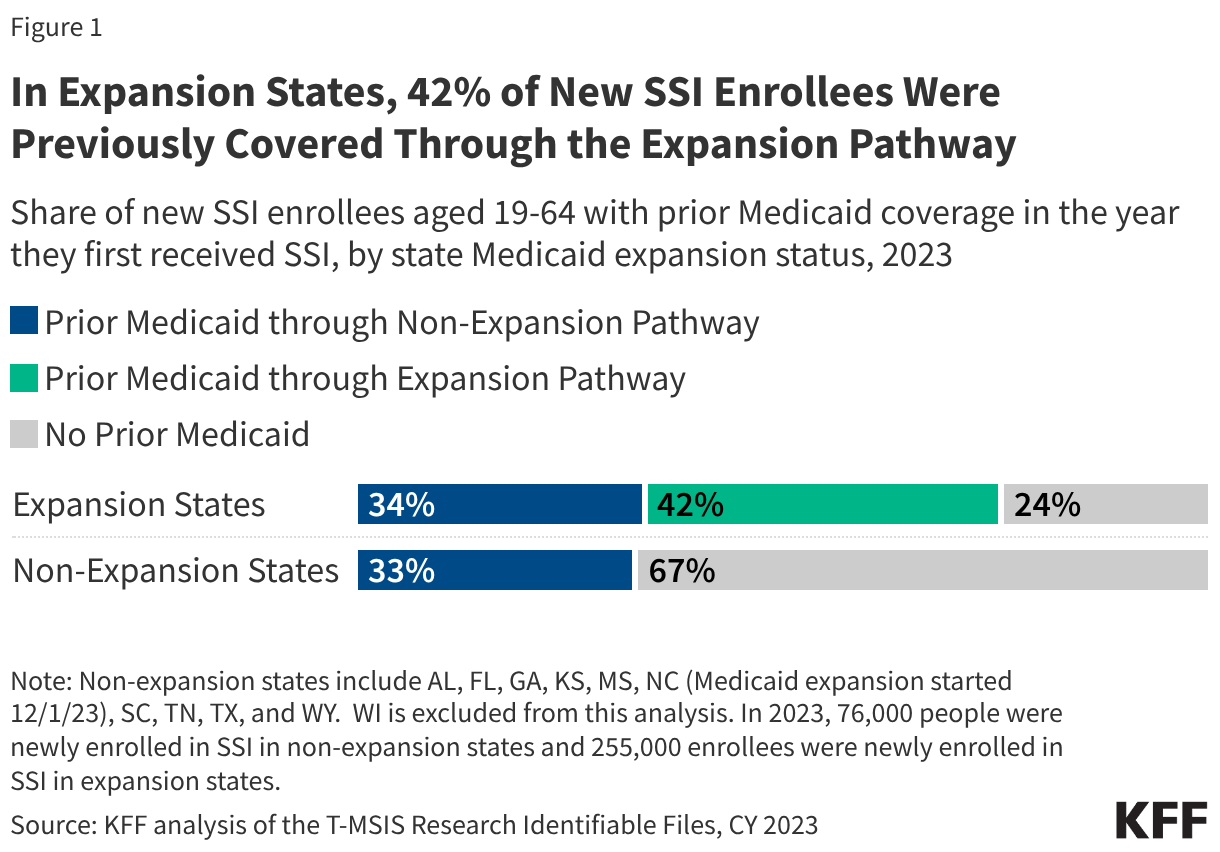
The reliance on these pre-SSI coverage pathways varies dramatically depending on whether a state has adopted the ACA Medicaid expansion. In expansion states, 76 percent of new SSI enrollees aged 19 through 64 had prior Medicaid coverage through a non-disability pathway before their approval, with 42 percent specifically covered through the expansion itself. By contrast, only 33 percent of new SSI enrollees in non-expansion states had prior Medicaid coverage during that same waiting period. In both types of states, roughly one in three new SSI enrollees relied on non-ACA Medicaid pathways, such as coverage designated for parents and caretakers. However, the ACA expansion accounted for an additional 100,000-plus covered individuals in 2023 alone, shielding them from the devastating financial and medical consequences of going uninsured while disabled and unemployed.
Demonstrating Eligibility for SSI and the Burden of Proof
Qualifying for SSI is a rigorous multi-step undertaking. To even be considered, applicants must meet strict federal limits on income and financial resources, alongside demonstrating a medically determinable physical or mental impairment that prevents substantial work for at least a year, or is expected to result in death.
For applicants under the age of 65, establishing a qualifying disability involves navigating a complex process overseen by the Social Security Administration and administered locally through state Disability Determination Services offices. The federal government invests billions of dollars annually into these state agencies to process claims, reflecting the sheer administrative weight of the system.
The evaluation process begins with earnings verification, requiring applicants to prove that their current income falls below the threshold for substantial gainful activity. Subsequent steps assess the severity of the applicant’s medical impairments across various recognized categories, ranging from musculoskeletal and neurological disorders to cardiovascular, respiratory, and mental health conditions. While certain catastrophic conditions qualify for expedited approval through specialized initiatives like the compassionate allowance program—which has greenlit over a million claims over the last two decades—the vast majority of applicants must undergo a meticulous review of their residual functional capacity, medical history, and past employment.
Evaluating an applicant’s ability to perform any job existing in the national economy requires comparing their personal profile against comprehensive occupational data. Critics note that the agency has long relied on dated occupational frameworks, prompting ongoing, multi-million-dollar modernization efforts in partnership with the Department of Labor. Despite these administrative mechanisms, the pipeline remains heavily congested. Initial disability determinations routinely take upwards of six months, and hundreds of thousands of applicants remain backlogged at any given time. Many face initial rejections that necessitate lengthy appeals, frequently driving total wait times past the one-year mark.
The Impact of Work Requirements on SSI Applicants
The introduction of Medicaid work requirements in January 2027 is poised to disrupt coverage for expansion enrollees who are simultaneously pursuing SSI. Under the upcoming rules, non-exempt adults will be required to document at least 80 hours per month of work, community service, or qualifying educational activities to maintain their benefits.
Because SSI applicants are inherently unable to work due to their medical impairments, meeting these standard community engagement thresholds will be virtually impossible for them. Consequently, they will have to secure an exemption or exclusion to keep their health coverage, with the medical frailty exclusion serving as their primary protective shield.
However, federal guidance released in mid-2026 establishes a restrictive definition of medical frailty, introducing a two-part test that requires individuals to demonstrate a physical or mental health condition severely impairing their ability to meet community engagement rules. This verification framework risks placing an intense administrative burden on vulnerable applicants, potentially leading to coverage losses simply due to documentation hurdles.
Furthermore, the disparate timelines of Medicaid renewals and SSI determinations mean that affected individuals may find themselves subjected to concurrent, overlapping assessments of their work capacity under different rules and criteria. While states are mandated to process standard income-based Medicaid applications swiftly, the shift toward mandatory six-month renewal cycles for expansion enrollees means that many disabled applicants will face strict work-exclusion reviews long before the Social Security Administration reaches a final decision on their disability status.
While recent guidance from the Centers for Medicare & Medicaid Services attempts to soften these blows by encouraging states to utilize administrative data and tiered frameworks to verify medical frailty automatically through existing medical claims, the safety net is far from foolproof. Even with the integration of claims data and provisions for self-attestation, administrative friction and strict documentation rules at renewal time could still leave many disabled individuals exposed to coverage interruptions or outright denials while they wait for their federal disability benefits to be approved.










No comments yet. Be the first to join the conversation!